10 min read
You mark the jack in petanque so that you can put it back exactly where it was if the wind, a foot or an animal moves it: under the official FFPJP rules, no claim is accepted for an unmarked jack. That is why experienced players draw a mark on the ground each time the jack is thrown and each time it moves. We explain the rule, the right habits and the oversight we see most often, on coaching courses as well as in competitions.
What is the point of marking the jack?
Marking the jack keeps an exact record of its position throughout the end. If the jack is moved by the wind, the slope, a foot or an animal, that mark on the ground lets you put it back without argument – something the rules do not allow for an unmarked jack.
Whether you call it the jack, the bouchon or the petit, the reason is the same: a jack moves at the slightest knock, and nobody remembers its position to the nearest centimetre. The mark also settles doubts during an end, for example whether a boule really did move the jack. We have seen real disputes in competitions over an unmarked jack: with no trace on the ground, nobody can prove where it was.
This habit is one of the basics we cover in our complete guide to the rules of petanque, from the draw to counting the points. It takes only a few seconds and protects the charm of our wonderful game: hard-fought, but fair.
Is it compulsory to mark the jack?
Marking the jack is required by the rules, which state that no claim is accepted for an unmarked jack or unmarked boules. However, forgetting to mark will not earn you a card: in January 2024, the FIPJP clarification on the rules of play pointed out that failing to mark is not directly subject to the penalties in its rules.
The two rules complement rather than contradict each other. You will not be penalised for forgetting to mark the jack but, since the rules allow no claim, there is nothing the umpire can do for you if it then moves. According to the same FIPJP clarification, this principle also applies to marking the boules and the circle.
In our programme, we remind players to mark the jack every time, after each move, to head off any dispute. In a friendly game, nobody will pull you up on it, but the same reflex will spare you plenty of arguments when it comes to counting the points.
What happens if the jack moves?
If the jack moves because a played boule has hit it, its new position counts and you must mark it again. If it is moved by the wind, the slope, a spectator, an animal or a boule from another game, the rules say it goes back in its place, as long as it was marked.
The table below sums up what the rules say, depending on what moved the jack.
| What moves the jack | Marked jack | Unmarked jack |
|---|---|---|
| A boule played during the end | The new position counts, and you draw a new mark | The new position counts too |
| The wind or the slope of the terrain | It is put back on its mark | It stays where it stopped, and no claim is possible |
| A foot, a spectator, an animal or a boule from another game | It is put back on its mark | Nobody can prove where it was, and no claim is accepted |
| A player stops or deflects the jack while it is moving | The opposing team chooses to leave it, put it back on its mark or place it further along its path | The opposing team can only leave it where it is |
Above all, remember the first row: marking does not freeze the jack. When a boule pushes it, play carries on from its new position, and that new spot is what you must mark before the next boule.
Dead jack and throwing distance: what the rules say
Under the rules, the jack is dead if it goes out of bounds, or if it is moved to less than 3 metres or more than 20 metres from the throwing circle for juniors, seniors and veterans. When throwing, these same players send it between 6 and 10 metres from the circle, at least 1 metre from any obstacle.
When is the jack dead?
A jack is dead when it goes out of bounds or outside the distance limits set by the rules: less than 3 metres from the circle, or more than 20 metres from juniors upwards and more than 15 metres for cadets, minimes and benjamins. Under the rules, what happens next depends on who still has boules to play:
- if both teams still have boules in hand, or if neither has any left, the end is void and the jack goes to the team that scored the points in the previous end, or to the one that won the draw at the start of the game;
- if only one team still has boules, it scores as many points as it has boules left.
When a played boule knocks the jack outside the limits, marking makes no difference: the same rules apply.
How far should you throw the jack?
Under the rules, which our programme covers in detail, the distance for throwing the jack depends on the player’s age category.
| Category | Distance for throwing the jack | Jack is dead if moved to more than |
|---|---|---|
| Benjamins | 4 to 7 m | 15 m |
| Minimes | 5 to 8 m | 15 m |
| Cadets | 6 to 9 m | 15 m |
| Juniors, seniors and veterans | 6 to 10 m | 20 m |
On neighbouring terrains, the rules also require the jack to be 1.50 m from any other jack or throwing circle. If the throw is not valid, the rules provide for the opposing team to place the jack by hand, at a regulation distance.
Distance is not only a matter of the rules: it serves the team’s tactics. In our programme, for example, we recommend a short jack of around 6 to 7 metres for an attacking strategy, as a short jack suits shooting better. The right choice also depends on reading the terrain, which we cover in our tips for improving your petanque.
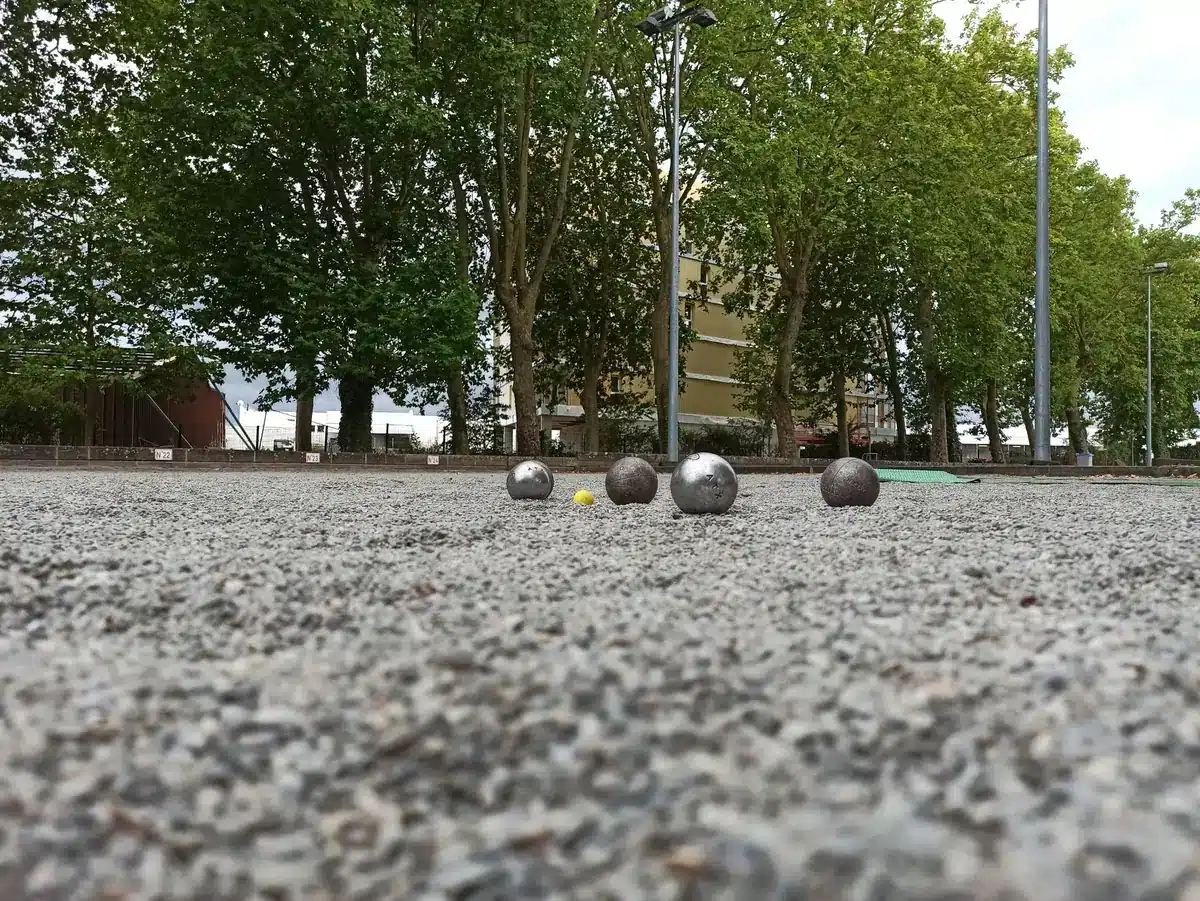
The “Pointing” module of our training programme covers terrain analysis and throwing the jack: you learn to choose the distance that favours your team depending on the score, the terrain and your strengths. A well-thrown jack should then be marked straight away: marking it is the first action of the end, even before the first boule.
How do you mark the jack, and when?
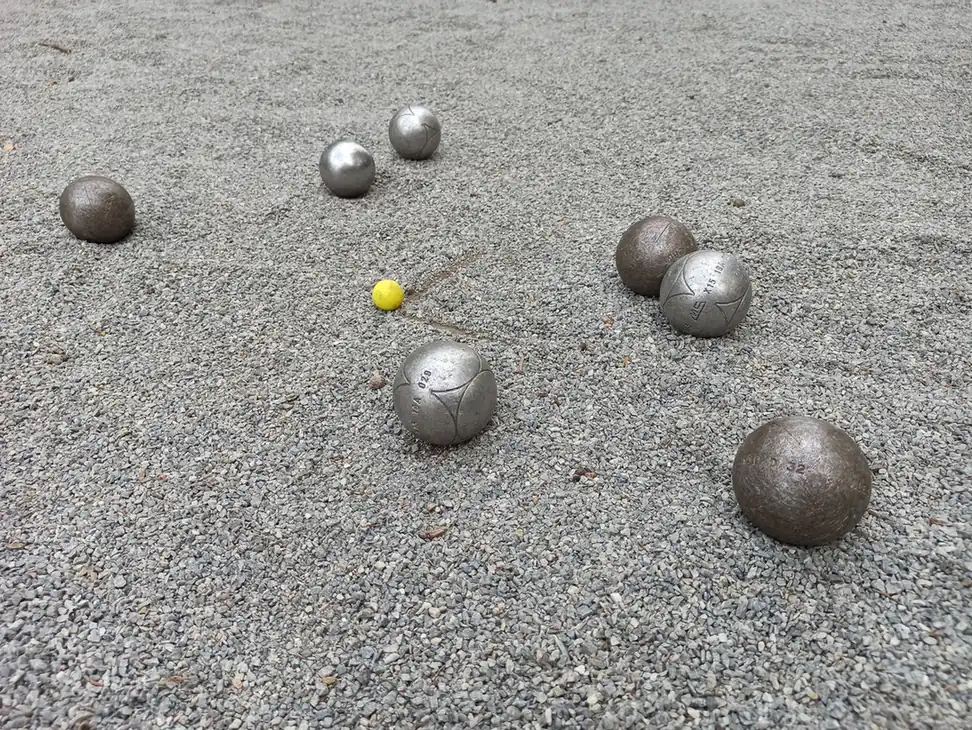
To mark the jack, you draw a small mark on the ground that lets you find its exact position, for example a circle around the jack or two lines crossing where it sits. You mark it just after a valid throw, before the first boule, and then again each time the jack has moved.
A few simple habits make the mark reliable:
- draw with the tip of your shoe or a small tool, without digging deep: a clean, shallow line is enough;
- on hard ground where your shoe leaves no trace, chalk will do;
- choose a mark that fixes the jack’s position both ways, front to back and left to right, which a single line cannot do;
- rub out the old mark for the jack when you draw a new one, so that there are never two marks on the ground;
- make sure the opposing team has seen the mark before playing.
The oversight we see most often
On our coaching courses in Nantes and Geneva, as in competitions, the mistake we see most often is simply forgetting. Some players do not mark the jack after the throw, while others mark it once and then forget to mark it again when a boule has moved it. The mark left on the ground then becomes misleading, because it shows a place the jack no longer occupies.
To make it automatic, link marking to a fixed moment: the jack stops, you mark it; a boule touches it, you mark it again before the next boule is played. Like any routine, once you have repeated it enough, you do it without thinking, and your focus stays on the game.
Should you mark the boules too?
Yes, you mark petanque boules just as you mark the jack, because the rules allow no claim for an unmarked boule. A boule that is holding the point can be moved by the wind, the slope or a foot; with no mark on the ground, nobody can prove afterwards where it was.
This is an oversight we come across often: the jack is carefully marked, but not the boules around it. Yet a boule moves for the same reasons as the jack, and a point lost this way can decide a close end.
There is no need to mark every boule in play, though. Concentrate on the ones that matter:
- the boule holding the point and those very close to the jack;
- boules that have stopped on a slope or on a very fast terrain, where they might start rolling again;
- boules close to a boundary line, an edge or a walkway;
- on a windy day, every boule that counts for the point.
Frequently asked questions
How is the jack allocated under the rules of petanque?
Under the rules, a draw, often a coin toss, decides which team throws the jack in the first end. After that, the jack goes to the team that won the previous end, and after a void end, to the team that scored last.
Why is the jack called the “cochonnet” in French?
“Cochonnet”, “but”, “bouchon” and “petit” are all French names for the same small ball you aim at; “bouchon”, the name used in the south of France, is said to come from the Occitan bochon, “small ball”. The origin of the word “cochonnet” is not firmly established, and several explanations are put forward, but none is authoritative.
What are the new FFPJP rules for petanque?
The new FFPJP rules can be found on the federation’s website, which publishes the official rulebook currently in force: that is the one to go by before a competition, rather than the summaries doing the rounds. As far as marking is concerned, the principle we teach is simple: under the rules, if it is not marked, no claim can be made.
What are the official rules of petanque?
The official rules of petanque are set out in the FFPJP rulebook, which is based on the FIPJP’s: the draw, the throwing circle, the jack thrown between 6 and 10 metres for seniors, successive ends and games played to 13 points. We go through them step by step in our page on the official rules of petanque.
One simple habit for playing with confidence
Marking the jack every time it is thrown or moved, then the boules that count, takes only a few seconds and protects you from disputes that the rules cannot put right. Build it into your routine, just like choosing the distance when you throw the jack: your mind stays free for the game. To keep improving, from throwing the jack to mental preparation, our training programme supports you at your own pace, from beginners to experienced players.
This programme is not sports instruction within the meaning of the French Sports Code. It is informal educational support, designed to enrich your personal practice of petanque, with no individual supervision and no qualification awarded.