17 min read
How do you progress in petanque? By working on five pillars together: a steady, repeatable throw, regular training built on measurable drills, reading the terrain, physical fitness and, above all, the mental game, with a routine before every boule. This guide, the starting point for our topic on petanque practice and training exercises, gives you a 10-step path, pointing and shooting exercises, and what Jean-François sees as most decisive on his coaching courses: the routine before every boule and managing stress.
How can you improve your petanque and play well?
How can you improve your petanque and play it well? The answer lies in five pillars worked on together: pointing and shooting technique, regular and focused training, reading the game, physical preparation and mental preparation. A player who works only on their throw soon hits a plateau, because a game is also won in the mind and in the choices you make.
Jean-François, our petanque coach, builds his coaching around these areas: physical preparation, technique, strategy and tactics, and mental preparation. Training is the thread that links them, because methodical repetition is what makes the throw automatic.
| Pillar | What it gives you | How to work on it |
|---|---|---|
| Technique | Accurate pointing and shooting that you can repeat exactly | Pointing and shooting drills, at several distances |
| Training | Automatic reflexes and consistency | Regular sessions, each with a measurable goal |
| Reading the game | The right choice at the right time: point or shoot, and where to play | Studying the terrain, deciding as a team |
| Fitness | A steady throw right up to the last end | Warm-up, cardio, core work, stretching |
| Mental game | Playing under pressure as you do in training | A routine before every boule, managing stress |
The last pillar is the one Jean-François considers most decisive: on his coaching courses, the routine and managing stress are what help players improve most in competition. We devote a whole section to it, after pointing, shooting and the exercises.
Learn petanque in 10 lessons: our 10-step path
Learning petanque in 10 lessons means following a logical order: knowing the rules, choosing your boules, getting into position, throwing, pointing, reading the terrain, shooting, training, building your routine, then playing in competition. Each step builds on the one before, and everyone works through them at their own pace.
- Knowing the essential rules. A game is played to 13 points and the jack is thrown between 6 and 10 metres for seniors, under the official FFPJP rules (in French); you will find the rest in our step-by-step guide to the rules of petanque.
- Choosing the right boules. The diameter depends on your hand and the weight on your position, as our guide to choosing petanque boules shows.
- Getting into position in the circle. Both feet stay inside the circle, and stable footing, facing the jack, is the basis of all accuracy.
- Holding your boule and releasing it without tension. The boule is usually held palm down, without squeezing, and rolls off the fingertips at the end of a smooth swing.
- Pointing. Start with the rolling point and the half-lob on even ground, then add the high lob when the terrain calls for it.
- Reading the terrain. Before each end, check the type of ground, the slopes and the obstacles that will deflect your boule.
- Shooting. First learn to shoot just in front of the boule, then to hit it directly, keeping the same throw.
- Training methodically. Choose drills with a numerical goal rather than throwing boules at random.
- Building your routine. Repeat the same preparation before every boule, in training and in competition alike.
- Playing games and entering competitions. Competition shows what holds up under pressure; after each competition, note what went well and what you still need to work on.
This path gives the order in which to learn, not a timetable. Experienced players, too, benefit from going back to steps 3 and 4 as soon as their throw starts to go wrong. The sections that follow go into detail on the steps where most players have the most to gain.
If you would rather follow this path with Jean-François, our training programme opens with the “Fundamentals” module, which covers the first steps on video: the basic rules, choosing your boules and the grip.
How do you point, and how can you improve your pointing?
Pointing in petanque means placing your boule as close as possible to the jack. The pointer chooses a trajectory to suit the terrain: the rolling point, which rolls almost all the way, the half-lob, which lands halfway and is the most common, or the high lob, thrown high so that it rolls as little as possible.
The key to good pointing lies in choosing your landing spot, the place where the boule should touch the ground. The more uneven the terrain, the closer to the jack you want your landing spot to be, leaving less distance for stones and hollows to interfere. You can point standing or crouching: choose the stance in which you are most stable, and stick with it.
To improve, vary the distance between 6 and 10 metres, the range in which the rules place the jack, and change terrain rather than repeating the same point in the same spot. The exercises in the section on training give you measurable goals for tracking your progress.
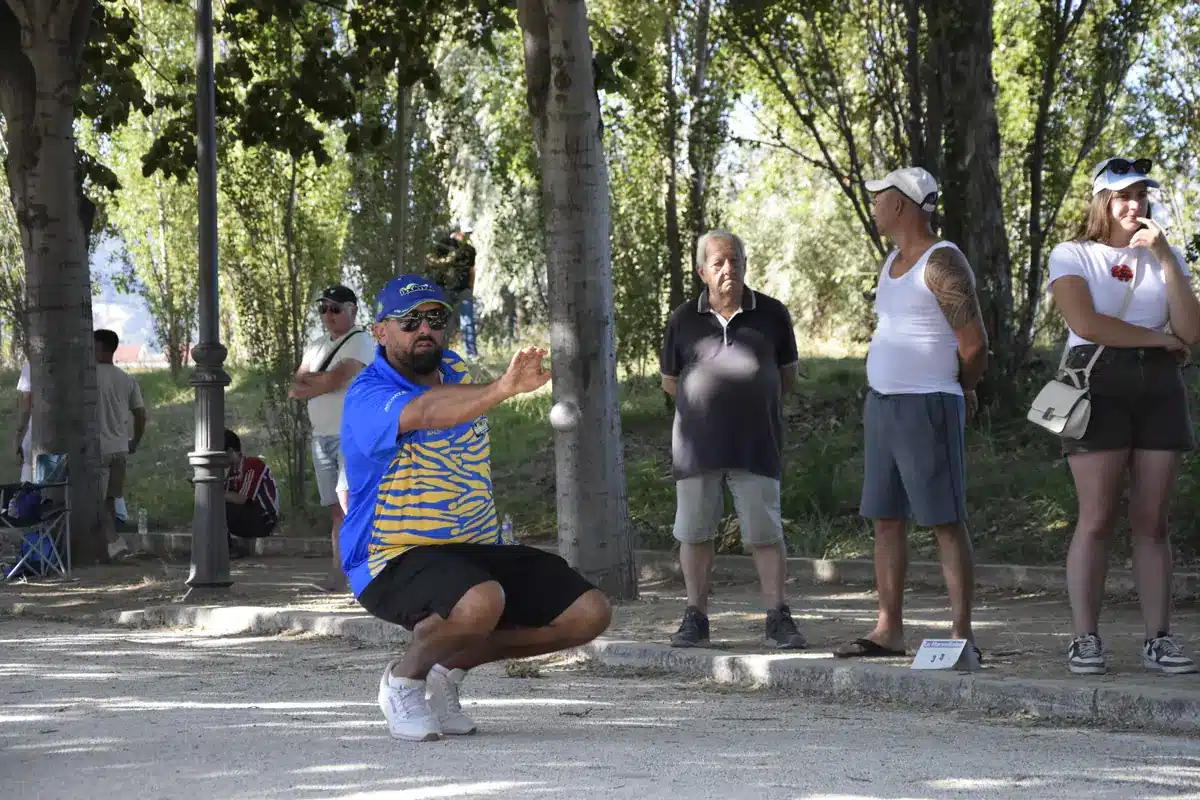
How do you shoot well and improve your shooting in petanque?
Shooting well in petanque comes down to a steady throw that never varies: firm footing in the circle, a smooth swing, your eyes fixed on the target and a boule that rolls off your fingertips on a regular arc. You first learn to shoot just in front of the boule, then to hit it directly.
Contrary to popular belief, the rules do not require you to shoot standing up: they require you to keep your feet inside the circle, without leaving it or lifting them completely off the ground, until the thrown boule has touched the ground. The vast majority of shooters still shoot standing up, as it gives the greatest range of movement, while the crouching shot keeps its place at short range.
Shooting just in front, direct hit, carreau: the different shots
Shots differ in where the boule touches the ground before hitting the target. The table presents them from the easiest to learn to the most prized.
| Shot | Where the boule touches the ground | When to choose it |
|---|---|---|
| Running shot | It rolls before reaching the target | Smooth terrain, a boule that is hard to hit in the air; not popular with purists |
| Shooting just in front | Just in front of the target | Even terrain; the first shot to learn |
| Direct hit (“plein fer”) | It hits the target without touching the ground first | Stony or uneven terrain |
| Jump shot | It goes over an obstacle boule to hit the one behind | Target hidden behind another boule |
| Carreau | The boule you hit flies off, and yours takes its place | The perfect shot, which leaves your team holding the point |
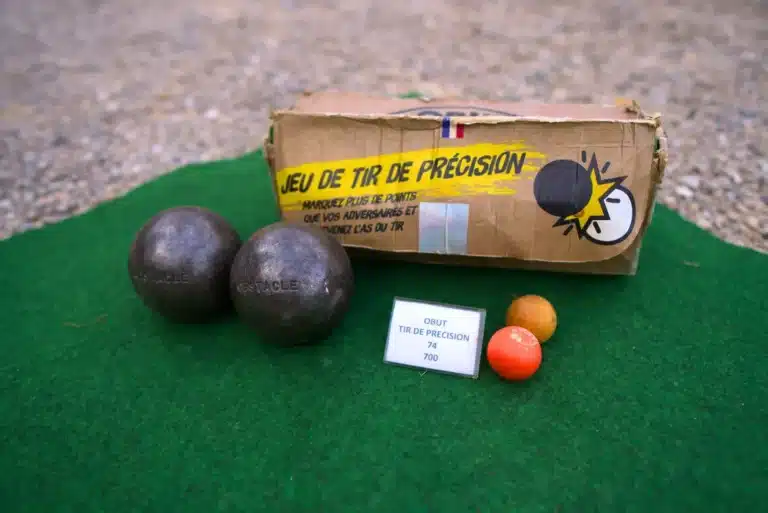
For more on accuracy, our article on precision shooting in petanque brings together how the event works and our technical tips. This event is an excellent way to measure your progress from one season to the next.
A classic mistake: releasing the boule too early
Releasing the boule too early is the mistake Jean-François shows in our video on the direct hit: the arc flattens, and the boule no longer clears the obstacle. In the same video, he points out that practice and repetition help to correct this fault. A release off the fingertips, without rushing, restores a high, regular arc.
This throw is easier to correct when you can see it broken down and watch it again: the “Shooting” module of our training programme covers each type of shot on video, from the running shot to the jump shot.
Petanque training: which exercises will help you improve?
Good petanque training alternates between pointing and shooting drills, each with a measurable goal, and match situations. In his shooting drills, Jean-François applies a simple rule: you only pass a distance after three consecutive successes, then move on to the next one, from 5 to 10 metres.
Organising a training session
An effective training session always follows the same order, from the simplest to the most demanding.
- Warm-up Shoulder and hip mobility, then a few boules at short range.
- Pointing One or two drills, at several distances.
- Shooting One drill, starting close, then moving back.
- Match situation A few boules played for real, with something at stake.
- Review Record your successes in a notebook, so you can track your progress from one session to the next.
Short, regular sessions are better than a long session now and then, because the throw is ingrained through repetition and breaks down with fatigue. Aim for quality of throw, not a number of boules.
Petanque exercises for beginners
The best exercises for getting started in petanque are simple, can be done on your own and can be scored. Here are three for pointing, to do with your three boules and a jack.
- The distance game Change the jack’s distance at every end, between 6 and 10 metres and in no particular order, then count the boules that stop within 50 cm. This teaches you to judge the distance, as in a game.
- The landing zone Place a hoop or a towel where your boule should touch the ground, and try to land every half-lob in it. This drill works on the consistency of your arc.
- Changing terrain Play the same drills again on smooth ground, then on stony ground, and watch how the same boule behaves differently.
Shooting drills: Jean-François’s three keys
For shooting, Jean-François introduces three progressive drills in our video on the direct hit, each passed with three successful shots in a row at every distance. The distances and gaps in the table are taken from that video.
| Drill | Set-up | What it works on | To pass it |
|---|---|---|---|
| The tyre and crossbar | A tyre on the ground, a bar above the trajectory | The whole throw and the arc; by adjusting the height of the bar, the landing zone for pointing | 3 boules in a row in the tyre, at each distance from 5 to 10 m |
| The obstacle plank | A plank laid on the ground, three target boules 30 cm behind it | The arc and the direct hit | 3 successful shots in a row, at each distance from 5 to 10 m |
| The jump shot over an obstacle boule | An obstacle boule in front of the target boule, 20 cm away, then 15, then 10 cm for the most experienced | Accuracy and control | 3 shots in a row that hit only the target boule, at four distances from 6.50 m to 9.50 m |
The rule of three consecutive successes changes everything: it forces you to reproduce the throw, instead of settling for a good boule now and then. Start at the shortest distance, and only move back once you have passed the previous one.
Training with others or at your club
In a group, petanque training gives you what solo practice lacks most: pressure, and other people watching you.
- Points challenges Everyone plays the same drill, and the highest total wins.
- The decisive boule A single boule to win the end, so you learn to play with something at stake.
- Video Film your throw on your phone, from the front and from the side, to see what you cannot feel.
- Stronger partners Playing with better players forces you to raise your game.
These drills give you benchmarks, but every type of point and shot needs its own fine-tuning. The “Pointing” and “Shooting” modules of our training programme cover them one by one, with demonstrations and practical exercises that you can rewatch as many times as you need.
The mental game and your routine: what helps you improve most
According to Jean-François, the mental game is what helps a player improve most on a coaching course: the same routine before every boule and managing stress well make the difference in competition. Technique is built in training; the mental game lets you find it again on the day it really matters.
Under pressure, the throw tightens up, the player rushes, and the boule that seemed to throw itself in training no longer does. This isn’t a lack of technique; it’s a lack of reference points. A routine and managing stress give you exactly those reference points.
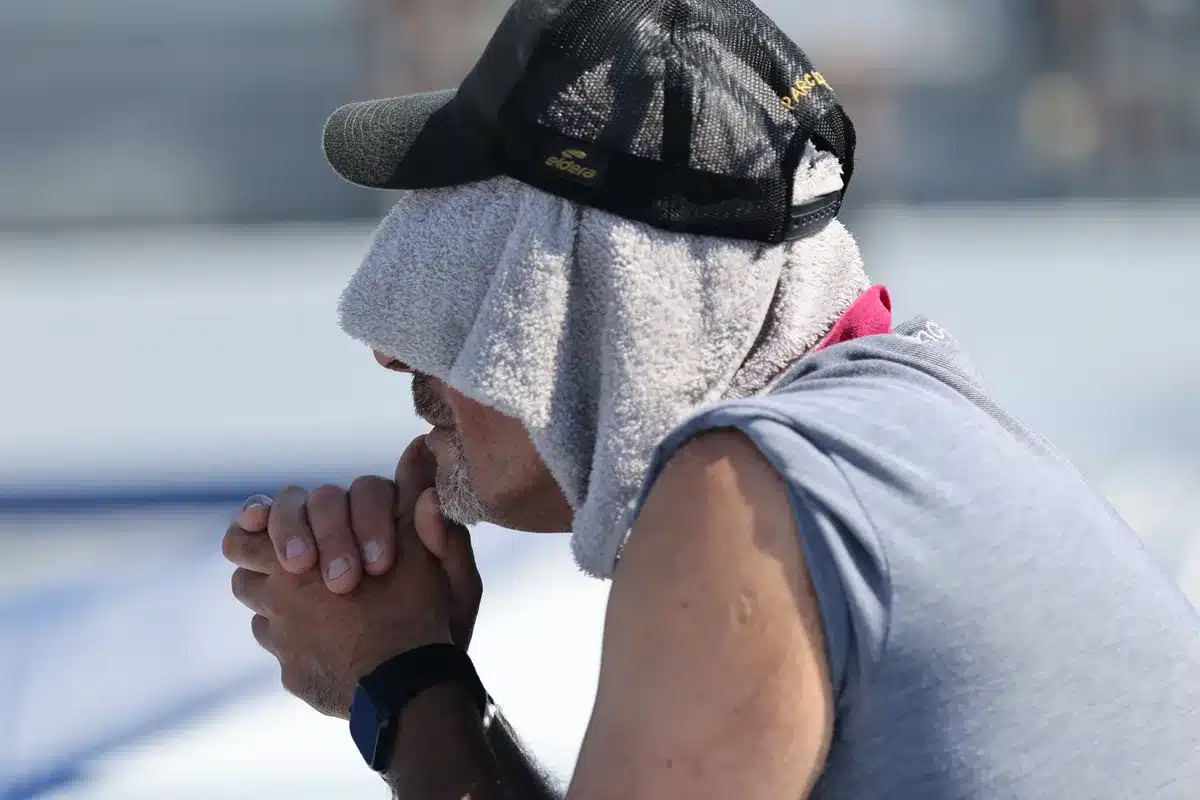
Building a routine before every boule
A routine is a sequence of actions and thoughts that never changes, repeated before every boule to give yourself the best possible conditions to play. It starts as soon as the end begins: drawing the circle, throwing and then marking the jack, studying the terrain.
Marking the jack is not a mere formality: it is a disciplined habit that heads off many disputes, as we explain in our article on marking the jack.
Here is an example of a simple routine that you can adapt to your game:
- look at the position of the boules and the terrain;
- decide on the shot with your partners, then choose your landing spot or your target;
- step into the circle and set your feet, always in the same way;
- breathe slowly, lengthening each out-breath;
- picture the boule’s trajectory, then play without waiting.
The rules give you one minute to play from the moment the previous boule has stopped: that is enough for a full routine, provided you have rehearsed it. An effective routine applies whatever the score, is worked on first in training, and remains your own: nobody can impose one on you.
Managing stress in competition: our tips
Managing stress in competition does not mean making it disappear, but stopping it from upsetting your throw. These simple tips help you keep your head in the game, whatever is at stake.
- Accept the stress: a little tension is normal, and even useful for staying alert.
- Breathe before you play: a slow breath out relaxes your shoulders and your arm.
- Stick to what you can control: your routine and your boule, not the score or your opponent.
- Move on after a mistake: the missed boule has been played, and the next one matters more.
- Talk to yourself as you would to a partner: a word of encouragement beats a telling-off.
- Set yourself goals for how you play rather than for the result, for example sticking to your routine for every boule.
- Practise staying calm off the terrain: slow breathing and relaxation can also be practised at home.
You work on these tools just as you work on a technical skill. The “Mental preparation” module of our training programme goes into each of them in depth: motivation, goal setting, performance routines, visualisation, self-talk, self-confidence, managing emotions and focus.
What strategies help you win at petanque?
Winning at petanque means reading the terrain before each end, then deciding as a team on the shot that gives you the best chance: pointing or shooting, depending on the position of the boules, the number of boules left on each side and the score. The best boule isn’t always the most spectacular one; it’s the most useful one.
Reading the terrain
A petanque terrain is never neutral: its surface and its contours decide how the boule behaves. Look at it from the circle, then from the jack, before choosing how you will point.
| Terrain | How the boule behaves | Usual way to point |
|---|---|---|
| Smooth and hard | It rolls far and straight | Rolling point or half-lob, played with a lighter touch |
| Stony or bumpy | It is deflected by stones and hollows | Half-lob or high lob, with a landing spot close to the jack |
| Soft or sandy | It slows down quickly | Landing spot closer to the jack, a firmer throw |
| Sloping | It turns downhill | Aim uphill of the jack, allowing for the side slope |
Deciding as a team
In triples, each position has its role: the pointer opens the end, the shooter knocks away boules that are in the way, and the middle player does either, as needed. Decide together, as a pair or a trio, keeping your voices down, then let the player stepping into the circle play with confidence. Second-guessing your choice as you throw costs more than making an imperfect one.
Watch your opponents too, from the very first ends: their strengths and weaknesses will tell you whether it is better to force them to shoot or to point. Between games, watching good players broadens your repertoire of solutions.
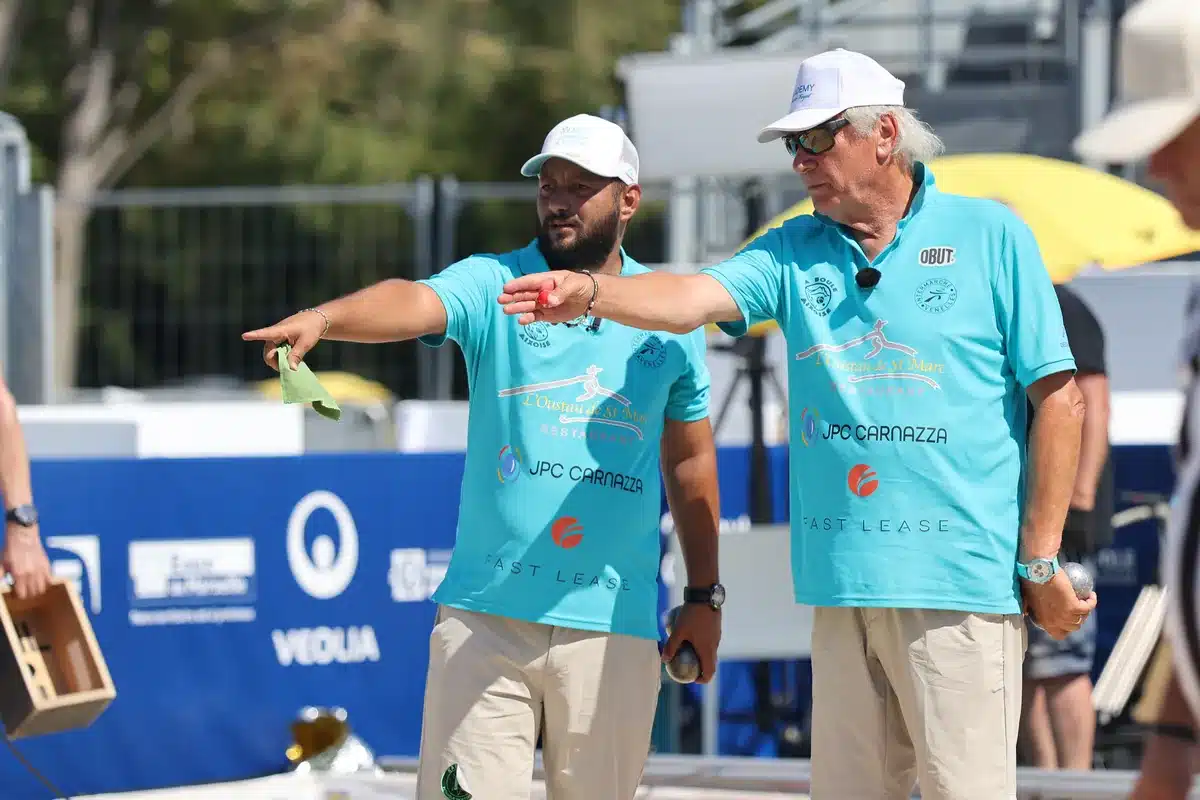
Warming up and fitness: preparing your body
Petanque puts demands on your legs, your back and your shoulder during the long hours of a competition. Warming up before you play and a little strengthening work between games help you keep a steady throw right up to the last end, and limit aches and pains.
Before a game, a few minutes are enough: shoulder, hip and wrist rotations, then a few boules at short range to find your touch again. If you don’t know the terrain, these first boules also show you how it plays.
In our video on stamina, Jean-François recommends cardio and core exercises between games, to last the length of a competition and improve your balance. To start with, the jumping jack he demonstrates in that video can be done without jumping, with a simple step to the side: 3 sets of 10, with 30 seconds’ rest. Regular stretching and light strengthening of the back and arms round off this work.
Always adapt these exercises to your abilities, and check with your doctor if you are unsure or feel any pain.
Competitions, partners and coaching: learning from others
Competitions, more experienced partners and an outside eye complement training on your own. Competition puts your game to the test under pressure, good players show you other solutions, and a coach spots the faults you cannot see yourself.
- Competitions Start with those run by your club or in your region, to get a feel for the atmosphere of competition and measure your progress.
- Your club An FFPJP licence gives you access to official competitions and to regular playing partners.
- Experienced players Watch their choices and the way they prepare each boule, and ask them for advice.
- Coaching courses There is no substitute for having your throw corrected on the terrain; we welcome players in Nantes and Geneva, as described on the page for our petanque coaching course.
- Videos Our YouTube channel, with 30,900 subscribers as of 12 October 2026, offers drills, tips and filmed games.
- Reading Technical books, biographies of champions and specialist articles enrich your understanding of the game.
Frequently asked questions
Why can’t I shoot straight in petanque?
A shot that goes off line is most often down to an alignment fault: feet or shoulders not properly lined up with the target, an arm that crosses in front of the body during the swing, or a wrist that turns at the moment of release. Film yourself from the front to find the cause, then correct one thing at a time.
How do you shoot in petanque without forcing it?
To shoot without forcing it, let the speed come from the swing and from transferring your weight forwards, rather than from the strength of your arm. A relaxed grip, without squeezing the boule, and a higher arc require less power than a flat shot.
What weight of boule should a shooter use?
A shooter generally chooses a slightly lighter boule than a pointer, as it is easier to handle and helps keep the throw fluid, whereas a pointer prefers a heavier boule, which is more stable on the ground. You will find guidelines by position and build in our guide to boule weight and diameter.
Do you need a machine to practise shooting in petanque?
Manufacturers offer accessories for shooting practice, such as target mats or boules linked by a cable. They are not essential: an old tyre, a plank and your own boules are all you need for Jean-François’s three drills described above.
Which petanque drills suit young players?
Young players improve with the same drills as adults, as long as you turn them into games: points challenges, coloured targets, records to beat. Adapt the distances to their age and strength, and keep sessions short, with the fun of playing as the driving force.
Improve your petanque at your own pace
So, in the end, how do you improve your petanque? By making progress on all the pillars at once: a throw repeated methodically, measurable drills, a sharp reading of the game, a well-prepared body and, above all, a routine that holds up under pressure. To go further, our training programme works through these pillars one by one, from pointing to shooting and from physical preparation to mental preparation, at your own pace. And as Jean-François reminds us at the end of his videos: “Let’s remember that victory over ourselves is the finest victory of all.”
This programme is not sports instruction within the meaning of the French Sports Code. It is informal educational support, designed to enrich your personal practice of petanque, with no individual supervision and no qualification awarded.