
19 min read
To know how to shoot in petanque, remember four guidelines: feet flat in the circle, eyes fixed on the target, an arm that swings smoothly, helped by the legs, and letting go of the boule late. One simple sign will tell you if you let go too early.
ContentsShow contents11 parts
- How to shoot in petanque?
- How do you stand in the circle to shoot?
- How do you shoot in petanque without forcing it?
- How do you shoot straight: where to look and how to aim?
- When should you release the boule when shooting?
- Direct hit, just in front or running shot: which shot to choose?
- How do you shoot a carreau in petanque?
- Why do you miss your shots? The most common mistakes
- How do you learn to shoot and improve your shooting?
- Frequently asked questions
- Shooting well comes down to consistency
 (the video plays on this page)
How to shoot in petanque?
Knowing how to shoot in petanque means being able to hit an opposing boule, or the jack (the small target ball), with a throw you can repeat exactly, end after end. That throw breaks down into four stages:
- Set yourself in the circle with your feet flat, the foot on your throwing side slightly forward and your weight slightly back.
- Pick a precise point on the target, and do not take your eyes off it.
- Draw your arm back slowly, well behind you, then, as it comes forward, let your legs provide the drive: this to-and-fro of the arm is called the swing.
- Release the boule late, as your arm rises towards the target: it rolls off your fingertips.
In the comments under shooting videos, the most common complaint is a simple one: “so how do we actually shoot?”. This article answers it with precise guidelines, the ones that Jean-François, our FFPJP-qualified coach, gives his students, to complement our topic on shooting and pointing technique.
Jean-François puts it plainly: nobody is a born shooter. He also gives a benchmark for your level: a good shooter regularly hits 3 boules out of 4, and many more on sandy, smooth terrain, which favours shooting. You start 5 metres from the target, then move back gradually until you can shoot from 6 to 10 metres: that is the distance at which the jack is thrown, under the official FIPJP rules (in French) (opens in a new tab).
5metres to start with
6to 10 metres in a game
3boules out of 4 for a good shooter
How do you stand in the circle to shoot?
The right shooting stance is upright, feet flat and pointing towards the target, with the foot on your throwing side slightly forward: the right foot for a right-hander, the left for a left-hander. Set your feet just wide enough apart to feel stable, unlock your knees and keep your body weight slightly back.
Jean-François suggests a short grounding routine as you step into the circle. Rock gently, forwards and backwards and from side to side, until you find your balance; then feel the pressure of your feet under your arches. Push your hips back a little, without rounding your lower back. Shoes with little heel also help you avoid being thrown forward at the moment of release.
Shooting is done standing, because that is how you keep your power, especially from long range. Crouching gives you stability but costs you power: keep that position for short distances, around 6 metres.
Right foot forward or feet level?
This question often comes up in the comments under shooting videos. In the basic stance, the foot on your throwing side is slightly forward, because this prepares the weight transfer towards the front. Feet level, side by side, remain an option: the weight then moves from right to left for a right-hander. Heavier-set players often choose this variant, which frees the movement of the hip.
Body weight, from heel to toes
As you draw your arm back, your weight rests mainly on the heel of the back foot, the left one for a right-hander. Only as the arm comes forward does the weight shift onto the toes of the front foot, the right one for a right-hander, right through to the release. If you start with your weight on the front foot, you will be thrown forward as you release and risk stepping out of the circle too early, which is a foot fault.
The official FIPJP rules (in French) (opens in a new tab) are strict on this point: your feet must be entirely inside the circle, without standing on the line; they must not leave it or be lifted completely off the ground until the thrown boule has landed (article 6). The other rules about the circle are set out in our guide to the rules of petanque.
How do you shoot in petanque without forcing it?
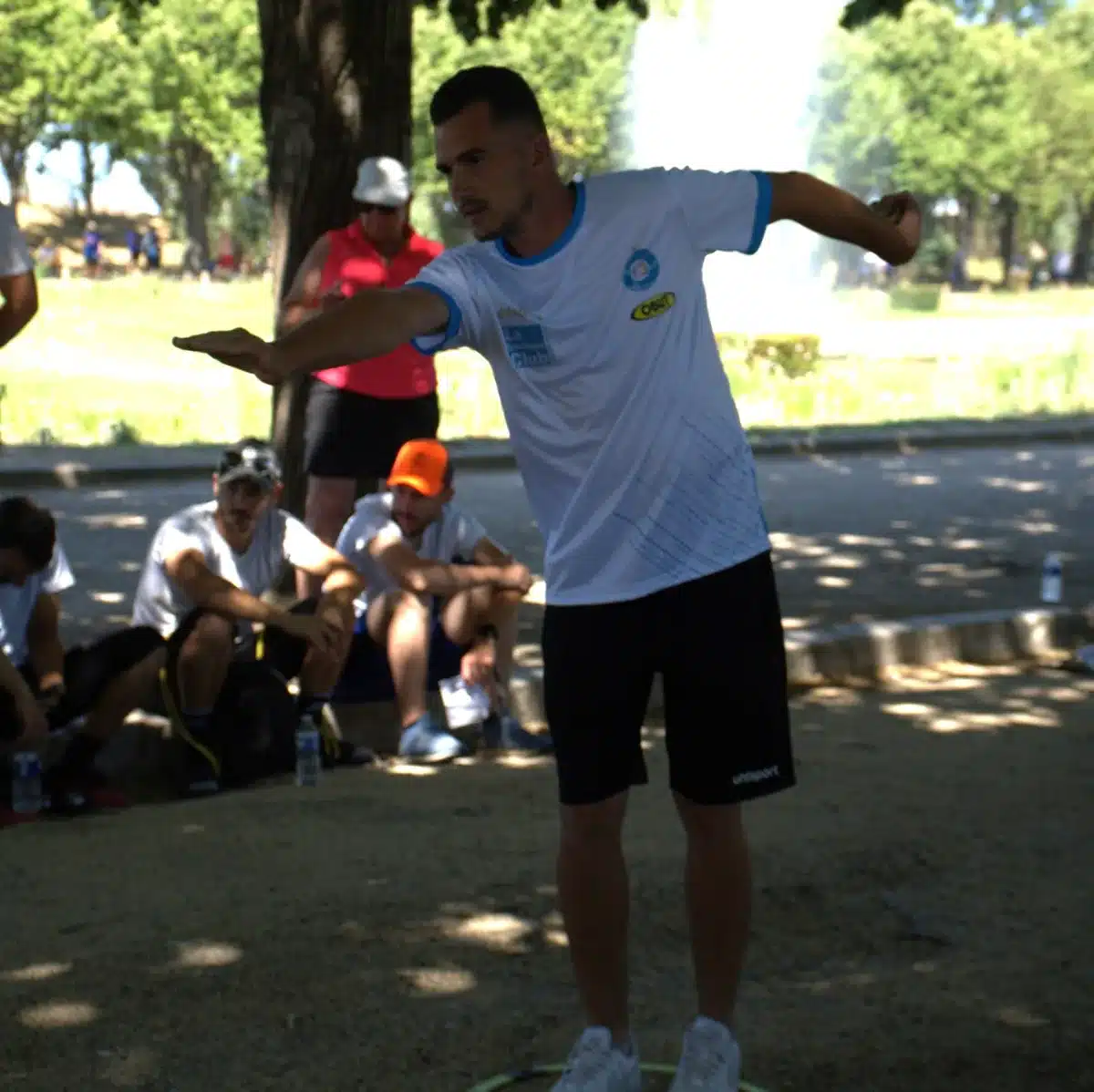
Shooting without forcing it in petanque means letting the power come from your legs and your swing rather than from a tense arm. The arm goes well back, slowly, then comes forward with increasing speed; the knees bend slightly on the way through and straighten at the release, like a catapult.
Forcing the shot is the most natural mistake when the target looks far away, and it is costly. Your muscles tighten, your upper body loses its balance and the boule goes off line. Never forcing is in fact a rule Jean-François stresses in the “Shooting” module of our programme.
A full swing, slow on the way back
For the swing, Jean-François uses the image of a pendulum: a ball on the end of a string, where your arm is the string and the boule is the ball. The arm comes down, straightens and goes well back, slowly; it speeds up gradually on the way forward, then its speed drops to zero just after the release. A big swing lets you shoot without forcing, as long as it stays in time with the rest of the throw.
Some shooters with short, quick throws are just as effective: more than the length of the swing, it is the speed of the arm that counts. Beware, though, of a cramped swing that barely goes back: it often creates tension.
The power comes from the legs
As the arm comes forward, the knees bend slightly. As the boule leaves your hand, your legs straighten fully and your upper body rises: you have the feeling of growing taller at the end of the throw. Jean-François calls this the catapult effect: that is what gives you the drive, not forcing with your arm.
Smooth, high and gentle
If you want to become consistent, Jean-François advises you to develop a smooth, high and gentle shot, with an arm that comes forward without rushing. The boule rises as it leaves your hand, then drops softly onto the target, instead of flying out flat like an arrow. Players who let go too early end up forcing the shot: they use a lot of energy, tire quickly, and the results do not always follow.
Relaxation starts in the head
Relaxation is not only a matter of muscles. For Jean-François, concentration is one of the keys to shooting: the aim is to get as relaxed as possible in just a few seconds. He names three qualities of a good shooter: self-confidence, balanced concentration and complete acceptance of every situation, including the shot you have just missed.
How do you shoot straight: where to look and how to aim?
To aim accurately and shoot straight in petanque, keep your eyes fixed on a precise point of the target, line up your dominant eye (the one you aim with) with your hand, and set your shoulders square on to the target. The arm that is not holding the boule, held away from your body, stops your upper body turning as you release.
Your eyes: the target, and nothing else
Jean-François is firm about it: you cannot hit a target you are not looking at precisely. Ignore the other boules and choose one precise point: the centre of the boule, its base (where it touches the ground) or one of its sides, depending on where it lies in the game. Taking your eyes off the target for a single second, to glance at the next lane for instance, is enough to make your shooting hit-and-miss.
Finding your dominant eye
Your dominant eye is the one that aims, the one you put to a camera viewfinder without thinking. It is not always on the side of your throwing arm, and a test of a few seconds is enough to find it:
- Stretch your arms out in front of you and join your thumbs and index fingers to make a triangle.
- With both eyes open, frame an object about 1 metre away in the middle of the triangle.
- Close your left eye: if the object stays centred, your dominant eye is the right one; if not, check by closing your right eye.
A right-hander who aims with the left eye, what Jean-François calls a cross-dominant right-hander, should not try to change eyes. He can turn his feet a little more to the right, or put his left foot further forward than his right, to line up his left eye with the target more easily.
Shoulders, upper body and the balancing arm
As you draw your arm back, your body is upright and your shoulders are square on to the target, like the base of a triangle with the target at its tip. Your upper body then leans slightly forward and towards your throwing side. This slight shift of the upper body, which Jean-François calls the body offset, frees the arm and lines up your dominant eye with your hand, while your head stays still. In our programme, Jean-François cites Mickaël Bonetto as a model of this body offset and of the weight transfer: our article on the Petanque World Championships explains what to look for when you watch him.
The arm that is not holding the boule, known as the balancing arm, has a real job to do: held away from the body, like a tightrope walker’s, it acts as a counterweight. Without it, the arm coming forward makes the upper body twist, to the left for a right-hander, and drags the boule off line. In the coaching course video at the top of this article, this is in fact the first thing Jean-François asks the participant to work on: his shoulders and upper body twist at times.
Finally, the throwing arm must be fully extended in the middle of the throw, like the string pulled straight by the weight of the ball. If it is not stretched out, it lacks speed at the release: the shoulder lifts, and the boule goes off to one side.
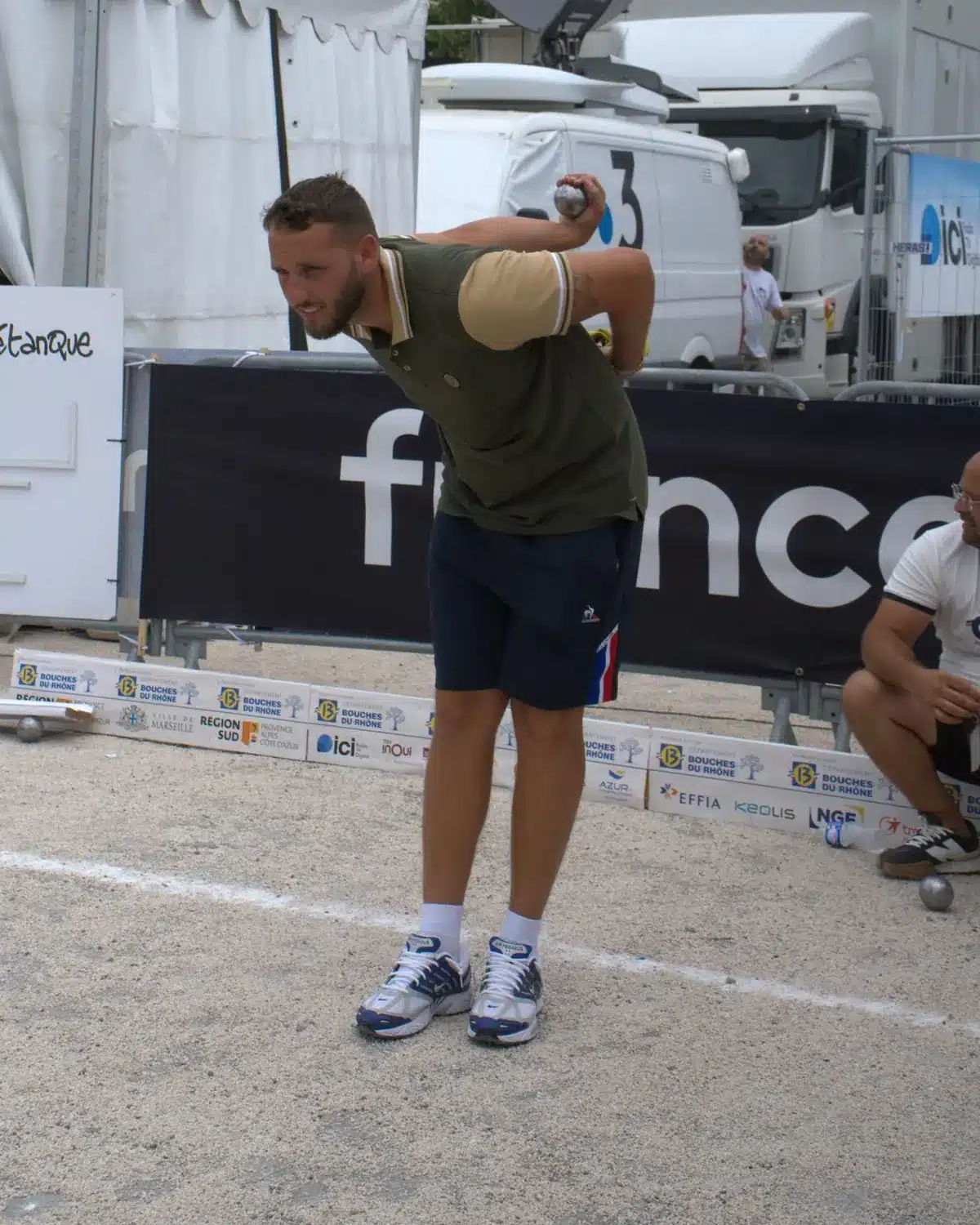
Your stance in the circle, grounding, body offset, gaze and weight transfer are at the heart of the “Stance” module of our training programme: each point is shown on video, and you can watch it as many times as you need.
When should you release the boule when shooting?
When shooting, you need a late release: the hand opens at the end of the throw, as the arm rises towards the target, and the boule rolls off your fingertips, at the height of your breastbone or your eyes. If you cannot see your hand in front of you at the moment of release, you have let go too early.
To position your hand, Jean-François uses a clock face as a guide, for the direct hit and for shooting just in front alike, two ways of shooting described further down. As the boule leaves your hand, your middle finger points at the target, at 12 o’clock, and your thumb towards 10 o’clock for a right-hander, towards 2 o’clock for a left-hander. The hand finishes flat, which gives the boule slight backspin: it spins backwards on itself.
The hand opens like a trapdoor: quickly, smoothly and fully. If your fingers stay bent, you hold on to the boule too long: it lands short or goes off line. An unwanted wrist twist at the end of the throw also sends the boule off line: it is the second correction Jean-François gives the participant in the video at the top of this article.
In our video on the direct hit (opens in a new tab), Jean-François shows what an early release costs: his boule fails to jump over the obstacle boule in front of the target. A late release, on the other hand, makes the boule rise and gives it its arc.
How do you hold the boule to shoot?
Whether you are shooting or pointing, you play palm down, with your palm facing the ground. Jean-François advises settling the boule in your palm, or very slightly on your fingers, then cradling it with relaxed fingers, without squeezing: the less you press, the looser your throw stays. When the distance gets close to 10 metres, or when tiredness starts to set in, many players move the boule a little further onto their fingers to keep their throw smooth.
With or without the thumb?
Both work. A thumb against the boule helps lock the wrist at the release, which helps if yours tends to move. But at the slightest tension, it presses on the boule and sends it off line. Jean-François lets the figures decide: try both ways, and keep the one that gives you the best success rate.
Direct hit, just in front or running shot: which shot to choose?
The choice of shot depends first of all on the terrain. The direct hit, where the boule strikes the target without touching the ground first, suits stony or uneven terrain. Shooting just in front, where the boule lands less than 30 cm short of the target, is played on sandy or smooth ground. The running shot, where the boule reaches the target rolling along the ground, needs even, smooth terrain.
| Shot | Where the boule touches the ground | Terrain | Good to know |
|---|---|---|---|
| Direct hit | Nowhere: it strikes the target full on | Stony, uneven | The most spectacular, and the one shooters prize most |
| Just in front | Less than 30 cm in front of the target | Sandy, smooth | Avoid on stony or very hard ground: the boule bounces over the target |
| Long running shot | Less than 3 m from the shooter, then it skids along the ground | Hard and smooth | Powerful; useful for clearing several boules or knocking the jack out |
| Short running shot | About 1 m from the target | Sandy | More accuracy, less power |
| Jump shot | Nowhere: it goes over an obstacle boule | – | A direct hit, the only way to reach a target hidden behind another boule |
When you are starting out, you shoot just in front or with a running shot more often, two shots that are easier to master. The running shot does not work everywhere: it becomes impossible when the target is hidden behind other boules. Spectators often find it inelegant; yet it remains a good option when you hit a bad patch, one of those spells when you cannot hit a thing with a direct hit.
Pointing or shooting: when should you shoot?
Pointing means getting your boule close to the jack; shooting means knocking a boule away, usually the opposing boule nearest the jack. Jean-François lists four reasons to shoot:
- to win the point, or defend it, by knocking away an opposing boule;
- to kill an end that is going badly, by knocking the jack out;
- to keep or extend your lead;
- to limit the damage when you have fewer boules left than your opponents.
Knocking the jack out only kills the end, though, if both teams still have boules to play, or if neither has any left: if only one team still has boules, it scores as many points as it has boules left. Our article on marking the jack explains when the jack is dead.
How do you shoot a carreau in petanque?
A carreau, in petanque, is a shot where your boule knocks away the target boule and takes its exact place in the game. You usually go for one with a direct hit: the boule rises out of the hand, leaves with slight backspin and drops softly onto the target.
Perfect carreau, rolling carreau, palet: what players call them
Not every successful shot is a carreau. Players distinguish between:
- Perfect carreau Your boule stops exactly where the target was.
- Rolling carreau Your boule moves on a little after the impact.
- Recoil Your boule rolls back, thanks to the backspin.
- Palet The target is knocked away, and your boule stays very close, without taking its exact place.
Guidelines for shooting more carreaux
A carreau is not a matter of luck: it takes preparation, especially with a direct hit. For Jean-François, everything starts with the arc, meaning the path the boule takes through the air: every shooter looks for their own, the one that lets them strike the target full on, or drop their boule right at the foot of the target boule to go for the perfect carreau. The release guidelines above, middle finger at 12 o’clock and hand flat, do the rest.
With a running shot too, a carreau is still possible: the faster and lower the boule skims along the ground, the better your chances of a carreau.
To work on your arc, Jean-François suggests a simple drill: it gradually raises your carreau rate and teaches you to shoot more smoothly.
The “Shooting” module of our programme covers the other ways of shooting one by one, from shooting just in front to the jump shot, with their adjustments.
Why do you miss your shots? The most common mistakes
A missed shot rarely comes down to the arm alone. The most common mistakes are forcing the shot, releasing too early, holding on to the boule by keeping your fingers bent, starting with your weight on the front foot, and forgetting the balancing arm, which lets the upper body twist.
The participant in the video at the top of this article describes this very problem: one day he shoots well, and the next, without knowing why, he shoots left, too short or too long. To improve your shooting, first find out which of these faults is yours: film yourself or practise in front of a mirror, as Jean-François advises. The camera or the mirror shows you the stray movements you cannot feel.
How do you learn to shoot and improve your shooting?
To learn to shoot, start close to the target, around 5 metres, with a clean throw, then make it harder step by step. Change only one variable at a time: the distance, then the size of the target, the strength of the shot, the spin on the boule and where it strikes.
Which exercises will improve your shooting?
Here, in order, is a progression built on Jean-François’s advice:
- During your warm-up, shoot a few boules from about 5 metres to check your release: your fingers open at the right moment and your hand finishes flat.
- Move back gradually to 10 metres, without changing anything else.
- Then make the target smaller: aim first at a target of two boules, then at a single boule, then at the jack.
- Work on your arc with the half-buried boule drill described above: you pass it when you hit 5 boules out of 10.
- Finally, test yourself with our coaching course challenge, described just below: 15 boules hit out of 20.
Break your throw down into stages, then repeat it, regularly and methodically. In winter, when the terrains are empty, you can still practise your shooting without a boule: our article on petanque training at home shows you how to rehearse your swing without throwing and film it on your phone.
Our coaching course challenge: 15 boules out of 20
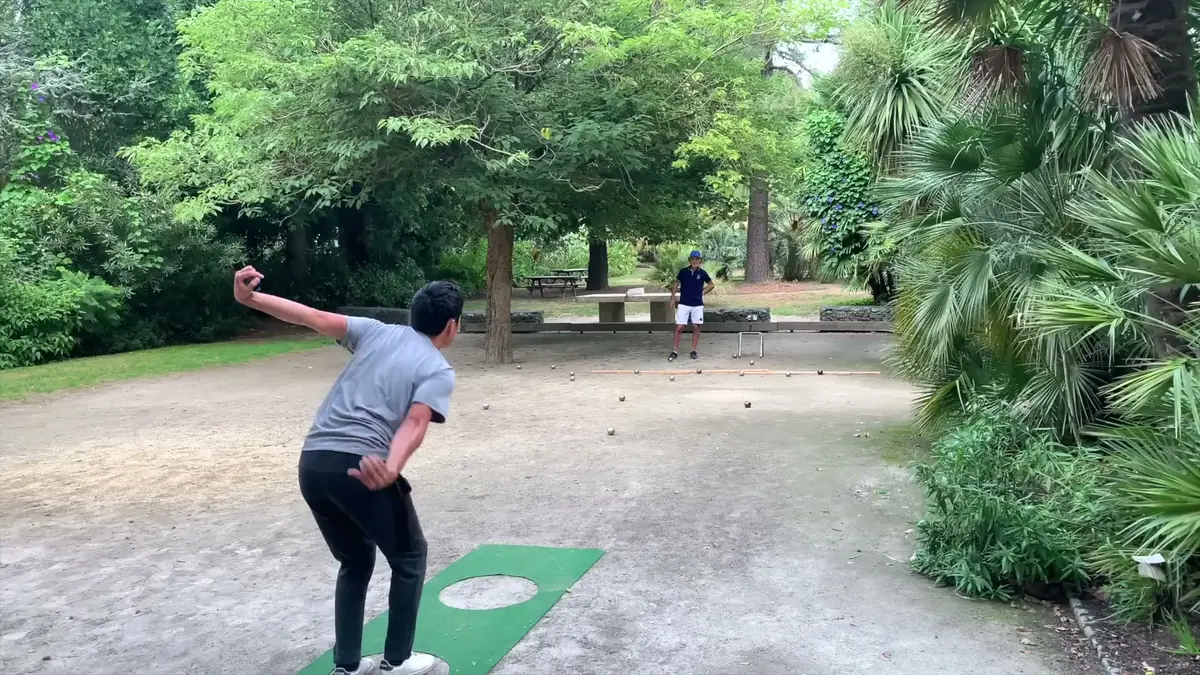
On our coaching courses, we measure shooting with challenges. In the video at the top of this article, Jean-François lines up 10 target boules and asks the participant for two sets of 10 shots, with one goal: at least 15 boules hit out of 20. The participant hits 8 in each set, 16 out of 20 in all, while Jean-François comments on his stance, grounding, shoulders square on to the target, swing and alignment.
Jean-François’s debrief shows that even a good shooter always has points to work on: the shoulders and upper body that sometimes twist, keeping the release on line, and protecting his concentration. During the challenge, someone walked past playing music, and the participant missed that shot. Set your own success criteria too: a challenge with a score tells the truth about your throw.
Drills for what comes next
Two of our articles take over from here. Our guide to improving your petanque sets out Jean-François’s three shooting drills: the tyre, the plank and the jump shot. And the precision shooting event, with its scored drills, works as a barometer to track your progress from one season to the next.
Nothing replaces an outside eye on your throw, though: that is the work we do with men and women players, drill after drill, on our coaching courses.
Frequently asked questions
What is the best boule for shooting?
Shooters often choose a very soft boule, which bounces little, because the harder a boule is, the more it bounces. For the diameter, the “Fundamentals” module of our programme recommends, for example, 76 mm for a shooter whose hand measures 20 cm from thumb to middle finger, and 75 mm for a pointer with the same hand. The other criteria are in our guide to choosing your petanque boules.
What weight of boule should a shooter use?
No weight is set for shooters: the FIPJP rules allow any boule from 650 to 800 g (article 2). Jean-François advises choosing the weight according to your position, and he steers pointers towards heavier, denser boules, which are knocked off line less by stones and slopes. To start with, he suggests an all-round set of 700 g; after that, borrow a few sets from fellow petanque players to compare weights and diameters before you buy.
What do players call a missed shot in petanque?
A missed shot goes by several names among French players. A “casquette” (a cap) just clips the top of the target without moving it, a “banane” (a banana) or a “crochet” (a hook) is a wild miss, well wide of the target, and a “carpe” (a carp) lands far too short.
Is the running shot allowed?
Yes: no article of the official FIPJP rules (in French) (opens in a new tab) forbids the running shot. The rules do, however, protect the ground: it is forbidden to press down, move or crush any obstacle, especially by sweeping in front of a boule to be shot, and only a hole made by a boule played previously may be filled in (article 10).
Shooting well comes down to consistency
So, in short, here is how to shoot in petanque: firm footing, eyes that never leave the target, a smooth swing driven by the legs and a late release, hand flat. None of these movements comes naturally, and each one becomes second nature through regular repetition, measured with challenges. Our training programme takes you through every stage on video, from your stance to the direct hit, so that you can progress at your own pace in our wonderful game.
This programme is not sports instruction within the meaning of the French Sports Code. It is informal educational support, designed to enrich your personal practice of petanque, with no individual supervision and no qualification awarded.
Your next read
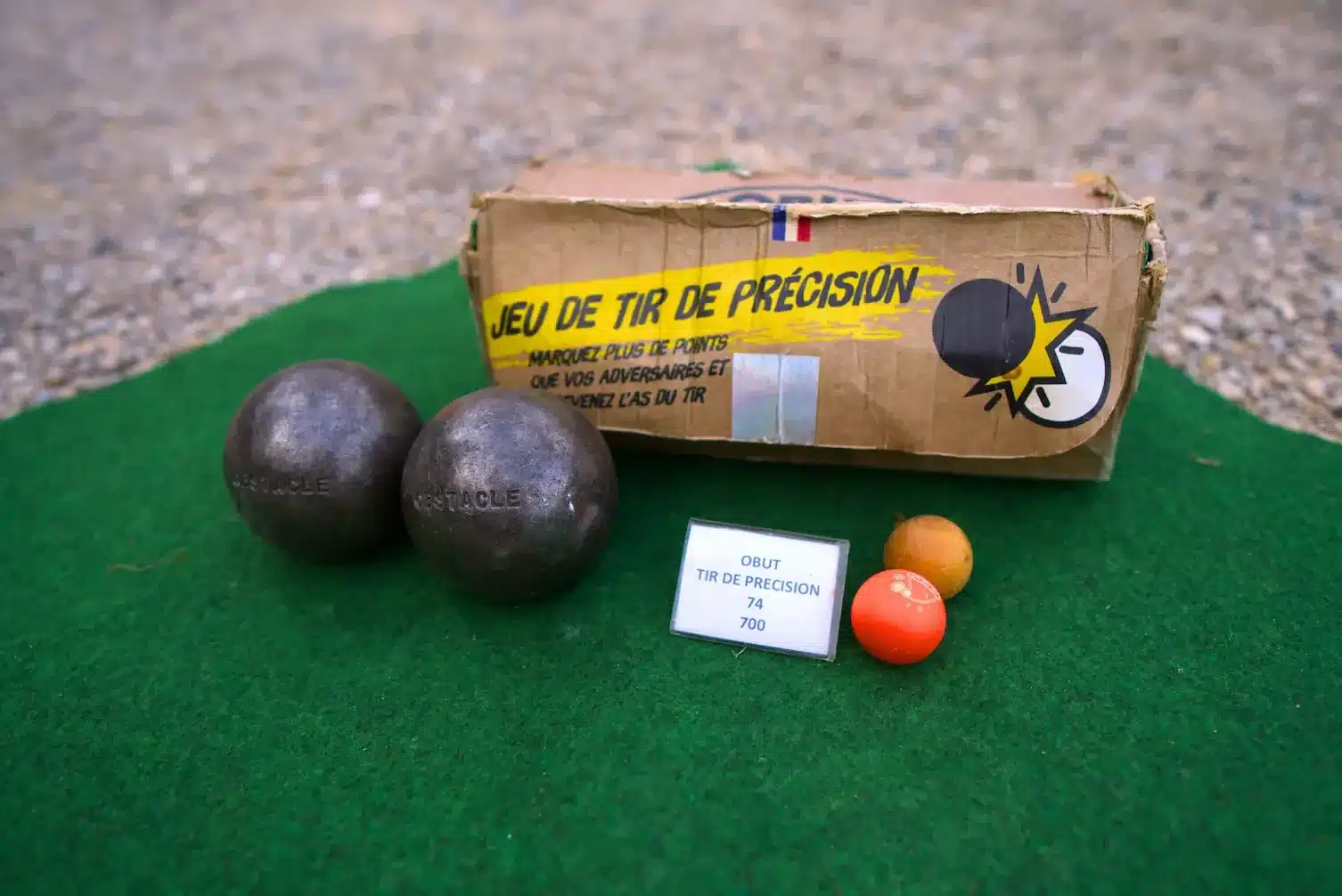
Precision shooting in petanque: rules, 5 workshops and practice
Once your throw is in place, the precision shooting event measures, drill by drill, whether it holds up at every distance.