21 min read
Precision shooting is the official event that measures a shooter’s skill in petanque: 20 shots over 5 workshops, from 6, 7, 8 and 9 metres, scored 0, 1, 3 or 5 points, for a maximum of 100 points under the FIPJP precision shooting rules (2025 edition, in French). This guide to precision shooting in petanque, the main article in our petanque technique topic, covers the shooting area, the points for each workshop and the competition rules, then how to use the event for shooting practice.
Precision shooting in petanque: how the event works
Precision shooting is an individual event in which the shooter, alone, facing fixed targets, takes 20 shots in a row: 5 workshops (five target set-ups), each shot once from each of 4 distances, from 6 to 9 metres. Each shot earns 0, 1, 3 or 5 points, and a full series is worth at most 100 points, according to the FIPJP rules.
20shots per series
5workshops
4distances, from 6 to 9 m
100points maximum
There is no opponent pointing and no end to win: each workshop recreates a situation the shooter comes across in a game, from a boule on its own to a boule hidden behind another, right through to the jack itself. The result comes down to a number, which makes this event an excellent way to measure your progress as a shooter.
The event is contested at the FIPJP World Championships, at the European Championships and at the French Championship, which the FFPJP organises every two years, according to its note on the French Precision Shooting Championship (in French).
Scoring: 0, 1, 3 or 5 points
Precision shooting is scored the same way for workshops 1 to 4, according to the tables in the rules; only workshop 5, where the target is the jack, has its own scoring.
| Result of the shot (workshops 1 to 4) | Points |
|---|---|
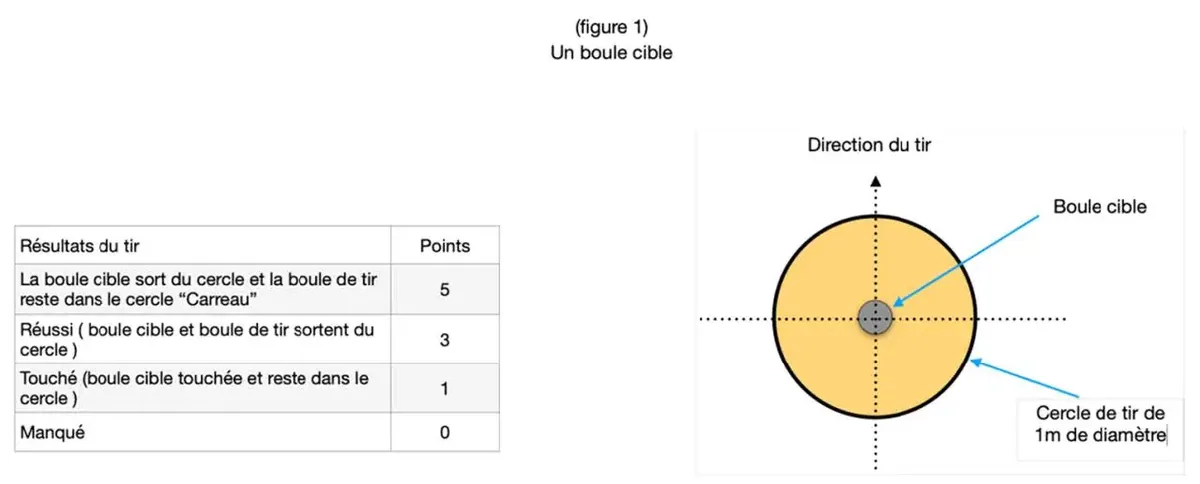
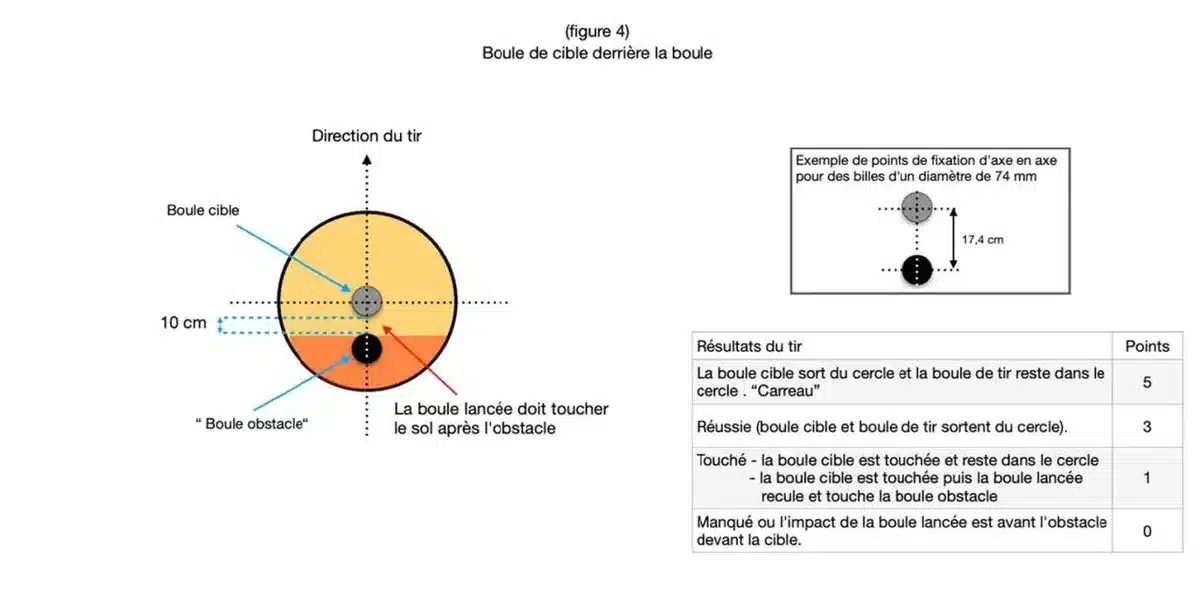
| The target boule leaves the circle, the shooter’s boule stays inside | 5 |
| The target boule and the shooter’s boule both leave the circle | 3 |
| The target boule is hit but stays in the circle | 1 |
| Target missed or invalid shot | 0 |
So a “carreau” in precision shooting is not quite the same as one in a game: the rules award 5 points as long as the shooter’s boule stays inside the 1 m circle, without requiring it to take the exact place of the target. In the workshops with an obstacle, 3 and 5 points can only be scored if no obstacle has been touched.
The rules specify that a shot is only valid if the boule lands inside the 1 m circle: a boule that lands on the line, even partly, makes the shot void, and it is a good idea to go over the line with chalk or plasticine so you can check. For the rules of an ordinary game, from how an end is played to counting the points, see our guide to the rules of petanque.
The shooting area: layout, distances and official equipment
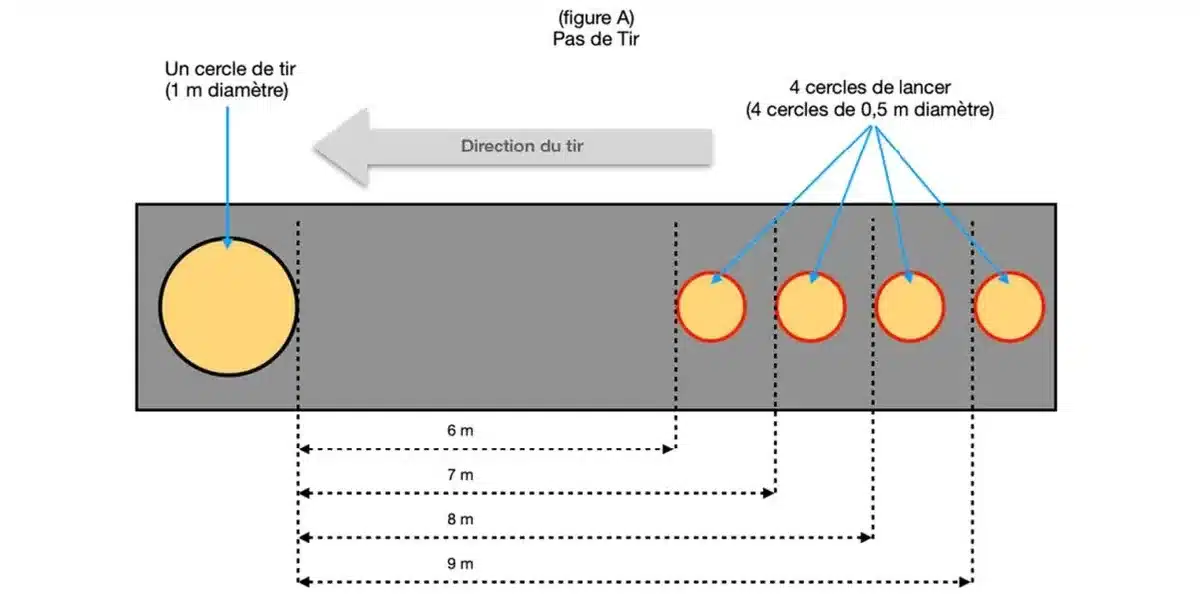
The official shooting area consists of a target circle 1 metre in diameter, where the targets and obstacles are placed, and four throwing circles 50 cm in diameter, whose front edges are 6, 7, 8 and 9 metres from the nearest edge of the target circle, according to figure A of the FIPJP rules.
The target boules are always placed in the centre of the target circle: they are therefore 6.5, 7.5, 8.5 and 9.5 metres from the edge of the throwing circles. The target jack in workshop 5, placed 20 cm from the edge of the circle nearest the shooter, is 6.2, 7.2, 8.2 and 9.2 metres away. The range “from 6.20 to 9.50 metres” that you often see quoted therefore gives the distance to the targets, not where the shooter stands.
| Throwing circle | Target boule (workshops 1 to 4) | Target jack (workshop 5) |
|---|---|---|
| 6 m | 6.5 m | 6.2 m |
| 7 m | 7.5 m | 7.2 m |
| 8 m | 8.5 m | 8.2 m |
| 9 m | 9.5 m | 9.2 m |
The official target equipment
The FIPJP rules set out precisely the equipment placed in the target circle.
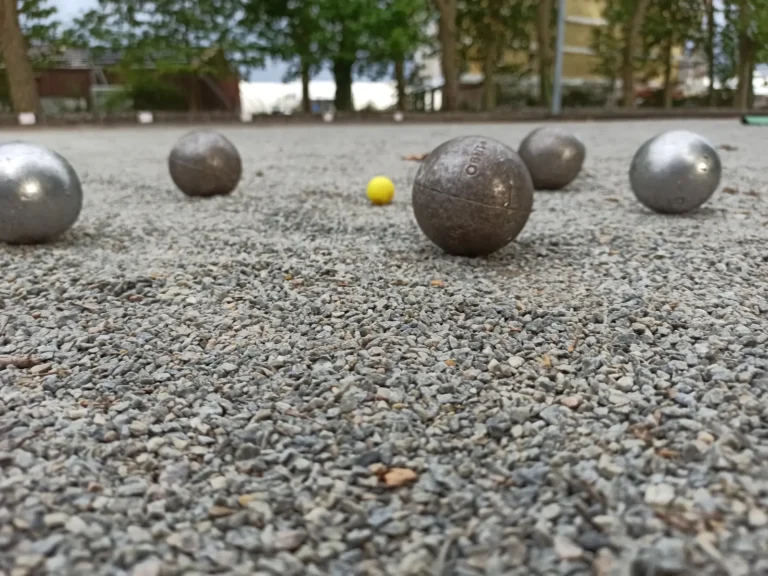
- The target boules: 74 mm in diameter, 700 g, smooth, light-coloured and identical for all the workshops.
- The obstacle boules for workshops 3 and 4: the same specifications, but dark-coloured.
- The target jack and the obstacle jack: 30 mm in diameter, made of boxwood, light-coloured, over 10 g.
- The FIPJP-approved template: it places each object at the prescribed spacing.
In competition, only an umpire or an authorised member of the organising team puts the targets back in place with this template; coaches and other players are not allowed to interfere with the shooting area.
The 5 precision shooting workshops and how they are scored
The 5 precision shooting workshops recreate five game situations: a target boule on its own, a boule hidden behind the jack, a boule tucked between two obstacle boules, a boule hidden behind an obstacle boule, then the jack on its own. Each workshop is shot once from each of the 4 distances, making 20 shots in all.
This table sums up figures 1 to 5 of the FIPJP rules; each workshop is then detailed with its points.
| Workshop | Target | Obstacle | What costs you all the points |
|---|---|---|---|
| 1 | Boule on its own, in the centre | None | Missing the target or landing outside the circle |
| 2 | Boule, 10 cm behind the jack | The jack | Landing before the jack or hitting it first |
| 3 | Boule between two boules, 3 cm away | Two black boules | Hitting a black boule first, or knocking one out with the target |
| 4 | Boule, 10 cm behind a boule | A black boule | Landing before the obstacle or hitting it first |
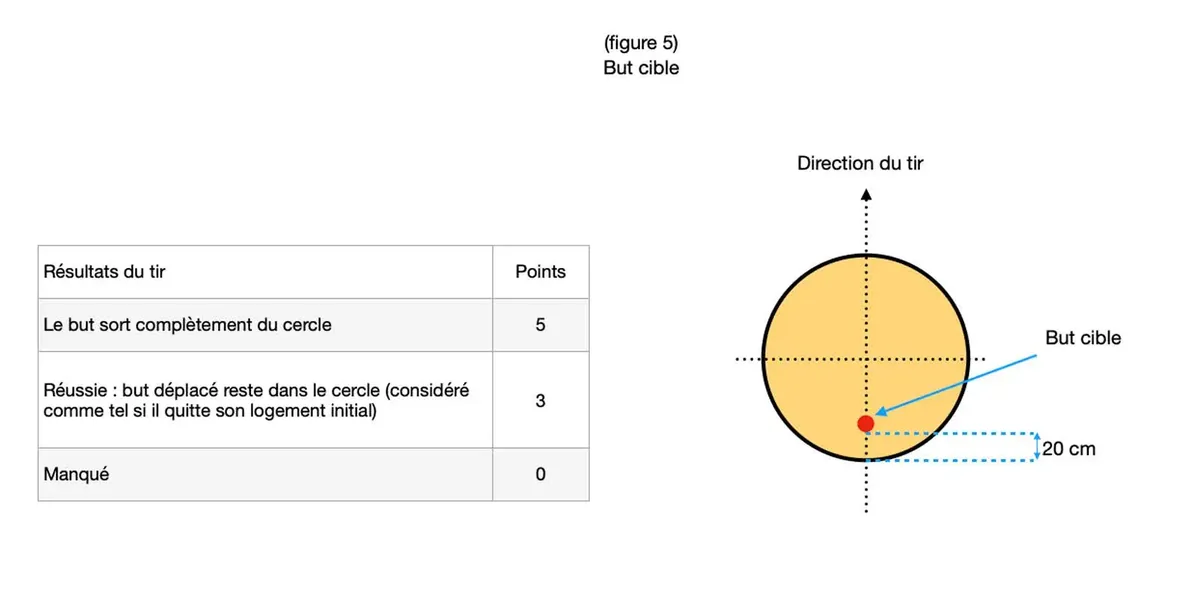
| 5 | Jack, 20 cm from the edge of the circle | None | Missing the jack |
Workshop 1: the target boule on its own
Workshop 1 places the target boule on its own in the centre of the target circle, with no obstacle at all: it is the shot closest to a direct hit in a game.
It is also the workshop that opens the series, at 6 metres. With no obstacle, the difference comes down to keeping your boule in the circle: knock the target out but go out with it, and the shot is only worth 3 points.
Workshop 2: the target boule behind the obstacle jack
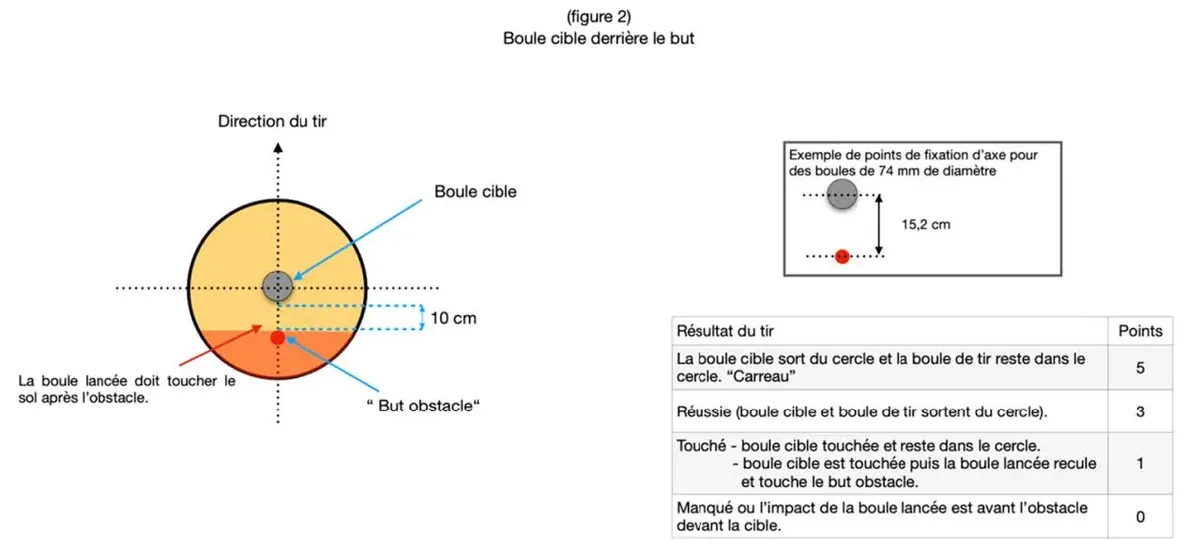
Workshop 2 places an obstacle jack in front of the target boule, 10 cm away from it, edge to edge: you have to go over the jack and land your boule beyond it.
We make this point in our filmed challenge: touch the jack first, even slightly, and the shot is worth zero, even if the target goes out afterwards.
Workshop 3: the target boule between two obstacle boules
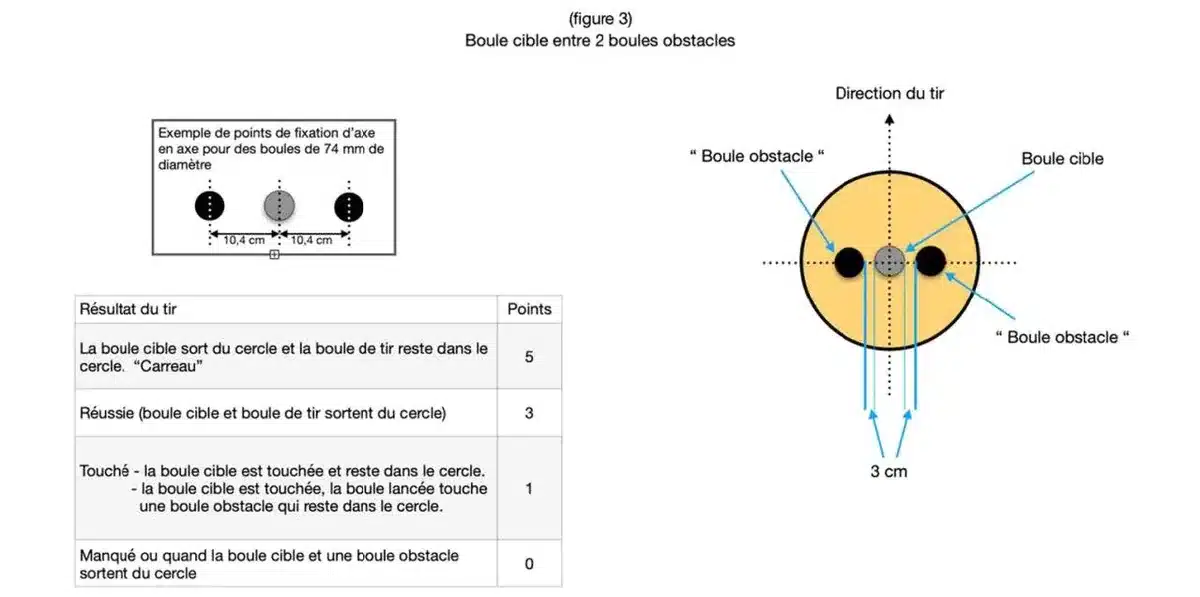
Workshop 3 flanks the target boule with two black obstacle boules, 3 cm away on each side: the shooter’s boule must arrive perfectly in line.
In our filmed challenge, it is presented as the workshop often considered the hardest: you have to stay perfectly straight, because the obstacle boules leave you only 3 cm to spare.
Workshop 4: the target boule behind an obstacle boule
Workshop 4 places a black obstacle boule in front of the target boule, 10 cm away from it: as in workshop 2, you have to jump the obstacle and land your boule beyond it, but this time the obstacle is a boule.
The 2025 rules specify that an obstacle touched on the rebound, after the target, is worth 1 point regardless of where the other objects end up. This is the jump shot, which Jean-François has players work on for precision, arc and control; our guide to improving your petanque even includes a drill for it, with an obstacle brought closer, from 20 to 10 cm.
Workshop 5: the target jack
Workshop 5 has you shoot at the jack on its own, placed 20 cm from the edge of the circle nearest the shooter: it is the smallest target in the event, 30 mm in diameter, and the only one with no 1-point score.
The distances change too: you shoot at the jack at 6.2, 7.2, 8.2 and 9.2 metres, rather than at 6.5 and beyond. In a game, shooting the jack is a way of killing an end that is going badly; and to know where it was before it moved, nothing beats the habit of marking the jack.
Workshops 2 and 4 call for a jump shot, workshop 1 for a well-placed direct hit, and workshop 3 for a perfect line. These are precisely the shots that the “Shooting” module of our programme breaks down on video, along with shooting just in front and the running shot.
Precision shooting rules in competition
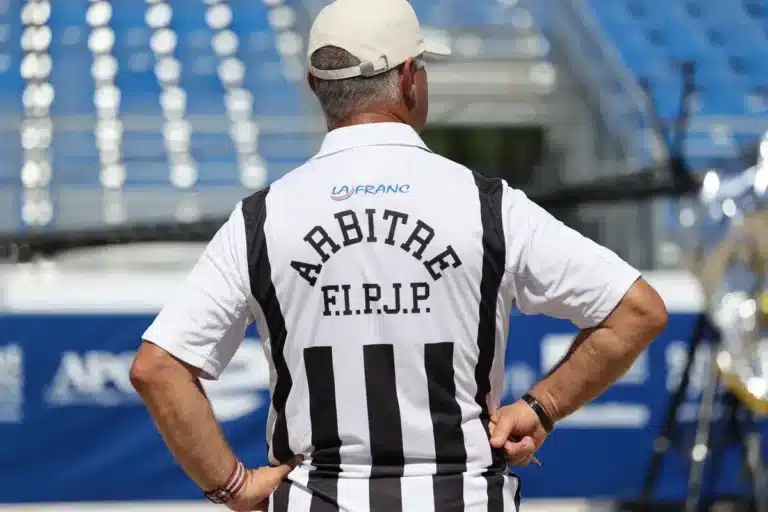
In competition, the FIPJP precision shooting rules require a series of 20 shots in no more than 15 minutes, with the feet on the ground until impact, in a fixed order, from workshop 1 at 6 metres to workshop 5 at 9 metres. At the World Championships, two qualifying rounds decide the 8 players who go through to the quarter-finals.
Shooting order and the clock
The shooter works through the workshops in order, from 1 to 5, and shoots each workshop from all four circles, from 6 to 9 metres: after the shot from 9 metres, they go back to 6 metres for the next workshop. They have no more than 15 minutes for their whole series, according to the rules.
The clock does not run while the targets are being set up: it starts when the scoring umpire raises an arm, once the template has been removed, and stops when the boule leaves the player’s hand. The shooter is told the time elapsed at the end of each workshop. As a guide, the FFPJP note allows an average of 20 minutes per shooter, and 40 minutes for a head-to-head from the quarter-finals onwards.
Feet on the ground and red cards
The FIPJP rules require the shooter to stay in their throwing circle, feet on the ground, until their boule touches the ground or the target. A foot lifted completely off the ground before impact earns a red card and the shot is cancelled, even if the player only leaves the circle afterwards; a foot that encroaches on the circle, at any point during the shot, is penalised in the same way.
A second red card ends the series, but the player keeps the points already scored. The umpire watching the feet stands facing the circle, at least 2 metres away, and is not allowed to warn a player whose foot is encroaching on the circle: it is up to the shooter to keep an eye on their own feet.
Qualifying, quarter-finals and ties
At the World Championships, according to the rules, each shooter plays a first series: the top 4 go straight through to the quarter-finals, and at least the next 16 contest a second round, starting with the lowest-ranked. The second round adds the two series together, and its top 4 complete the line-up of 8 quarter-finalists.
The quarter-finals pit 1st against 8th, 4th against 5th, 3rd against 6th and 2nd against 7th, then the winners play each other through to the final, the two opponents shooting alternately on the same shooting area. Where video is in place, each coach has a green card to challenge an umpire’s decision.
In the event of a tie, the rules favour the player with the most 5-point shots, then the one with the most 3-point shots. If the tie persists for the last qualifying place, or in the final stages, a shoot-off is played with one boule per workshop from the 7-metre circle; if necessary, it is repeated and stops as soon as one player scores more than the other on a target.
The departmental and regional championships that qualify for the French Championship follow these FIPJP rules, with a repechage of at least 12 players behind the 4 direct qualifiers, according to the FFPJP note.
One boule per distance, the clock ticking, an opponent who shoots just before you: in the final stages, precision shooting becomes as much a matter of focus as of technique. The “Mental preparation” module of our training programme works on exactly that, with performance routines, focus and managing your emotions.
Shooting practice: exercises and precision workshops
The 5 precision shooting workshops are among the best exercises for shooting practice in petanque: one boule per distance, targets always placed the same way, and a score out of 100 that lets you track your progress from one session to the next.
They are no substitute for the first throwing drills, such as the ones Jean-François introduces in our guide to improving your petanque: the tyre and crossbar, the obstacle plank and the jump shot over an obstacle boule, each passed with three consecutive successes at every distance. Precision shooting comes next, as a test: it puts a number on whether your technique holds up when you only get one boule.
Marking out your shooting area with a tape and a template
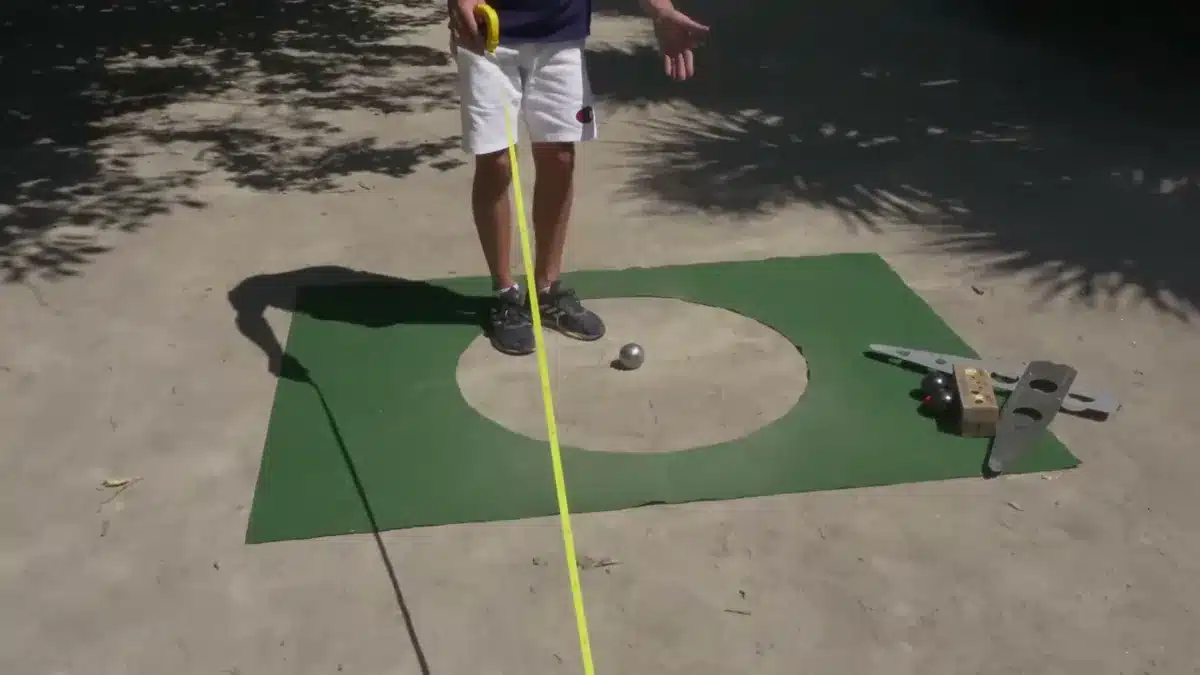
A practice shooting area can be marked out in a few minutes with a 10-metre tape, as we did for our filmed challenge. The measurements are those of the FIPJP rules.
- Measure 9 metres between the near edge of the target circle and the front edge of the furthest throwing circle, then place a throwing circle every metre, at 8, 7 and 6 metres.
- Draw a target circle 1 m in diameter on the ground, or lay down a mat of that size, and mark its centre.
- Place the target boule in the centre, then the obstacles with the template: 10 cm for workshops 2 and 4, 3 cm for workshop 3.
- Fill in the impact mark after each shot, so the target area is back to neutral.
- Write down the score for each shot on a sheet: 0, 1, 3 or 5.
Without a template, an ordinary tape measure is enough for the gaps; the template mainly saves time and guarantees identical gaps from one shot to the next. If you are a beginner, the FFPJP’s simplified version of the event, described in our frequently asked questions, is a good starting point: only two throwing circles, at 6 and 7 metres, and obstacles placed 20 cm away.
Our filmed challenge: 28 points to 17
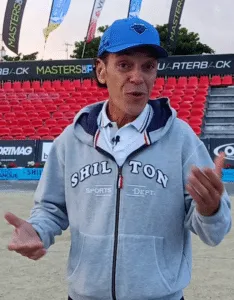
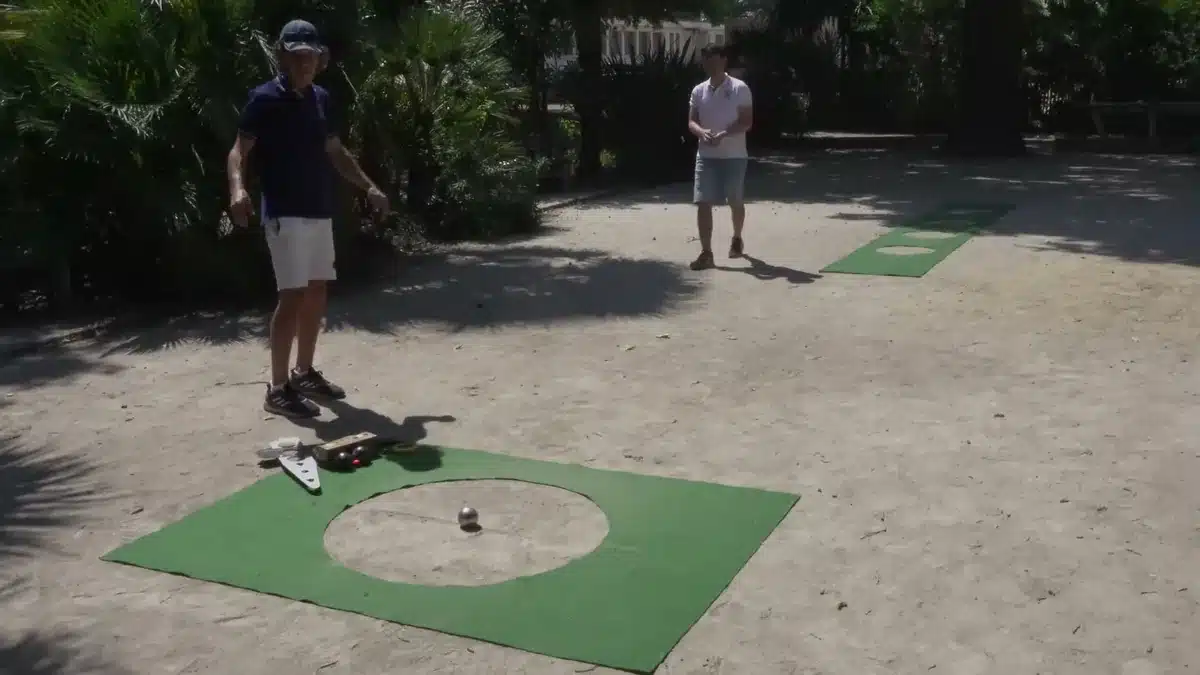
In August 2022, Jean-François, our petanque coach, challenged his son Alexandre, who films the videos for our channel, to a full series of 20 shots. They had marked out and measured the shooting area themselves with a 10-metre tape, and used a template and approved targets. In very hot weather, and with no warm-up boules, Jean-François finished on 28 points and Alexandre on 17.
These figures give an honest benchmark for a player in training. Jean-François sets the target at the end of the video: “Aiming to beat 30 points is good. 40 is even better”, while you keep working on your whole throwing technique to give yourself more room for improvement.
The 4 mistakes we see most on coaching courses
On coaching courses, four mistakes keep coming up among players trying their hand at precision shooting, and each one costs points in a different way.
- Forcing the shot The player tightens up, tenses their muscles and loses their line; as Jean-François points out in his programme videos, the more you force it, the less chance you have of succeeding.
- Mishandling the change of distance After the shot at 9.5 m, you have to get the distance right at 6.5 m straight away, with just one attempt.
- Lifting a foot before impact Red card and shot cancelled, even if the boule was perfect.
- Touching the obstacle In workshops 2, 3 and 4, the boule touches the jack or a black boule before the target, and the shot is worth 0.
To root out these mistakes, nothing beats a practice session where every shot counts: write down your points, or take on a partner, as in our challenge. On coaching courses, Jean-François also has players shoot at white boules touching black boules, behind a front row of boules that must not be touched, to work on precision before the event.
Correcting these faults with a coach watching is still the quickest way: that is what we do in the practice sessions on our coaching courses near Nantes.
A foot that lifts, like a forced shot, is something you tackle first through your footing. The “Stance” module of our programme is devoted to your position in the circle, grounding and weight transfer.
Learning to shoot: from precision shooting to shooting in a game
Learning to shoot starts close to the target, at around 5 metres, with stable footing and a smooth throw, before gradually increasing the distance; as a rule, you learn shooting just in front before the direct hit. Precision shooting comes later, once the technique is in place, to check that it holds up at every distance.
In a game, the shooter also has to choose their shot to suit the terrain: a direct hit on stony ground, a running shot on smooth ground, a jump shot when the target is hidden. Jean-François gives this benchmark in his programme videos: a shooter of a good standard regularly hits 3 boules out of 4 on terrain that suits shooting.
Each of these shots has its place in our topic on shooting and pointing, and our video “How to master the direct hit” (in French) shows the basics out on the terrain.
Kit, template, mats: the equipment for practising precision shooting
To practise precision shooting, you need at the very least a target boule, two obstacle boules, a jack, a 10-metre tape and something to mark out the circles. A kit, a template and mats make setting up quicker and the gaps more accurate, but none of them is essential to get started.
| Equipment | What it is for | Essential? |
|---|---|---|
| Target boule and two obstacle boules | Recreating the targets for workshops 1 to 4 | Yes; your own boules can stand in |
| Jack | Obstacle in workshop 2 and target in workshop 5 | Yes |
| 10-metre tape | Placing the throwing circles at 6, 7, 8 and 9 m | Yes |
| Template | Placing the obstacles 10 cm or 3 cm away | No, but it guarantees accurate gaps |
| Target and throwing mats | Marking out the circles | No; a circle drawn on the ground is enough |
| Score sheet | Writing down 0, 1, 3 or 5 for each shot | Yes, to track your progress |
Obut’s precision shooting set, the one in our opening photo, includes two black boules, a white boule, a red jack and score sheets, according to the manufacturer’s product page. If you’d like to get one, you’ll find this Obut precision shooting set on Amazon (affiliate link).
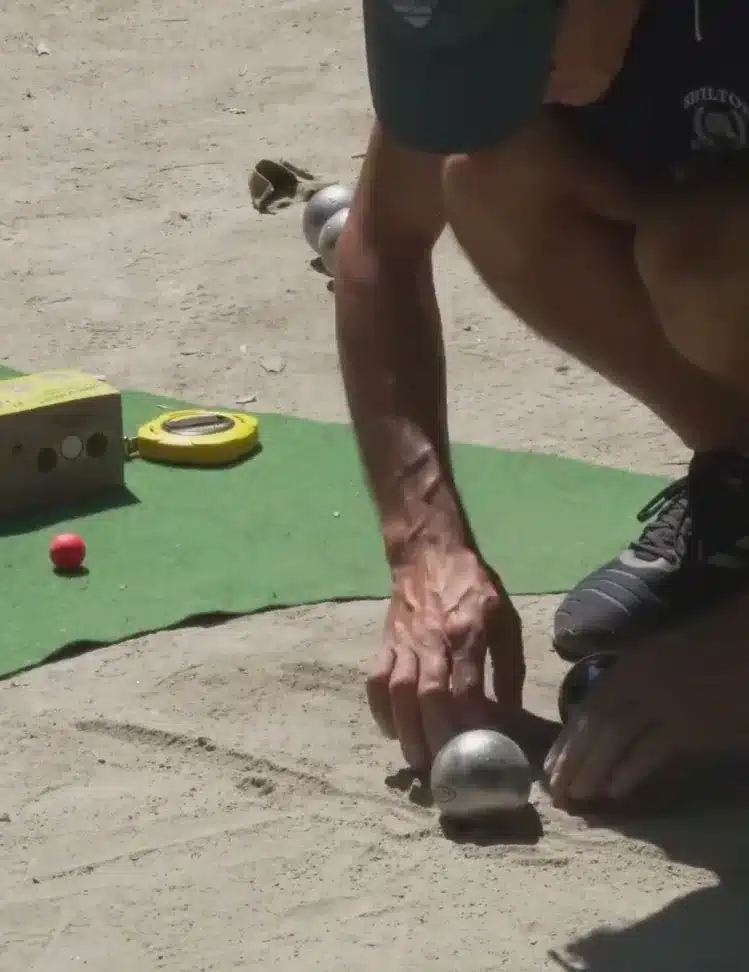
For shooting, stick with your usual boules: during our challenge, Jean-François was shooting with 75 mm, 680 g boules, and Alexandre with 74 mm, 680 g boules. You choose the diameter and weight of your shooting boules to suit your hand and your game, as explained in our guide to choosing your petanque boules.
Precision shooting champions, records and the 2026 World Championships
The ratified world record in precision shooting is 67 points out of 100, shared by France’s Christophe Sévilla, on 3 July 2011 in Mâcon, and Italy’s Diego Rizzi, on 23 July 2017 in Wrocław, Poland, according to the FIPJP records table. In the men’s event, Dylan Rocher has won three world titles, in 2018, 2021 and 2023.
The same FIPJP table gives the women’s record, 61 points, shared by two French players, Angélique Papon, in 2006 in Grenoble, and Audrey Bandiera, in 2015 in Bangkok, as well as the youth record, 62 points, set by France’s Kevin Malbec in 2005 in Longueuil, Canada.
The latest world champions
According to the roll of honour of the petanque World Championships (in French), Dylan Rocher dominated the men’s event from 2018 to 2023, before Madagascar’s Jean-François Rakotondrainibe won the title in Dijon in 2024.
| Year | Venue | World champion |
|---|---|---|
| 2018 | Desbiens (Canada) | Dylan Rocher (France) |
| 2021 | Santa Susanna (Spain) | Dylan Rocher (France) |
| 2023 | Cotonou (Benin) | Dylan Rocher (France) |
| 2024 | Dijon (France) | Jean-François Rakotondrainibe (Madagascar) |
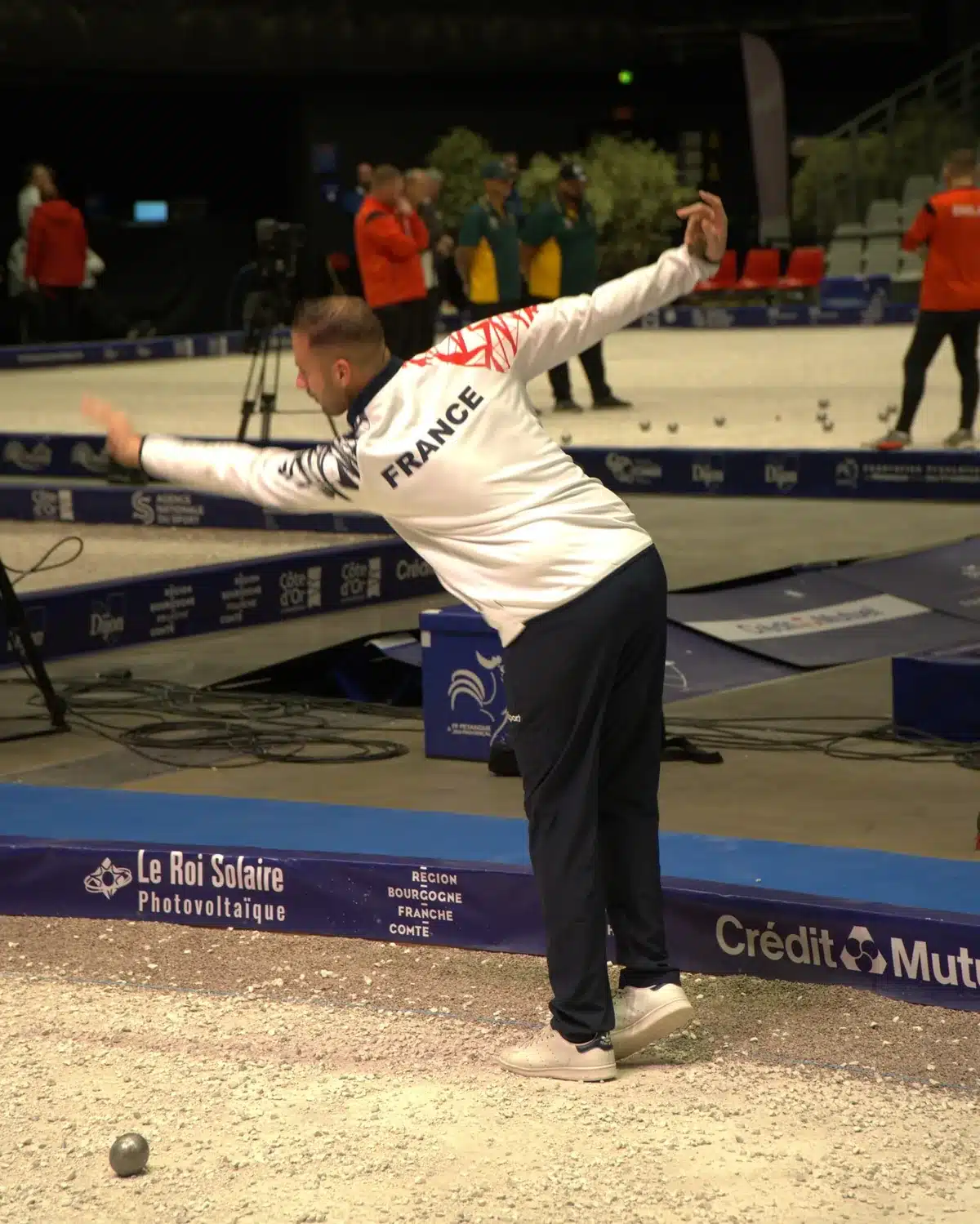
In the women’s event, Thailand’s Kantaros Choochuay was crowned in 2025 in the Douaisis, in France; for France, Angélique Colombet has won three titles, in 2006, 2008 and 2009. The upcoming 2026 petanque World Championships (in French), which feature senior triples and precision shooting, start on 20 November 2026 in Khon Kaen, Thailand.
Under the rules, each nation enters only one shooter, chosen from the four players in its team for the World Triples Championship. Only the defending champion can come back to defend their title even if their country has not qualified.
What score should you aim for in precision shooting?
A good score in precision shooting depends on your level: our own series from 2022 and the world records give a sense of scale.
| Score out of 100 | What it represents | Source |
|---|---|---|
| 17 and 28 | Alexandre’s and Jean-François’s scores, with no warm-up | Our 2022 filmed challenge |
| Over 30, then 40 | The recommended practice target | Jean-François, in the same video |
| 61 | The women’s world record (Angélique Papon in 2006, Audrey Bandiera in 2015) | FIPJP records table |
| 67 | The world record, shared (Christophe Sévilla in 2011, Diego Rizzi in 2017) | FIPJP records table |
The French Precision Shooting Championship
The French Precision Shooting Championship is held every two years, in odd-numbered years, for senior men and senior women, according to the FFPJP note; the 2025 edition took place during the French veterans’ and “promotion” championships. Players qualify through departmental and then regional championships, played under the FIPJP rules, with every workshop at every distance. The next one should therefore take place in 2027, subject to the federation’s calendar.
Frequently asked questions
Which workshop helps you learn to shoot straight in petanque?
Workshop 3 in precision shooting, the target boule between two obstacle boules 3 cm away, is the best judge of your line: the slightest deviation hits a black boule. Start at 6 metres, then move back when your shots pass cleanly between the obstacles.
Do you need a machine to practise shooting in petanque?
No: a shooting area marked out with a 10-metre tape, a target boule, two obstacle boules and a jack are all you need to practise all 5 workshops. Shop-bought accessories save time, but it is the score you write down for each series that helps you improve your game.
Do young players take part in precision shooting?
Yes: the FFPJP simplified precision shooting rules (in French), posted online by the Charente-Maritime committee, keep only two throwing circles. Cadets, juniors and seniors shoot from 6 and 7 m, at targets 6.5 and 7.5 m away, and minimes and benjamins from 5 and 6 m, at targets 5.5 and 6.5 m away. The obstacles are placed 20 cm away instead of 10, while the 3 cm gap in workshop 3 stays the same.
Precision shooting, a barometer for your shooting
Remember the essentials of precision shooting in petanque: 20 shots, 5 workshops, a single boule per distance and feet that stay on the ground until impact. Set up on your own terrain, it becomes the most honest of barometers: write down your scores, aim for 30 points and then 40, and track your progress from one season to the next. To work on the technique that pushes this score up, our training programme takes you from the jump shot through to mental preparation, at your own pace.
This programme is not sports instruction within the meaning of the French Sports Code. It is informal educational support, designed to enrich your personal practice of petanque, with no individual supervision and no qualification awarded.