

28 min read
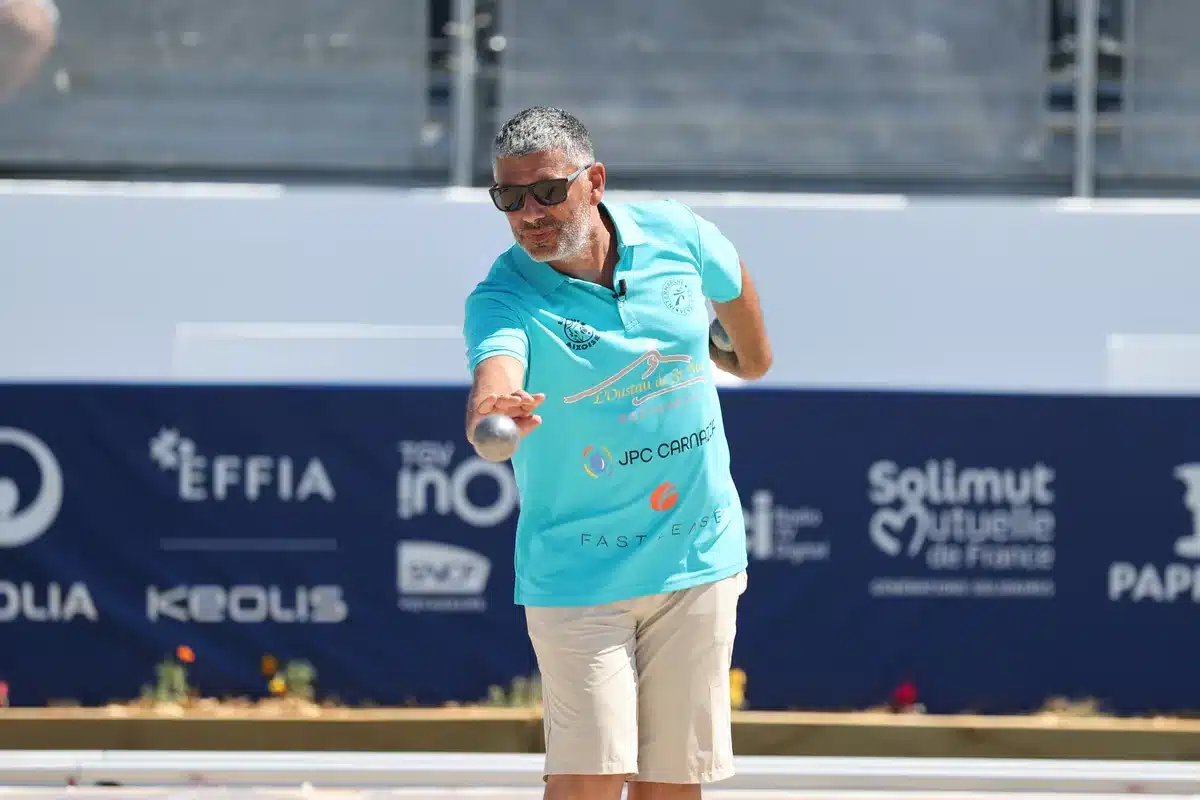
Petanque, the French game of boules, is played from a circle, feet planted: you throw your boules as close as possible to a small ball, the jack, 6 to 10 metres away, and the first team to 13 points wins. Petanque rules even let you knock the jack away.
ContentsShow contents13 parts
- Petanque rules in 1 minute
- How far do you throw the jack in petanque?
- How is a game of petanque played?
- Triples, doubles, singles: how many players and boules?
- Playing with children: what distances and which boules?
- How do you count the points in petanque?
- What happens if the jack goes out of bounds?
- Terrain, boules and jack: what do the rules say?
- Friendly game or competition: what changes?
- What are the new petanque rules in 2026?
- The 4 rule mistakes we see most often
- Frequently asked questions
- Play by the rules, then improve your game
Petanque rules in 1 minute
Petanque is played in singles, doubles or triples: each player throws their boules from a circle, feet still, to place them closer to the jack than the opponents’ boules. Under the official FIPJP rules (opens in a new tab), the jack is thrown between 6 and 10 metres, and games are played to 13 points.
Here are the petanque rules in simplified form, to read before your first game, whether with friends or at a club:
- The teams. There are three official formats: singles and doubles, with 3 boules per player, and triples, with 2 boules per player (Article 1 of the rules).
- The circle. The team that wins the draw draws a circle 35 to 50 cm in diameter, or places a rigid 50 cm circle (Article 6).
- The jack. Also called the “but” or the “bouchon” in French, it is thrown by a player from that team between 6 and 10 metres from the circle (Article 7).
- The feet. They stay inside the circle, on the ground, until the thrown boule touches the ground (Article 6).
- The order of play. The first boule goes to the team that threw the jack; after that, it is always the team that does not hold the point that plays (Article 16).
- The points. When the end is over, the best-placed team scores one point for each boule closer to the jack than the opponents’ best boule (a principle reflected in Article 29).
- What comes next. The team that scored throws the jack again from where it finished, and the first team to 13 points wins (Articles 5 and 7).
- The time limit. Each player has one minute to play their boule (Article 21).
The name is said to come from the Provençal expression “pè tanca”, feet planted: in petanque, you throw without a run-up, unlike in jeu provençal, where the player takes a run-up. Jean-François introduces these basics in our video “Basic rules of petanque” (in French), a little further down this page and on our YouTube channel, which had 31,000 subscribers as of 13 October 2026.
This guide, the starting point of our petanque rules and umpiring topic, also covers distances, scoring, what happens when the jack goes out of bounds, competition rules and what has really changed in 2026.
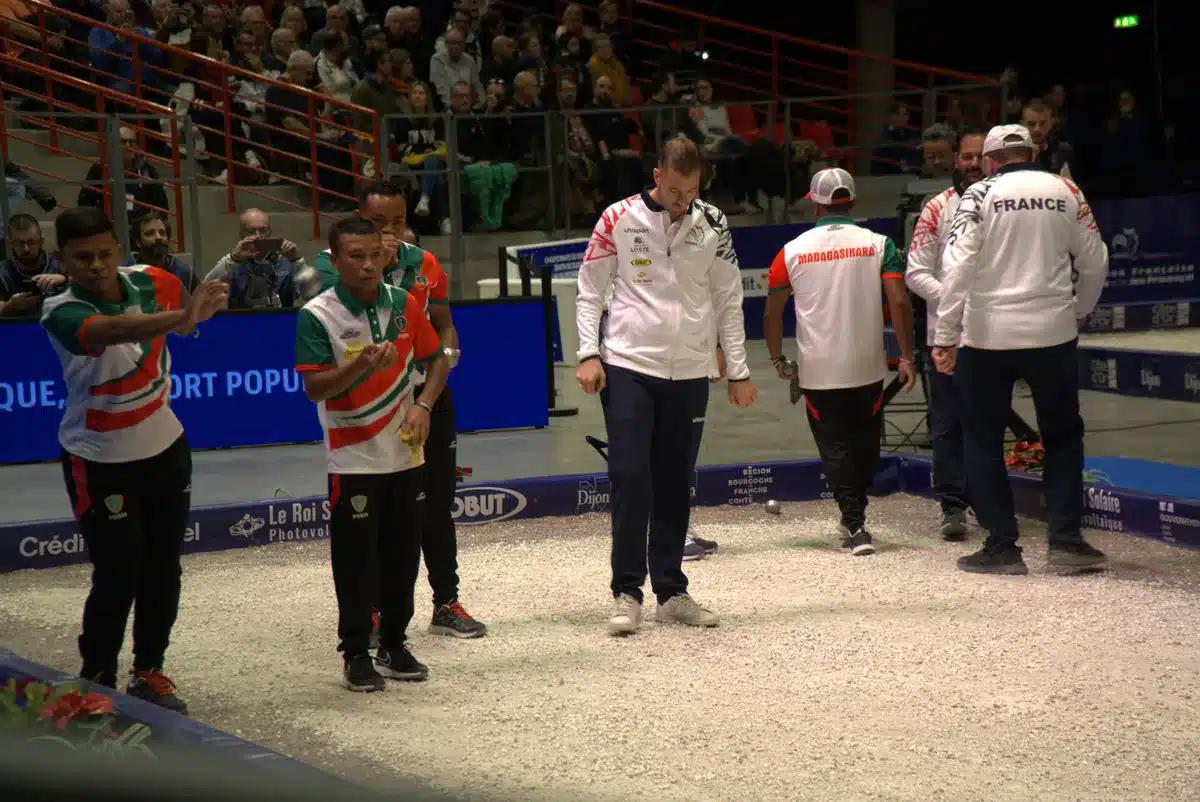
The French words you’ll hear on the terrain
Whether you play in France or with French players, here are the words you will hear most often, with their English equivalents and what they mean.
| French word | In English | What it means |
|---|---|---|
| Cochonnet, “but” or “bouchon” | The jack | The small 30 mm ball that both teams try to get close to, thrown 6 to 10 m from the circle |
| Boules | Boules, or petanque balls | The metal balls you throw, weighing 650 to 800 g each |
| Cercle | The circle | The circle you throw from, 35 to 50 cm across, with both feet inside it |
| Mène | An end | The equivalent of a round: from the throw of the jack until the last boule stops |
| Pointer | Pointing | Throwing your boule so that it stops as close as possible to the jack |
| Tirer | Shooting | Throwing your boule to knock an opponent’s boule, or the jack, out of the way |
| Carreau | A carreau | A shot where your boule knocks the target boule away and takes its place |
| Tête-à-tête, doublette, triplette | Singles, doubles, triples | The three official formats: 1 against 1, 2 against 2, 3 against 3 |
| Faire Fanny | To lose 13–0 | To lose a game without scoring a single point |

How far do you throw the jack in petanque?
Under Article 7 of the FIPJP rules, the jack is thrown between 6 and 10 metres from the inside edge of the circle for juniors and seniors. It must also be at least 50 cm from any obstacle and from the end line of the lane, and remain visible from the circle.
| What is measured | Regulation distance | Article |
|---|---|---|
| Jack to the inside edge of the circle (juniors, seniors) | 6 to 10 m | 7 |
| Jack to any obstacle, or to the end line of the lane | At least 50 cm | 7 |
| Jack to the circle or the jack of another game | At least 1.50 m | 7 |
| Jack to the side lines | No minimum | 7 (note) |
| Circle to any obstacle | At least 1 m | 6 and 7 |
| Circle to another circle or the jack of another game | At least 1.50 m | 6 and 7 |
| Jack moved during an end | Dead beyond 20 m (15 m for younger players) or under 3 m from the circle | 9 |
| Opponents of the player throwing | At least 2 m, to the side, beyond the jack or behind the player | 17 |
A common mix-up: the 1-metre minimum applies to the circle, and the 50 cm minimum to the jack (Article 7). Near the edge of a terrain, remember two cases: the end line of the lane requires 50 cm, whereas the side lines, whether they separate lanes or are dead-ball lines, require no minimum distance (Article 7, note). Lastly, the jack must be visible to a player standing fully upright in the circle, with their feet at its inner edges; in the event of a dispute, the umpire decides without appeal.
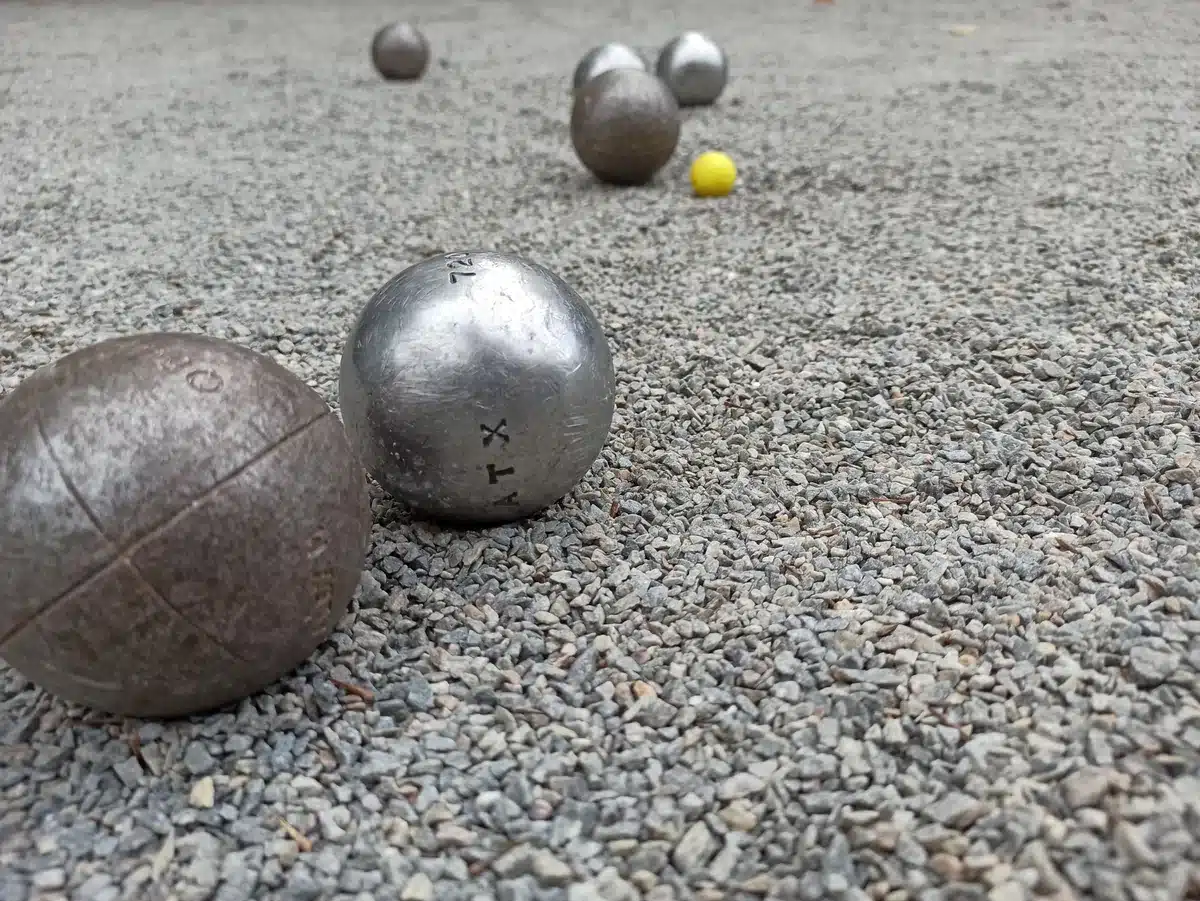
What happens if the jack is not thrown correctly?
The team throwing the jack has only one attempt: if the throw is not valid, the opposing team places the jack itself, by hand, in a valid position (Article 6). The team that lost the jack still plays the first boule (Article 7).
The jack must be thrown within one minute, and an opponent placing it after a failed throw must do so immediately (Article 7). If the thrown jack is stopped by an umpire, an opponent, a spectator or an animal, it is thrown again; if it is stopped by a team-mate, it goes to the opponent, who places it (Article 8).
A jack can still be contested after the first boule, but not once the opponent has also played a boule: it is then deemed valid once and for all (Article 8).
Where do you throw the jack from in the next end?
In the next end, the team that scored draws or places the circle around the spot where the jack finished in the previous end (Article 7). If this circle would be less than 1 metre from an obstacle, or less than 1.50 metres from another circle or jack, it is placed at the regulation distance. If the jack could not be thrown to every regulation distance from there, the player may step back, in line with the previous end’s play, without exceeding the maximum distance allowed for throwing the jack.
Whether to throw the jack to 6 or to 10 metres is not only a matter of the rules: it is a tactical choice in its own right, depending on your game and your opponent’s. The “Pointing” module of our training programme covers terrain analysis and throwing the jack, before going through each way of pointing.
How is a game of petanque played?
A game of petanque is played in successive ends: one team draws the circle, throws the jack and plays the first boule, then the team that does not hold the point plays until it wins the point back or runs out of boules. Once the end is over, the points are counted, and play starts again until one team reaches 13 points.
What is an end?
The end is the phase of play from the throw of the jack until the last boule stops: it is the equivalent of a round. A game has as many ends as it takes for one team to reach 13 points. The FIPJP rules state that each new end begins as soon as the last boule of the previous one has stopped (Article 33).
The draw and the throwing circle
A draw decides which team chooses the terrain, if it has not been allocated by the organisers, and throws the jack first (Article 6). Any player from that team then draws a circle 35 to 50 cm in diameter, big enough for their feet to fit entirely inside it, or places a rigid circle with an internal diameter of 50 cm.
The circle goes at least 1 metre from any obstacle and at least 1.50 metres from another circle in use or from the jack of another game (Articles 6 and 7). In competitions, if the organiser provides regulation circles, players must use them.
When you play, your feet stay entirely inside the circle, without encroaching on its edge, and must neither leave it nor be lifted completely off the ground before the thrown boule has touched the ground (Article 6). No other part of the body may touch the ground outside the circle. The same article makes an exception: a player with a lower-limb disability may place only one foot in the circle, and a player in a wheelchair rests at least one wheel inside it, the one on the side of the throwing arm.
Who plays after the first boule?
The first boule is played by the team that won the draw or that scored the points in the previous end; after that, it is always the turn of the team that does not hold the point (Article 16). Holding the point means having the boule closest to the jack. When one team has no boules left, the other team plays all its remaining boules.
Boules are played one at a time, and a boule that has been thrown cannot be replayed, unless a boule or jack from another game, an animal or a moving object has stopped or deflected it (Article 16). To win back the point, the player chooses between pointing (placing their boule close to the jack) and shooting (knocking the opposing boule away). The team makes this choice together, and we talk about it in our guide to improving your petanque.
Marking the jack and the boules
The rules require you to mark the jack’s position on the ground when it is first thrown, then every time it moves (Article 6), and to mark the boules that count in the same way: without a mark, no claim is accepted (Article 22). Our article why mark the jack in petanque explains what this small habit saves you, and how to do it properly.
Triples, doubles, singles: how many players and boules?
Petanque is played 3 against 3 (triples, 2 boules per player), 2 against 2 (doubles, 3 boules per player) or 1 against 1 (singles, 3 boules per player), under Article 1 of the FIPJP rules. The same article states that no other format is allowed.
| Format | Players | Boules per player | Boules per team |
|---|---|---|---|
| Triples | 3 against 3 | 2 | 6 |
| Doubles | 2 against 2 | 3 | 6 |
| Singles | 1 against 1 | 3 | 3 |
So a team plays at most 6 boules per end, which also caps the number of points it can score in that end.
Two players: singles
With 2 players, the official format is singles: each player plays 3 boules, and the rules are the same as for teams (Article 1). You throw the jack, point, shoot and measure yourself, so you have to manage your choices and your emotions on your own. With friends, nothing stops you from adapting the formats when there are more of you, but it is then no longer an official format.
Positions in triples
In triples, each player usually plays a set position: the pointer, who opens the end; the middle player, an all-rounder; and the shooter, whose job is to knock away the opposing boules. Jean-François points this out in our video on the basic rules: everyone would do well to play the position where they are most useful to their team.
Precision shooting is a separate, individual event with its own rules: we introduce it in our article on precision shooting in petanque.
Playing with children: what distances and which boules?
For children, the FIPJP rules allow shorter distances in competitions for younger players, without putting a figure on them (Article 7), and boules of 600 grams and 65 mm for players aged 11 and under (Article 2). The FFPJP’s rules for the 2026 benjamins-minimes club championship (opens in a new tab) (in French), however, set playing distances of between 5 and 8 metres.
Age categories are set by Article 13 of the FFPJP’s 2026 administrative and sporting rules (opens in a new tab) (in French), based on the age reached during the sporting season. The distance ranges in the table are the guidelines we use for youth competitions: the FIPJP rules leave these distances to the competitions concerned, and the only official figure we have found is the one for the benjamins-minimes club championship.
| Category | Age reached in the season (FFPJP 2026) | Jack distance |
|---|---|---|
| Benjamins | 8 and under | 4 to 7 m |
| Minimes | 9 to 11 | 5 to 8 m |
| Cadets | 12 to 14 | 6 to 9 m |
| Juniors | 15 to 17 | 6 to 10 m (FIPJP Article 7) |
| Seniors | 18 and over | 6 to 10 m (FIPJP Article 7) |
| Veterans | 60 and over | 6 to 10 m, as for seniors |
In the club championship, benjamins and minimes play together at distances of 5 to 8 metres. In their competitions, players aged 11 and under may use boules weighing 600 grams with a diameter of 65 mm, provided they are made by an approved manufacturer (Article 2 of the FIPJP rules). For younger players, a moved jack is only dead beyond 15 metres, compared with 20 metres for juniors and seniors (Article 9).
With friends or family, nothing stops you from bringing the jack closer to suit the child and giving them lighter boules: the pleasure of succeeding matters more than the regulation distance. A young licensed player can also play in the category above their own, and in the senior category, provided they play alongside an adult licensed player or are accompanied by one (Articles 13 and 14 of the FFPJP rules).
How do you count the points in petanque?
In petanque, only the team with the boule closest to the jack scores when the end is over: it gets one point for each boule closer than the opponents’ best boule. So a team scores from 1 to 6 points in an end, 3 at most in singles, and the game is played to 13 points under Article 5 of the rules.
The same Article 5 allows league games and qualifying heats to be played to 11 points, and some competitions are played within a time limit. Losing 13–0 is called “faire Fanny”, to use the time-honoured French expression. To keep track of the score without mistakes, you can use our petanque point counter.
Worked examples: how an end is scored
The examples below are all in doubles, with 6 boules per team; each result follows the FIPJP rules.
| Situation when the end is over | Result | Rule |
|---|---|---|
| Team A has boules 5, 12 and 40 cm from the jack; B’s best boule is 20 cm away | A scores 2 points: its boules at 5 and 12 cm | Scoring principle |
| A has four boules closer than B’s best boule | A scores 4 points | Scoring principle |
| The two best boules, one from each team, are the same distance away, and nobody has any boules left | The end is dead; the jack goes to the team that scored the points in the previous end | Article 29 |
| A tie, and both teams still have boules | The team that played the last boule plays again, then the other, alternately, until one team holds the point | Article 29 |
| A tie, and only A still has 2 boules | A plays them and scores as many points as it has boules closer than B’s best boule | Article 29 |
| The jack goes out of bounds; A still has 2 boules in hand, B none | A scores 2 points | Article 14 |
A boule picked up before the points are agreed is dead, and no claim about it is accepted (Article 27). So wait until the points have been counted before picking up your boules.
Who measures the point, and how?
Measuring a point is the responsibility of the player who played last or one of their team-mates, and the opponents always have the right to measure after them (Article 26). It must be done with an appropriate instrument, which each team must have, and measuring with your feet is forbidden.
To measure, you may temporarily remove the boules and obstacles between the jack and the boules being measured, after marking their positions (Article 25). A team whose player moves the jack or one of the contested boules while measuring loses the point (Article 28). In competitions, an umpire can be called at any stage of the end, and their decision is final (Article 26).
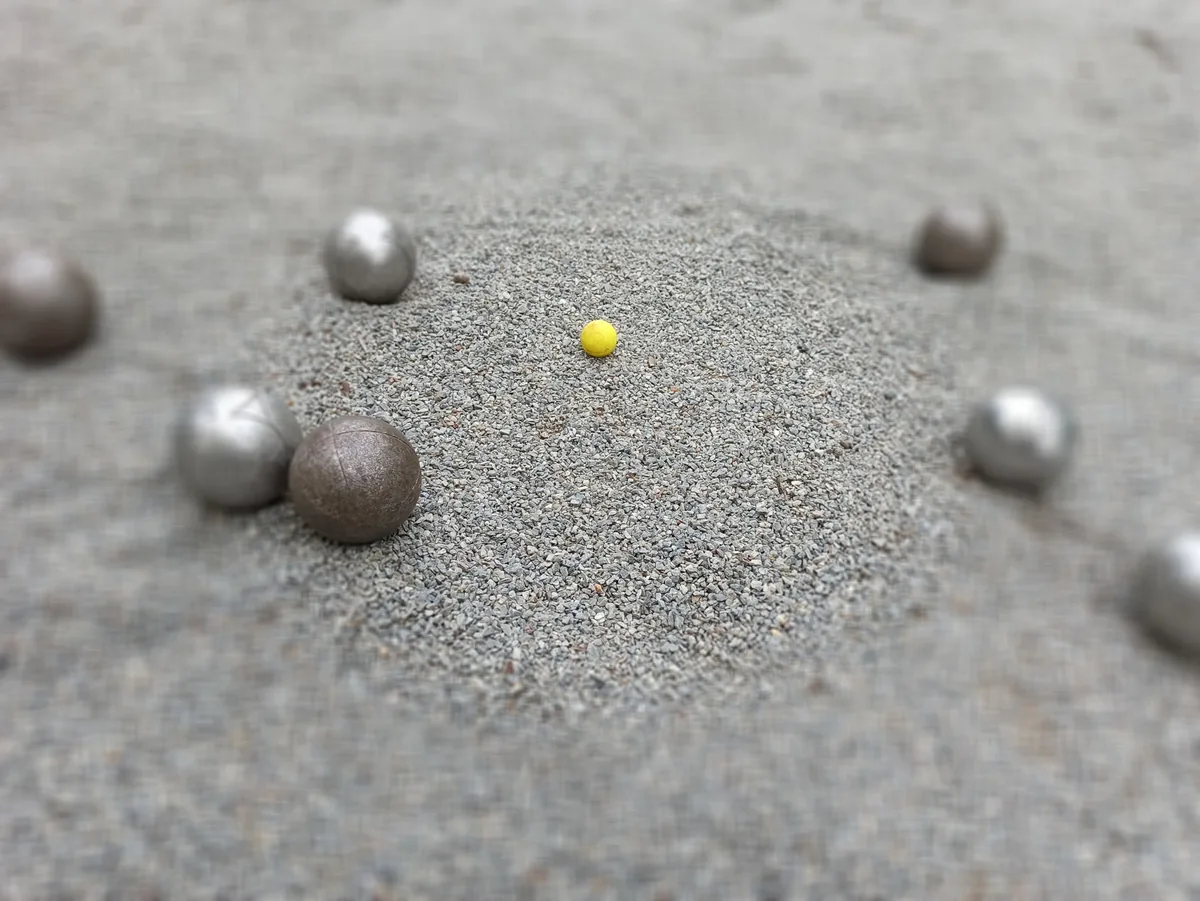
What happens if the jack goes out of bounds?
When the jack goes out of bounds during an end, it is dead, and Article 14 of the FIPJP rules sets out three cases: if both teams still have boules, or if neither has any, the end is void; if only one team still has boules, it scores as many points as it has boules left.
| Boules left to play | Result | Who throws the jack next |
|---|---|---|
| Both teams | The end is void, no points | The team that scored the points in the previous end, or that won the draw |
| Only one team | It scores as many points as it has boules in hand | The team that has just scored |
| Neither team | The end is void, no points | The team that scored the points in the previous end, or that won the draw |
Shooting the jack: a permitted shot
Deliberately knocking the jack out of bounds is allowed, and it is sometimes the best shot, since Article 14 applies whatever the intention. Take a game of triples where team B is holding 3 points but has no boules left in hand, while team A still has 3. If A’s shooter knocks the jack out with their first boule, A scores 2 points for the boules it still has in hand, instead of letting B score 3 points.
The boule that knocked the jack out does not count: only the boules still to be played after the shot count. It is a detail people often forget when counting.
When is the jack dead?
The seven cases in Article 9, from an out-of-bounds area to a lost jack
When is the jack dead?
The seven cases in Article 9, from an out-of-bounds area to a lost jack
The jack is dead in the seven cases listed in Article 9 of the FIPJP rules:
- it goes into an out-of-bounds area, even if it then comes back onto the authorised playing area;
- once moved, it is no longer visible from the circle, unless it is only hidden by a boule;
- it is moved to more than 20 metres from the circle, 15 metres for younger players, or to less than 3 metres;
- on marked lanes, it crosses more than one neighbouring lane, or crosses the end line of the lane;
- it cannot be found after five minutes of searching;
- an out-of-bounds area lies between it and the circle;
- in a time-limited game, it leaves the designated playing area.
A jack straddling the boundary remains valid: it is only dead once it is entirely beyond the boundary, viewed from directly above (Article 9). A jack moved by a boule played in the same game stays valid where it stops, whereas a jack moved by the wind, a spectator or an object from another game is put back in its place, provided it was marked (Article 12).
When is a boule dead?
A boule is dead as soon as it goes entirely into an out-of-bounds area, under Article 19; if it is straddling the boundary, it remains valid. If it comes back into play, sent back by the slope or by an obstacle, it is removed, and anything it has moved is put back in place, provided those objects had been marked.
A dead boule must be removed immediately: if the opposing team plays a boule first, it is considered live (Article 19). A boule accidentally stopped or deflected by a player from its own team is also dead (Article 20). On the other hand, a boule that goes onto the neighbouring lane remains valid, unless it crosses more than one lane or crosses a dead-ball line (Articles 18 and 19).
Terrain, boules and jack: what do the rules say?
Petanque is played on any surface, under Article 5 of the FIPJP rules; a marked terrain measures at least 15 × 4 metres for national championships and international competitions, and never less than 12 × 3 metres elsewhere. Boules are made of metal, 70.5 to 80 mm in diameter and 650 to 800 grams in weight (Article 2).
| Item | What the rules say | Article |
|---|---|---|
| Marked terrain | At least 15 × 4 m for national championships and international competitions; at least 12 × 3 m in other competitions, where the federations permit | 5 |
| Barriers around the terrains | At least 1 m from the outer lines | 5 |
| Boules | Metal, hollow, 70.5 to 80 mm and 650 to 800 g, with the manufacturer’s mark and the weight engraved, approved by the FIPJP | 2 |
| Boules for players aged 11 and under | 600 g and 65 mm allowed in their competitions | 2 |
| Jack | Wood, or an approved synthetic material, 30 mm (± 1 mm) and 10 to 18 g | 3 |
| Prefabricated circle | Rigid, 50 cm internal diameter (± 2 mm), or a folding circle approved by the FIPJP | 6 |
The strings separating the lanes are not dead-ball lines, except for the end lines of the lanes and those marking the outside of the playing area (Article 5). On an open terrain with friends, agree before the game on the limits beyond which a boule or the jack is out: you will avoid plenty of arguments. For beginners, Jean-François recommends a fairly smooth terrain, without too many obstacles.
Using a boule that has been tampered with, filled with lead or sand, or re-tempered to change its hardness leads to the immediate disqualification of the player and their partners (Articles 2 and 2a). Leisure boules are fine for playing with friends, but only approved boules are allowed in competitions. To choose the right diameter and weight for your hand, follow our guide to choosing petanque boules.
A painted jack is allowed, but it must not be possible to pick it up with a magnet (Article 3). A light-up jack, handy for evening games with friends, is only allowed in competitions if it is approved by the FIPJP, like any synthetic jack.
The rules set limits; within them, you choose the diameter, weight and hardness of your boules to suit your hand and your position. The “Fundamentals” module of our programme goes over equipment and the basic rules, choosing your boules and how to hold the boule, all on video.
Friendly game or competition: what changes?
The rules of the game are the same in a friendly game and in a competition, but an official competition adds an umpire, a licence, approved boules, a strictly timed minute to play, card penalties and a regulation dress code. Among friends, these things are settled amicably, preferably before the first end.
| Aspect | Friendly game | Official competition |
|---|---|---|
| Licence | Not needed | Required to register (Article 4 of the FIPJP rules); digital, via a QR code, in France (Article 3 of the 2026 FFPJP rules) |
| Boules | Leisure boules are fine | Boules approved by the FIPJP (Article 2) |
| Circle | Drawn, 35 to 50 cm | The organiser’s circle if one is provided, otherwise a regulation drawn or rigid circle (Article 6) |
| Time to play | No limit | 1 minute per boule and for throwing the jack (Articles 7 and 21) |
| Umpiring | Settled amicably | An umpire, whose decision on measuring is final (Article 26); complaints must be made to the umpire before the game ends (Article 31) |
| Penalties | None | Yellow, orange and red cards (Article 35) |
| Dress | Up to you | Correct dress and enclosed shoes (Annex VII of the FFPJP rules) |
| Smoking and phones | Allowed | No smoking on the lanes, electronic cigarettes included, and no phone use during games (Article 39) |
| Lateness | No consequence | 1 penalty point after a quarter of an hour, then 1 point per 5 minutes; team eliminated after 30 minutes (Article 32) |
The one-minute rule
The minute to play starts as soon as the jack or the previously played boule stops, or as soon as the measuring is finished if a point had to be measured, under Article 21. Going over the time limit earns the whole offending team a yellow card, and a player who has already been shown a yellow card loses a boule, in the current end or the next one (Article 35).
The umpire’s cards
Yellow, orange, red: the scale of penalties in Article 35
The umpire’s cards
Yellow, orange, red: the scale of penalties in Article 35
Article 35 of the FIPJP rules sets out a scale of penalties, applied by the umpire once an infringement has been observed:
- the yellow card: an official warning;
- the orange card: disqualification of the boule played or to be played;
- the red card: exclusion of the offending player for the game;
- beyond that, disqualification of the team at fault, or of both teams in the event of complicity.
So the red card excludes the player for the game in progress, not for the whole competition: exclusion from the competition falls under Article 39, for bad behaviour or violence. A simple reminder of the rules at the start of a game does not count as a warning (Article 35).
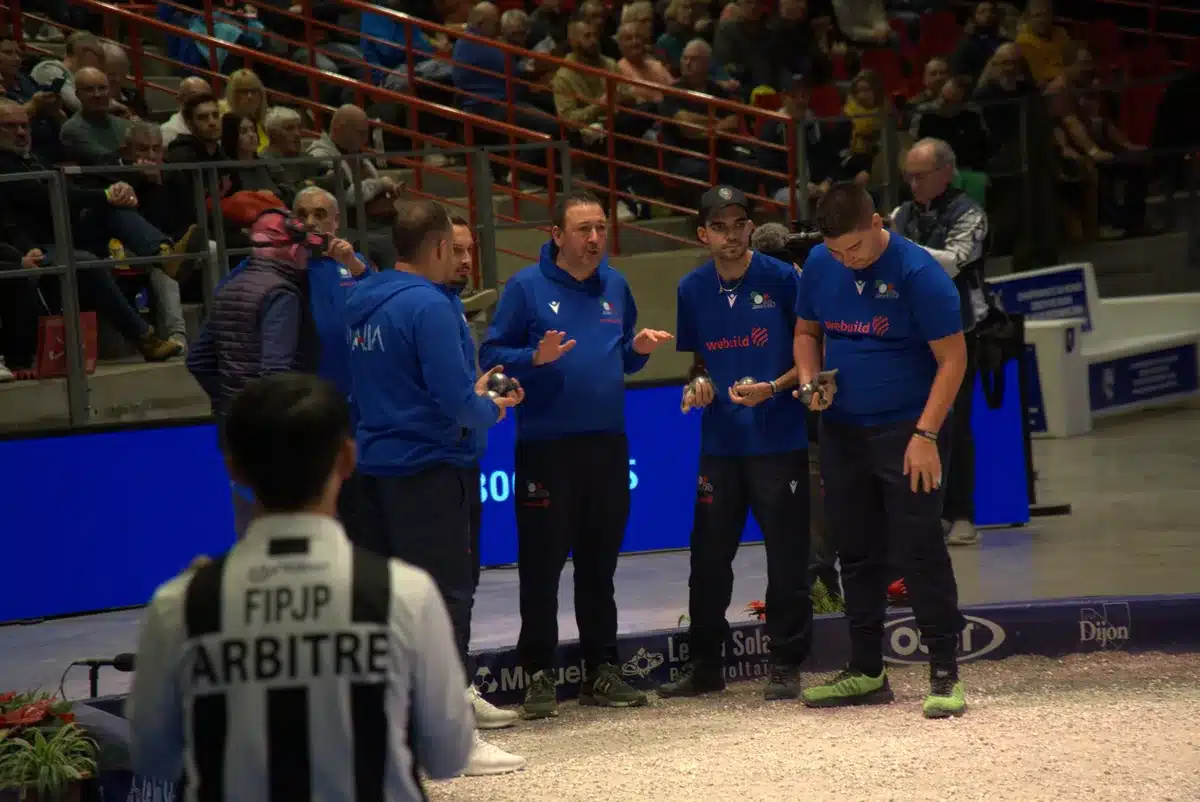
What are the new petanque rules in 2026?
The rules of the game have not changed in 2026: the FIPJP rules in force date from December 2020. What is new comes from the FFPJP’s 2026 administrative and sporting rules, which govern competitions in France: a digital licence via a QR code, more detailed rules on competition dress, and the end of the PASS CONTACT.
On 13 October 2026, we compared the texts in force on the FIPJP and FFPJP websites with the 2023 version of the federation’s rulebook. Here is what really changes, and what does not.
The rules of play: unchanged since December 2020
The rules of play published by the FIPJP end with a note that they were approved by the Executive Committee in December 2020: distances, the circle, scoring, measuring, the minute to play and the cards have not changed since. This is the text the FFPJP applies in France.
Several pieces published in late 2025 present the ban on sweeping as new for 2026. Yet it already appears in Article 10 of the 2020 text, which forbids pressing down, displacing or crushing any obstacle on the playing area, and in particular penalises sweeping in front of a boule to be shot. Umpires may apply it more strictly, but we have found no change to this article in the official texts.
The same Article 10 allows two actions: testing the landing point with one of your boules (tapping the ground no more than three times), and filling in a hole left by a previously played boule, which the player about to play or one of their partners may do.
What really changes: the 2026 federation rulebook
Compared with its 2023 version, the FFPJP’s 2026 administrative and sporting rules bring these changes (quotations translated from the French):
- the licence goes digital: “The Licence is digital, in the form of a QR code that includes the licence number.” (Article 3); it keeps the same number and must be validated every year;
- competition dress is set out in more detail in Annex VII, described below;
- the PASS CONTACT, a one-day licence for a promotional competition, has disappeared from the text;
- on the umpiring side, the age limit of 65 for becoming a candidate umpire has been removed, with an annual medical check-up beyond the age of 65.
Competition dress under Annex VII
Annex VII of the FFPJP rules requires correct dress in competitions, covering tops, bottoms, shoes and accessories. The 2026 text includes these points in particular:
- no clothing with holes, graffiti, studs, sequins, loud multicoloured patterns, patches, cuts or tears;
- no eccentric outfits, swimwear or fancy dress, and no vest tops or vests that leave the shoulders bare;
- shoes enclosed on top, at the front and at the back, so no slippers or flip-flops;
- “Leggings, dresses and skirts are not permitted”, leggings being the 2026 addition;
- a new sentence: “Trousers and jeans are forbidden.”
We quote this last sentence as it appears in the text, translated word for word, without interpreting it. The safest option is to come in sportswear and check with the organiser or your club before a competition. To choose a polo shirt that complies, see our guide to Shilton petanque clothing. It is the competition jury that has the final say on dress, and the umpire alone who rules on shoes, up to and including disqualification of the team.
The 4 rule mistakes we see most often
On our coaching courses and in competitions alike, the mistakes and disputes we see most often involve four rules: feet in the circle, the unmarked jack, measuring the point, and the jack or a boule going out of bounds. Knowing them spares you lost points, cards and plenty of arguments.
We come across them with players of every level on our petanque coaching courses, in Nantes as well as in Geneva, with Jean-François, our FFPJP-qualified coach.
1. Feet and the circle
Treading on the edge of the circle, lifting a foot before the boule touches the ground, or placing your circle too close to an obstacle: these three faults come up all the time. The rules are clear: feet entirely inside the circle, not encroaching on it, on the ground until the boule touches the ground, and the circle at least 1 metre from any obstacle (Articles 6 and 7). In competitions, the fault can earn you a card under Article 35.
The right habit: check where the circle is before throwing the jack, and keep your feet planted until the boule touches the ground.
2. The unmarked jack
A jack or a boule that moves without having been marked can no longer be put back in place, and no claim is accepted (Articles 6 and 22). The right habit: mark the jack as soon as it is thrown and every time it moves, then mark the boules that count.
3. Measuring the point
Measuring disputes come up in three situations: working out who holds the point, measuring during the end, and touching a boule while measuring. During the end, measuring tells you which team has to play, and the next player’s minute only starts once the measuring is done (Article 21). But a team whose player moves the jack or a contested boule while measuring loses the point (Article 28).
The right habit: have one measuring instrument per team, as Article 26 requires, move slowly, and call the umpire if in doubt.
4. The jack or a boule out of bounds
When the jack goes out, the confusion is between a void end and points for the team that still has boules: the end is only void if both teams, or neither, still have boules to play (Article 14). For a boule that goes out, remember that it must be removed immediately, otherwise it becomes live again as soon as the opponent plays (Article 19).
These mistakes often come down to haste or the tension of the moment. The same routine before every boule, from stepping into the circle to the release, helps you follow the rules without thinking about it, and stay calm when a dispute breaks out. The “Mental preparation” module of our training programme covers exactly that: performance routines, focus and managing your emotions.
Frequently asked questions
Petanque or boules: what’s the difference?
In Britain, petanque is often simply called “boules”, or “French boules”. Strictly speaking, though, it is one of several games played with boules: in petanque, you throw with your feet planted in the circle, whereas in jeu provençal the player takes a run-up.
Can you play petanque on grass?
Yes. Article 5 of the FIPJP rules states that petanque is played on any surface, so grass is fine. In a competition, however, the organising committee or an umpire can require the teams to play on a marked terrain.
Can you hit the jack?
Yes. You may shoot the jack, and even knock it out of bounds on purpose, since Article 14 applies whatever the intention. It is sometimes the best shot: you’ll find an example in the section “What happens if the jack goes out of bounds?”, further up this page.
Why is petanque played to 13 points?
The FIPJP rules set the game at 13 points (Article 5), without explaining why, and allow league games and qualifying heats to be played to 11 points. This score leaves room for sudden turnarounds, since a team can score up to 6 points in a single end.
Where can you find the official rules of petanque as a PDF?
The rules of play can be downloaded from the FIPJP website: they are the official rules for the sport of petanque (opens in a new tab), approved in December 2020 and still in force. The texts specific to French competitions, including the 2026 administrative and sporting rules, are gathered on the FFPJP’s official rules and texts page (opens in a new tab) (in French).
How can you learn petanque in 10 lessons?
Learning petanque follows a logical order: know the rules, choose your boules, take your position in the circle, throw, point, read the terrain, shoot, then practise methodically. We set out this 10-step path in our article on learning petanque and improving your game.
Play by the rules, then improve your game
The rules of petanque are quick to learn, and the rulebook sums them up in a few figures: a jack between 6 and 10 metres, feet in the circle until the boule touches the ground, and 13 points to win. Knowing them inside out, from marking the jack to measuring the point, spares you lost points and leaves your mind free to enjoy our wonderful game. The next step happens on the terrain: your throw, your choices and your mental game, which our training programme helps you build at your own pace.
This programme is not sports instruction within the meaning of the French Sports Code. It is informal educational support, designed to enrich your personal practice of petanque, with no individual supervision and no qualification awarded.
Your next read
How to progress in petanque: training, technique and the mental game
Now you know the rules, here is the 10-step path to learning petanque: choose your boules, take your position in the circle, throw, point, read the terrain, shoot, then practise methodically.