
11 min read
Whether you point standing or crouching in petanque comes down to balance versus seeing the ground: you stay standing, more stable, when the jack is over 8 metres away; you crouch to see the bumps better when it is about 6 metres away. A 10-throw test will settle it.
ContentsShow contents9 parts
- Should you point standing or crouching in petanque?
- Why point crouching?
- Why point standing?
- Which position should you choose for the terrain and the distance?
- Knees, age, balance: can you point well standing?
- How do you set yourself up crouching in the circle?
- How do you find your pointing position?
- Frequently asked questions
- Standing or crouching: the key points
Should you point standing or crouching in petanque?
Standing, you gain stability; crouching, you read the terrain better, but you lose balance. Neither position is best for everyone: whether you point standing or crouching in petanque depends on the distance to the jack, the type of terrain and your physical condition. Jean-François, our coach, says so in our programme: standing or crouching, it is the player who chooses their position.
The rules do not decide for you either: they set where your feet go, not how low your body is. According to the official FIPJP rules (opens in a new tab), applied in France by the FFPJP, your feet stay entirely inside the circle, without treading on the line, and only leave it once the boule has touched the ground. No other part of your body may touch the ground outside the circle. The jack (the small target ball), for its part, is thrown between 6 and 10 metres from the circle, as our guide on how far you throw the jack in petanque explains: within those limits, it is the distance that guides your choice.
In the “Pointing” module of our programme, Jean-François gives two simple guidelines. You generally point crouching when the jack is close to 6 metres, on fast terrain where the boule runs a long way. You tend to point standing when the jack is more than 8 metres away, on soft and deep terrain, where the boule rolls less. Between 6 and 8 metres, the choice is yours.
6metres, a close jack: you readily crouch
8metres, beyond which you generally stay standing
10metres, the furthest the jack may be thrown
| Criterion | Standing | Crouching |
|---|---|---|
| Balance | More stable, feet firmly grounded | Less stable, heels raised |
| Reading the terrain | Higher view | Eyes close to the ground, hollows and slopes easier to see |
| Distance | Beyond 8 metres | Close to 6 metres |
| Terrain | Soft and deep | Fast |
| Throw | The most natural throw | Lower, softer, shorter |
| Effort | Spares your legs | Takes coordination and muscle tone |
Knowing how to point in petanque is not just about position: your grip, the swing of your arm and your choice of landing spot, the place where the boule touches down, matter just as much. These are covered in our petanque technique articles.
Why point crouching?
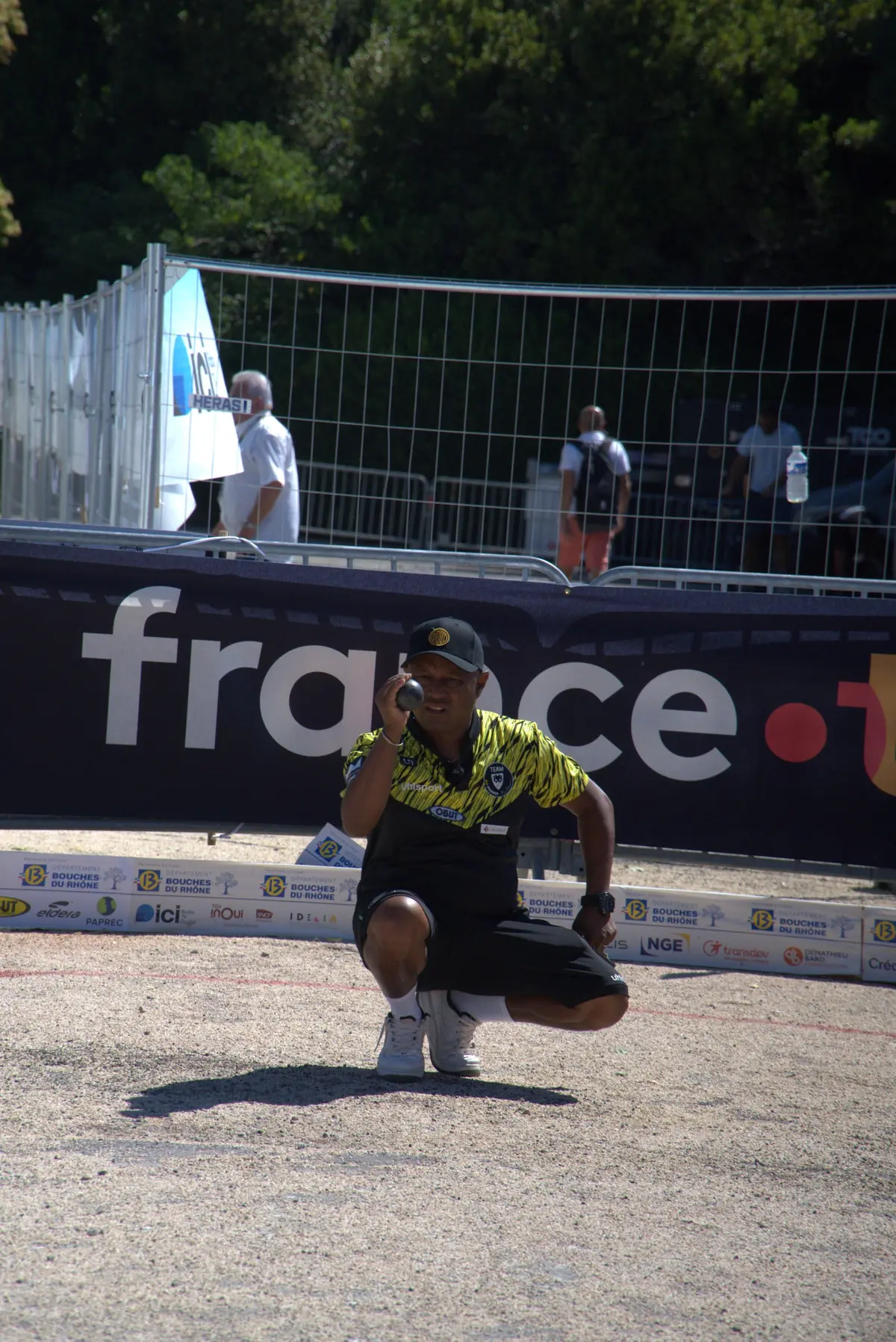
Crouching to point does two things: it helps you read the terrain and lets you throw gently to a close jack. Your eyes drop close to the ground and pick out hollows, bumps and side slopes, the sideways tilts in the ground that push the boule off line. For the throw itself, Jean-François explains in our programme that you crouch to throw lower, softer and shorter than when you stand.
The rolling point and the gliding point are mainly played crouching: in both cases, the boule lands 2 or 3 metres from the circle, then rolls to the jack. The rolling point remains effective on smooth, hard ground such as packed earth or tarmac.
The price is balance. Crouching, heels raised, you are less stable: holding the position takes coordination as you bend your legs, and good muscle tone. A boule thrown while your body sways rarely goes where you wanted it.
Why point standing?
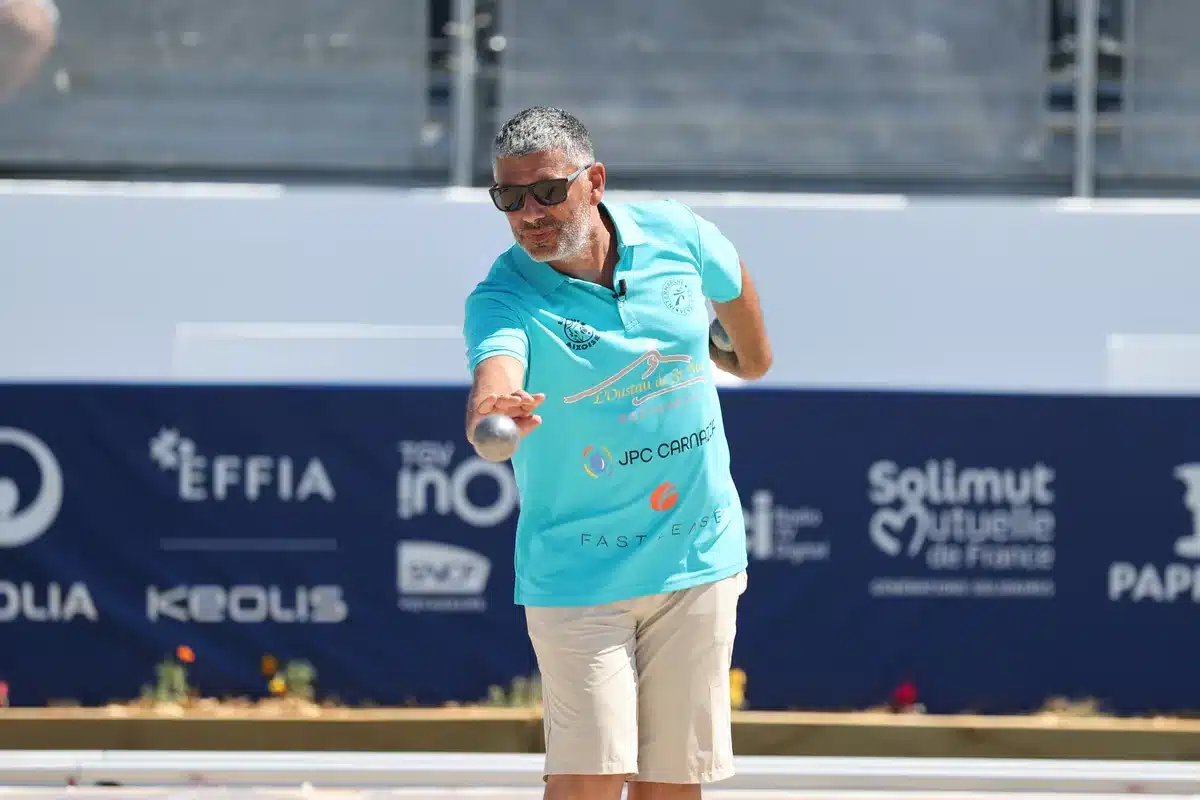
Pointing standing up means choosing the most stable position: with both feet firmly grounded, your body keeps its balance and your arm more easily finds the power it needs over long distances. It is the recommended position when the jack is more than 8 metres away and on soft, deep terrain.
The high lob is also played standing in most cases. It is the hardest technique to control: the boule travels almost all the way through the air and lands about 1 metre from the jack, Jean-François reminds us in the “Pointing” module. It is ideal on sandy, heavy or waterlogged terrain. If you play it crouching, it is mostly at under 8 metres, and you need strong, supple legs to rise during the throw and finish it standing, body fully upright.
Few players manage the crouching high lob consistently, which is why Jean-François advises working on it standing. Yet he cites Michel Loy, who plays it in both positions with great mastery, so this advice is no hard-and-fast rule: it mainly tells you where to start.
Which position should you choose for the terrain and the distance?
The right position depends on the way of pointing that the terrain calls for: on fast ground, you play the rolling point crouching; on heavy ground, you play the high lob generally standing; the half-lob, for its part, is played in whichever position you choose. Distance then refines the choice: at around 6 metres, you readily crouch; beyond 8 metres, you stay standing.
| Technique | Where the boule lands | Terrain | Recommended position |
|---|---|---|---|
| Rolling point and gliding point | 2 or 3 metres from the circle | Smooth and hard: packed earth, tarmac | Crouching |
| Half-lob | Halfway to the jack | Almost any, it is the most versatile | Whichever you are most comfortable in |
| High lob | About 1 metre from the jack | Sandy, heavy, waterlogged | Standing; crouching possible under 8 metres |
The half-lob, where the boule lands halfway and then rolls, is the most widely played technique, because it adapts to almost any ground. To play it, Jean-François leaves the choice to you: take up whichever position in the circle feels most comfortable, crouching or standing, whether you throw the boule higher or lower.
How do you point well on stony terrain?
When pointing on stony terrain, leave the rolling point aside: lift the boule in a half-lob or a high lob, most often standing, so that it clears the stones and only lands on a clean, flat landing spot. In the “Pointing” module, Jean-François sums it up like this: on irregular, soft or stony ground, you need to vary your game.
On sharp gravel firmly set in the ground, a boule thrown too high risks digging in or being knocked off line. Some players then use the skidding point: the boule leaves low and lands within the first third of the distance, with strong backspin to stop it sooner. Few players master it. Before you play, the rules allow you to fill in a hole made by a boule played previously, but never to crush or move a stone (Article 10).
To see these techniques in motion, the “Pointing” module of our training programme devotes a video to each one, from the rolling point to the high lob. You see the half-lob and the high lob played crouching, then standing.
Knees, age, balance: can you point well standing?
Yes, you can point very well standing, and it is even Jean-François’s choice for the high lob. If your knees or your thighs can no longer cope with crouching, or if it unbalances you, nothing forces you to crouch: the rules impose no position, and the half-lob, the most widely played technique, works just as well standing.
Between standing and crouching, there is an intermediate position. If you lack balance or muscle tone, Jean-François recommends a half-crouch, with your legs half bent, before working on the full crouch. It is a good halfway house for players who want to keep their eyes lower without bending their legs all the way. And if knee pain keeps coming back, talk to your doctor rather than forcing the position.
You can also work on the crouching position away from the terrain, because it relies on the strength of your thighs. The “Physical preparation” module of our online programme offers an equipment-free lower-body routine, with squats and lunges, to do at your own pace. For more exercises to do at home, in winter or on days without a terrain, read our article on petanque training at home.
The rules also provide for exceptions for players with disabilities. Under Article 6 of the FIPJP rules, a player disabled in the lower limbs may place only one foot inside the circle, as long as the other foot is not in front of it. A player in a wheelchair keeps at least one wheel inside the circle, the one on the side of the throwing arm.
How do you set yourself up crouching in the circle?
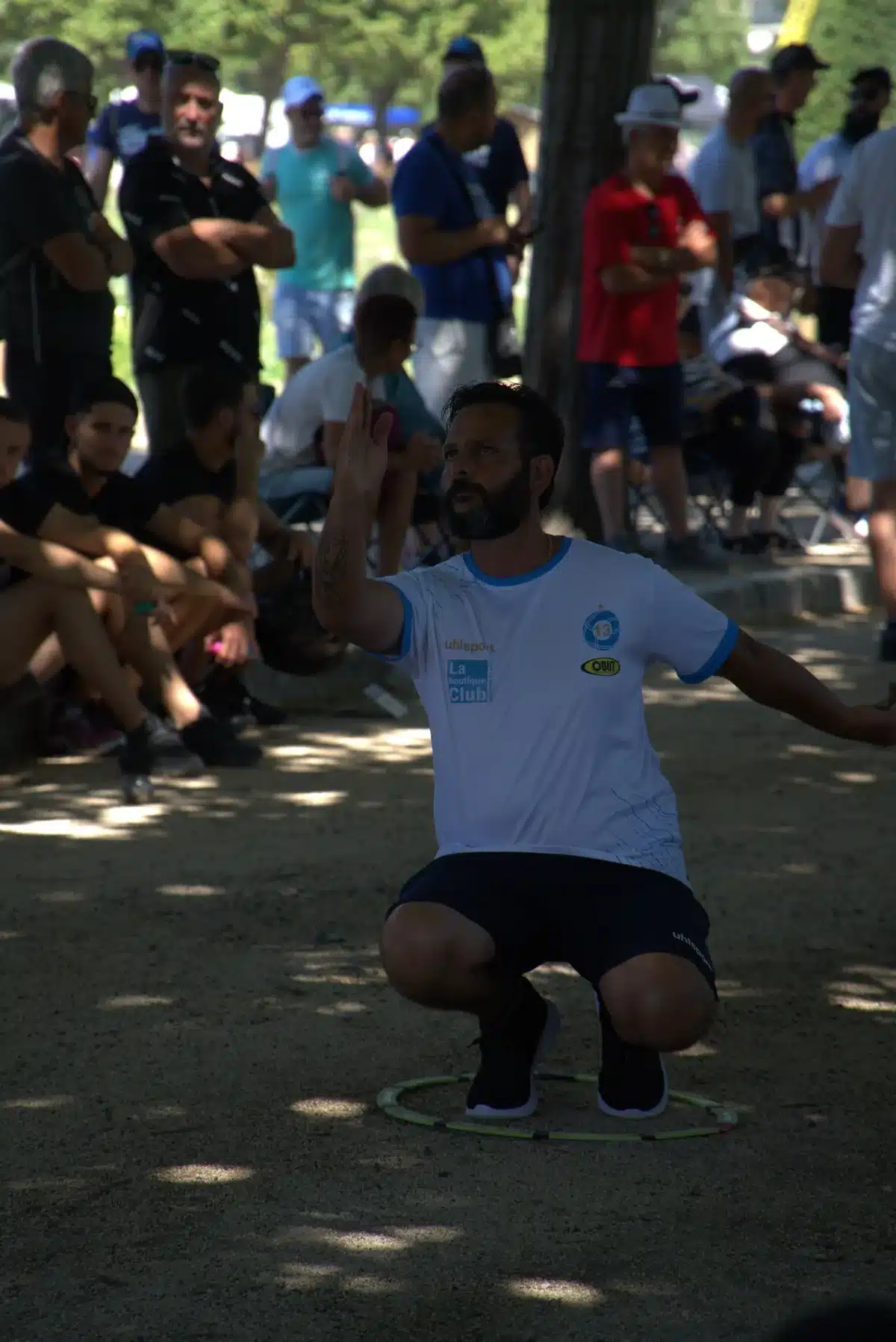
Crouching, find your balance before the throw: heels raised, upper body and shoulders straight, and your non-throwing arm held in line with your shoulders as a counterweight. Rather than spreading your knees, turn your thigh towards your throwing-arm side and put your weight on that side: your swing, the to-and-fro of your arm, then stays on the line of play.
Some players even pull back the foot on the throwing-arm side: this is known as a “reversed feet” stance, and it stops the knee getting in the way of the swing coming back through.
When pointing, your arm goes back only a little. A good pointer keeps a short backswing and relies more on bending the legs as the arm comes forward, to stay stable. In a video on our channel, Jean-François shows this to a player on a coaching course: the best pointers stop their arm early on the backswing, and it is the knees that do the work.
How do you find your pointing position?
The best pointing position is found on the terrain, by comparing: at the same distance and on the same landing spot, play a few boules crouching then a few standing, and keep the position that leaves the most boules close to the jack. This is the practical way to apply Jean-François’s criterion: play in the position in which you are most comfortable.
Run the test at two distances, because the winning position often changes between a jack at 6 metres and a jack at 9 metres. Jean-François’s guidelines point the same way: you tend to crouch for a close jack on fast ground, and to stay standing for a distant one. But if you place your boules better standing at every distance, stay standing: results matter more than theory.
Whatever position you play from, crouch to read the terrain. Jean-François recommends it before every point: look first while crouching in the circle, then while crouching behind the jack, facing the circle, to spot stones, thicker patches and side slopes. If you point standing, you then simply stand up to play.
Frequently asked questions
Can you shoot crouching in petanque?
Yes, you can play a crouching shot, mainly at short range: Jean-François keeps it for jacks close to 6 metres, for example for a running shot (the boule rolls before hitting the target), and advises shooting standing beyond 8 metres. For shooting, the standing position remains the benchmark. Foot placement, the throw and how a shooter aims are covered in detail in our guide to shooting in petanque.
What is the difference between a pointer and a shooter?
The pointer places their boule as close as possible to the jack or in an area chosen by the team; the shooter hits an opponent’s boule, or the jack, to knock it away. In triples (three players per team), the pointer is the player assigned to that role: they play the first boule of the end, in other words the round, standing or crouching, and Jean-François expects stamina, finesse and a sharp eye for observation from them. Experienced players often consider pointing harder than shooting, Jean-François reminds us.
How do you point with spin?
When pointing with spin, you can call on two families of spin. Backspin slows the boule down: you cock your wrist as you draw your arm back, then release the boule from your fingertips, which makes it spin backwards and stop sooner. Right-to-left and left-to-right spin are used to get round an awkward boule and are covered in the “Pointing” module.
Which boule and what weight should you choose for pointing?
Pointers generally choose a slightly smaller, heavier, dense and grooved boule (with lines cut into its surface), which holds its line on side slopes and stops sooner. As for weight, the FIPJP rules allow anything from 650 to 800 grams, and many pointers choose a boule of 700 grams or more. For choosing by hand size, see our guide to choosing petanque boules.
Standing or crouching: the key points
To choose whether to point standing or crouching in petanque, look first at the terrain and the distance, then listen to your body. Crouching, you read the terrain better and play close jacks better on fast ground; standing, you gain stability for long distances and the high lob; in a half-crouch, you find a middle way if your balance lets you down. The right position is the one that keeps you stable from the start to the end of the throw. Our training programme then takes you further, technique by technique, so that every point becomes a reliable throw in our wonderful game.
This programme is not sports instruction within the meaning of the French Sports Code. It is informal educational support, designed to enrich your personal practice of petanque, with no individual supervision and no qualification awarded.
Your next read
How to progress in petanque: training, technique and the mental game
Pointing and shooting exercises to make your throw consistent, whatever your position.