

11 min read
The petanque circle rule lets you step out only once the thrown boule has touched the ground. Until then, both feet stay inside, without touching the edge, or you risk a card. If your foot leaves too early, check where your weight sits as your arm swings back.
ContentsShow contents8 parts
- When are you allowed to step out of the circle in petanque?
- What is the penalty for stepping out of the circle too early?
- Why does the umpire let it go?
- Why do shooters step through?
- How do you step out without a foot fault?
- Where does the feet-in-the-circle rule come from?
- Frequently asked questions
- Stay in the circle, then step through
 (the video plays on this page)
When are you allowed to step out of the circle in petanque?
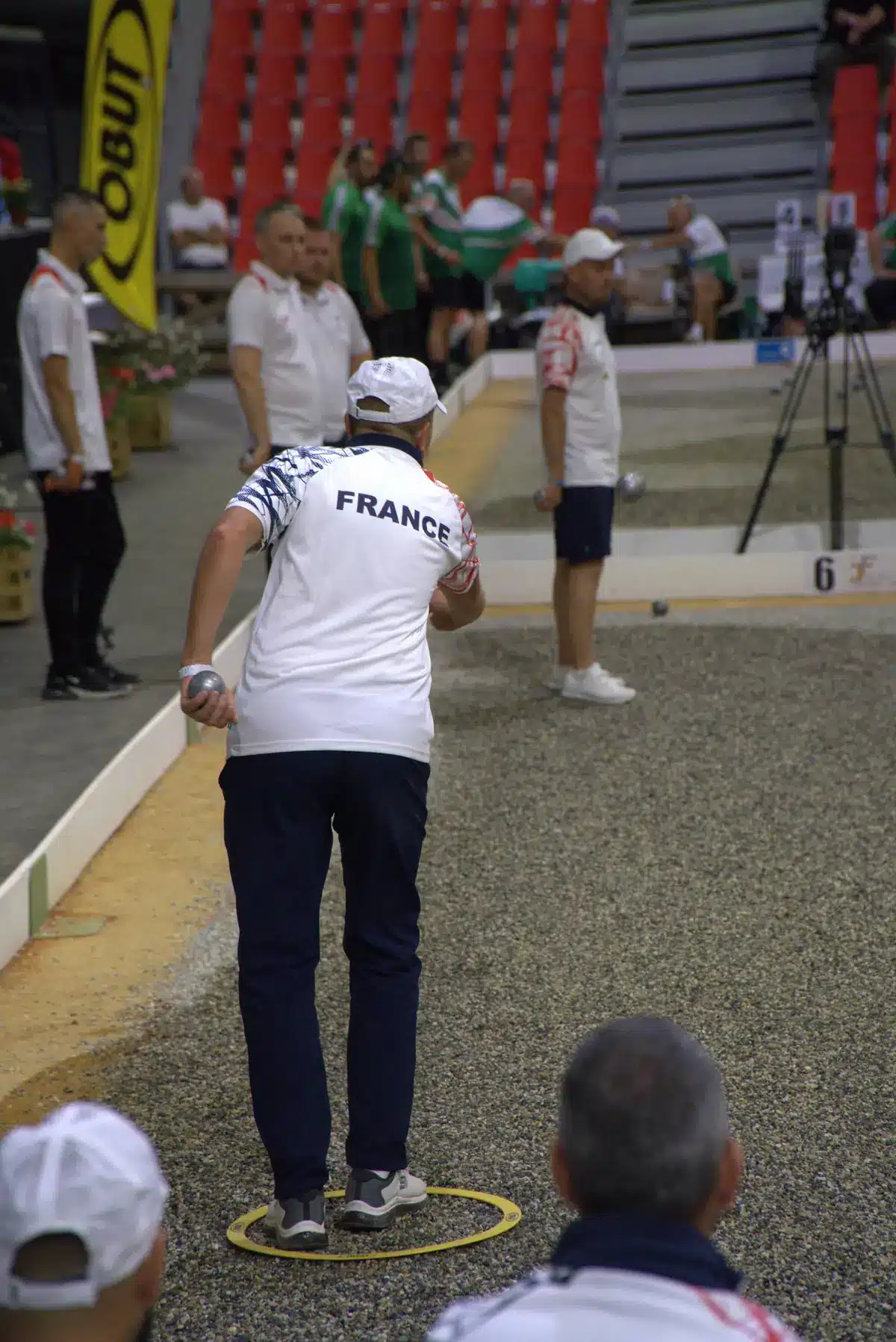
To step out of the circle without breaking the petanque circle rule, you have to wait until the thrown boule has touched the ground, not before. Until then, both of the player’s feet stay entirely inside, planted on the ground, without encroaching on the circle (putting a foot on its edge), and no other part of their body touches the ground outside.
This rule is set out in Article 6 of the official FIPJP rules (opens in a new tab): this is the international federation’s text, and the French federation (FFPJP) applies it in France. The passage is worth reading word for word: “The players’ feet must be entirely on the inside of the circle and not encroach on its perimeter and they must not leave it or be lifted completely off the ground until the thrown boule has touched the ground.” The next sentence adds: “No part of the body may touch the ground outside the circle.”
A circle drawn on the ground measures 35 to 50 cm across; a rigid circle, which you lay down on the ground, has an internal diameter of 50 cm. Either way, it must be placed more than 1 metre from any obstacle (same article). It must also be at least 1.5 metres from another throwing circle in use or from the jack of another game. How a game unfolds, from the draw to scoring each end (each round), is explained in our guide to the rules of petanque.
35to 50 cm for a drawn circle
50cm for a rigid circle
1metre at least from any obstacle
Is lifting your heel a fault?
Lifting your heel is not a fault: the rules forbid a foot that leaves the circle or is lifted “completely” off the ground, not a foot rolling onto its toes. The rules of play say “feet”: they do not say whether a single foot lifted completely is enough to count as a fault. The precision shooting rules, which cover a separate event, settle it: a single foot lifted completely before impact earns a red card there, as we explain in our guide to precision shooting. In a game, the safest course is to keep both feet in contact with the ground until impact.
What about a direct hit?
When you shoot for a direct hit, the boule strikes the target boule directly, without touching the ground first. The rules of play only refer to the moment the boule touches the ground and say nothing about this case. The precision shooting rules, for their part, count impact “on the ground or the target”. If in doubt, wait until the boule has come down before letting your foot go.
Who places the circle, and where?
In the first end, any member of the team that won the draw chooses the starting point, then draws or places the circle (Article 6). If the organisers provide regulation circles, both teams must use them. In all cases, the circle is marked before the jack is thrown.
In the following ends, the team that won the previous end throws the jack. The circle is then placed around the spot where the jack lay when that end was over, with some exceptions, such as an obstacle too close by (Article 7). For juniors and seniors, the thrown jack must end up 6 to 10 metres from the inside edge of the circle.
What is the penalty for stepping out of the circle too early?
A shooter who steps out of the circle before their boule touches the ground incurs the graduated penalties in Article 35 of the FIPJP rules (opens in a new tab): a warning, disqualification of the boule, then exclusion for the game. Each penalty takes the form of a card, which only an umpire can show.
| Card | What it means | What happens to the boule |
|---|---|---|
| Yellow | Official warning | It stays in play |
| Orange | Disqualification of the boule played or to be played | It is disqualified |
| Red | Exclusion of the player for the game | The player takes no further part in the game |
Two misconceptions keep coming up about what happens to the boule, and the rules correct both of them:
- The boule is automatically disqualified On our Facebook Page, the most liked comment in one debate on the subject said just that. Yet Article 24, under which a boule thrown contrary to the rules is dead, makes an exception for faults covered by the graduated penalties of Article 35. A foot fault is one of them, so the boule is not automatically disqualified.
- The boule is replayed That is wrong too, because “Any boule thrown cannot be replayed” (Article 16).
A foot that leaves too early therefore costs a card, or nothing at all if no umpire has seen it.
Why does the umpire let it go?
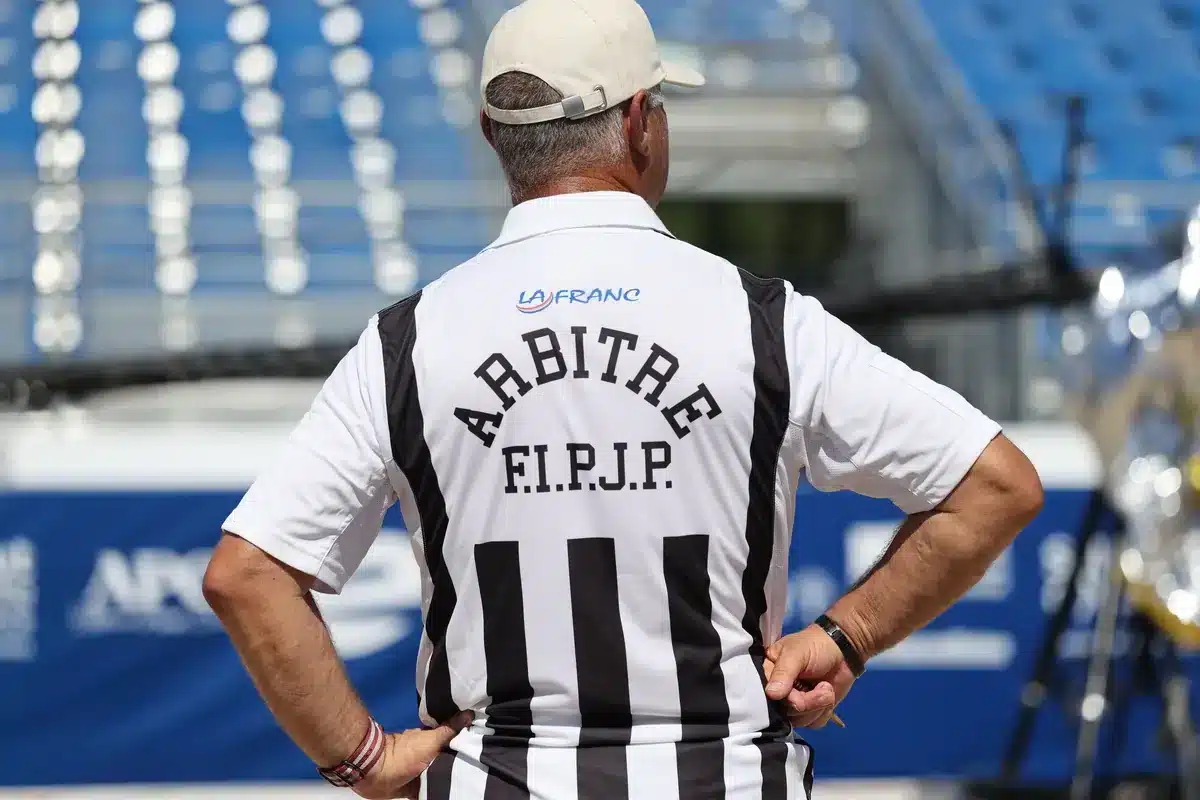
An umpire only penalises a fault they have seen for themselves. For the warning, the FIPJP rules (opens in a new tab) are clear: it “can only be given after an infringement of the rules” (Article 35). A foot out of the circle spotted on television, in slow motion or from the stands therefore counts for nothing if the umpire did not see it at the moment of the throw.
Under our videos, one comment sums up the problem: everyone watches the boule and never the player. At the moment of release, the opponents’ eyes, like the crowd’s, follow the boule, and a foot that goes a split second too early goes unnoticed.
A player who sees the fault can report it, but to the umpire, not to their opponent: “To be considered, any complaint must be made to an umpire” (Article 31). And once the game is over, the same article accepts no further complaints. A fault spotted afterwards, on a video, therefore changes nothing on the scoreboard. The other disputes that keep coming up in competitions, from a hand put down on the ground to a boule picked up too soon, are settled rule by rule in our article on petanque umpiring rules.
Why do shooters step through?
Shooters, men and women alike, “step through”, meaning they bring a foot forward out of the circle, because their body weight moves forward at the moment of release. This is weight transfer: it gives the shot its power and accuracy. When that weight reaches the front foot too early, the body is carried forward, and the foot leaves the circle before the boule has landed.
On French terrains, this is also called “taking the step”. Jean-François, our FFPJP-qualified coach and mental performance coach, describes this transfer in our programme. As the arm draws back, the weight rests on the back foot; as the arm comes forward, it moves from the back heel to the toes of the front foot, at the moment of release. When this transfer comes at the right moment, it helps you shoot straight more often, without forcing, even from a distance.
If the weight reaches the front foot too early, the player is thrown forward. Jean-François warns that it leads to a loss of balance and a tendency to step out of the circle, which is against the rules. Three game situations push you into stepping through too early:
- Forcing the shot: the harder you push, the more you tense up, and your upper body loses its balance.
- The running shot: in this shot, where the boule lands before reaching the target, the shooter leans further forward than for a direct hit.
- Shooting from long range: the boule stays in the air longer, giving the foot more time to go before impact.
The step itself is not a fault: it is part of the follow-through, and it becomes legal as soon as the boule has touched the ground. The “Stance” module of our training programme covers this weight transfer, the body offset (a slight lean of the upper body towards your throwing arm) and where to place your feet in the circle, with demonstrations.
How do you step out without a foot fault?
To step out without a foot fault, keep your weight on your heels as your arm swings back, let it move forward only at the release, and wait until the boule touches the ground before letting your foot come through. The step then comes after impact, as the natural end of the throw.
If you find yourself saying “I step out of the circle when I shoot”, start with the guidelines Jean-François gives in our programme, from your stance to the release:
- Before throwing, both feet are planted in the circle, flat, heels and toes on the ground.
- As the arm draws back, your weight is slightly back, on your heels, and your knees are unlocked, slightly bent, to absorb the energy of the release.
- At the release, your weight moves forward, and the arm not holding the boule balances your upper body, like a tightrope walker.
- After the release, your eyes stay on the target, and your foot only goes once the boule has landed.
Do not force your shot: forcing is what unbalances your upper body. Jean-François also recommends low-heeled shoes, so that you are not thrown forward at the release. To shoot without forcing, letting the power come from your legs and your arm swing, you will find all his guidelines in our article on how to shoot in petanque.
Where does the feet-in-the-circle rule come from?
The feet-in-the-circle rule was born with petanque itself. In 1907, in La Ciotat, Jules Lenoir, whose rheumatism stopped him taking a run-up in jeu provençal, is said to have started playing with his feet together in a circle drawn on the ground. That is where the name comes from: playing “pieds tanqués”, meaning “feet planted” on the ground.
In jeu provençal, players take a run-up: in our video on position in the circle, Jean-François recalls the “three steps” players take to throw their boule. Stepping through before impact, then, means briefly going back to what petanque set out to remove: the run-up.
Frequently asked questions
Can you put a hand or a knee down outside the circle?
No: Article 6 of the rules forbids any part of the body other than the feet from touching the ground outside the circle. When you crouch to point, your knee may touch the ground, provided it stays inside the circle. To get your position right when you crouch to point, see our article on pointing standing or crouching.
Does the rule apply in a friendly game?
The rules are the same for everyone, but without an umpire, no one can show a card. Among friends, agree on the rule before the game. Getting into the habit of waiting for impact now will save you a nasty surprise on competition day.
Does a disabled player have to keep both feet in the circle?
No. A player with a disability in the lower limbs may place only one foot in the circle, provided the other is not in front of it. A player in a wheelchair rests at least one wheel inside it, the one on the side of the throwing arm (Article 6).
Can you clear the inside of the circle?
Yes. You can clear the inside of the circle at any time during the end, to give you a steadier footing, but you must put it back in good order once the end is over (Article 6).
What happens if you pick up the circle before the end is over?
The circle is put back in place, but only the opponents are allowed to play their boules (Article 6). So before you pick up the circle, wait until every boule has been played.
Has the circle rule changed in 2026?
No. The rules of play in force are still those the FIPJP approved in December 2020, which the FFPJP applies in France. What is new in 2026 comes from the FFPJP’s administrative and sporting rules (the licence, competition dress), not from the rule on keeping your feet in the circle.
Stay in the circle, then step through
Remember the order of things: the boule touches the ground, then the foot leaves. The petanque circle rule does not ask you to freeze, only to wait for impact. A well-timed weight transfer makes that wait feel natural. To work on this throw with Jean-François, from your position in the circle all the way to shooting, our training programme is there for you, at your own pace.
This programme is not sports instruction within the meaning of the French Sports Code. It is informal educational support, designed to enrich your personal practice of petanque, with no individual supervision and no qualification awarded.
Your next read
Petanque rules: the complete, up-to-date guide
There you will find the rest of the rules, from the draw to scoring, and the other most common rule mistakes.