

17 min read
Petanque umpiring rules are those of the international federation (FIPJP), in force since December 2020: the umpire goes by that text, not by club habits. A shot many players think is banned is allowed, and an automatic gesture while counting can cost you the point.
ContentsShow contents11 parts
- Which rulebook has the final say in a dispute?
- Tied point: who plays again when two boules are level?
- Can you put your hand on the ground when pointing?
- Does a boule picked up before the end is over still count?
- Last boule played without measuring: who scores the point?
- Is the running shot forbidden in petanque? And sweeping before shooting?
- The jack comes back near the circle: is the end void?
- Red card: game lost or exclusion?
- How do you avoid disputes, with or without an umpire?
- Frequently asked questions
- Play by the rules, and keep a cool head
Which rulebook has the final say in a dispute?
For petanque umpiring rules, only one text has the final say: the official FIPJP rules (opens in a new tab), approved in December 2020 and still in force. The FFPJP applies them in France, and the umpire settles any dispute over play on that basis. The other official texts do not replace them: each has its own purpose.
| Text | What it covers | Useful for |
|---|---|---|
| Official FIPJP rules (December 2020) | The rules of play: circle, jack, measuring, dead boules, cards | Settling a dispute during the game |
| FFPJP umpiring guide (updated in 2022) | The umpire’s role, with the articles of the rules explained | Understanding a decision, becoming an umpire |
| FFPJP umpiring code | The umpire’s duties before, during and after the competition, and the rules specific to the jeu provençal | Knowing what the umpire must do |
| FFPJP’s 2026 administrative and sporting rules | Licences, age categories, competition dress | Knowing what is new in 2026 |
What people call the “new 2026 rules” are therefore not new rules of play: the digital licence and the new dress rules come from the administrative and sporting rules. The French federation’s texts are gathered on the FFPJP’s official rules and texts page (opens in a new tab), and you will find all our articles on the rules in our petanque rules and umpiring topic.
Beware, too, of old versions of the rules still circulating online: their articles are numbered differently. The dead jack case, for example, appears as article 13 in them, whereas it is article 14 in the December 2020 text. Throughout this page, we give the numbers from the text in force.
Tied point: who plays again when two boules are level?
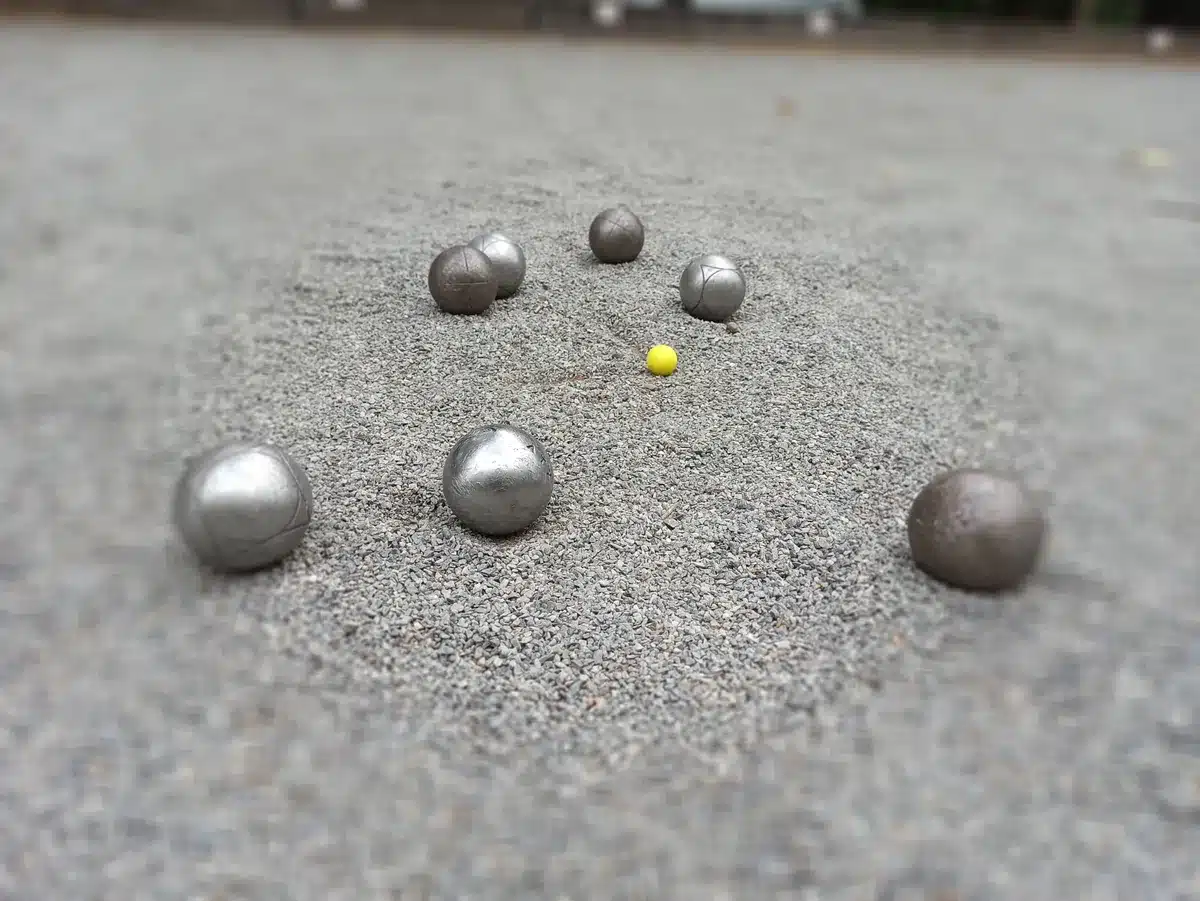
When the two boules closest to the jack, one from each team, are the same distance away and both teams still have boules to play, the team that played the last boule plays again. The other team then plays, and so on alternately, until one of the two teams takes the point. That is article 29 of the official FIPJP rules (opens in a new tab).
On a tied point, the question “who plays again?” comes up in the comments under several umpiring videos, a sign that the rule catches out plenty of players. The rules set out 3 cases, depending on the boules still in hand:
| Boules still to play | What happens | Article 29 |
|---|---|---|
| Both teams | The team that played the last boule plays again, then the other, alternately, until one team holds the point | 3rd case |
| One team only | It plays its boules and scores as many points as it has boules closer than the opponents’ best boule | 2nd case |
| Neither team | The end is dead: the jack goes to the team that scored the previous end, or that won the toss | 1st case |
3cases set out in article 29
2metres between the players and the umpire who is measuring
A tie is not decided by eye; it is established by measuring. The measuring falls to the player who played last or to one of their teammates, and the opponents always have the right to measure after them (article 26). In a competition, an umpire can be called at any time during the end: their decision is final, and while the umpire is measuring, the players must stand at least 2 metres away.
The next player has one minute to play, but that time limit only starts once the measuring is over (article 21), so take the time to measure properly. For scoring and how an end finishes, our guide to the rules of petanque covers everything in detail.
Can you put your hand on the ground when pointing?
Yes, you may put your hand on the ground when pointing, as long as it stays inside the circle. On this point, article 6 of the FIPJP rules forbids only one thing: touching the ground outside the circle with any part of the body other than the feet. A hand or a knee put down outside the circle during the throw is therefore an offence, subject to the penalties in article 35.
The question often comes from pointers who play crouching, and some are told at their club that it is not allowed. The exact text is clear, though: “No part of the body may touch the ground outside the circle.” In the “Stance” module of our programme, Jean-François, our FFPJP-qualified coach, reminds players of this text, adding that it applies during the throw.
The circle is 50 cm across at most: space is tight, and a player who needs support must put their hand down inside it, without going over the edge.
The same article makes an exception for players with a disability in a lower limb: they may place only one foot in the circle. For wheelchair players, it is enough for one wheel, the one on the side of the throwing arm, to rest in the circle.
In a competition, if an opponent objects, the umpire applies the text, and the simplest thing is to ask the umpire before the game. Article 6 also covers feet leaving the circle before the boule touches the ground. This forward step by the shooter, much discussed in the comments under competition videos, is a separate subject that we will cover in a future article.
Does a boule picked up before the end is over still count?
No, a boule picked up before the end is over is dead. Article 27 of the FIPJP rules forbids picking up played boules until the end is complete: a boule removed before the points are agreed no longer counts, and no claim is allowed. Worse still, if a player picks up one of their boules while their partners still have boules in hand, those partners can no longer play them.
Take a close end: a player thinks the point is settled and picks up their boule out of habit, before the second point has been measured. Their boule no longer counts, even if it held that second point, and the score of the end changes. The rule applies to both teams: nobody touches anything until everyone agrees on the points.
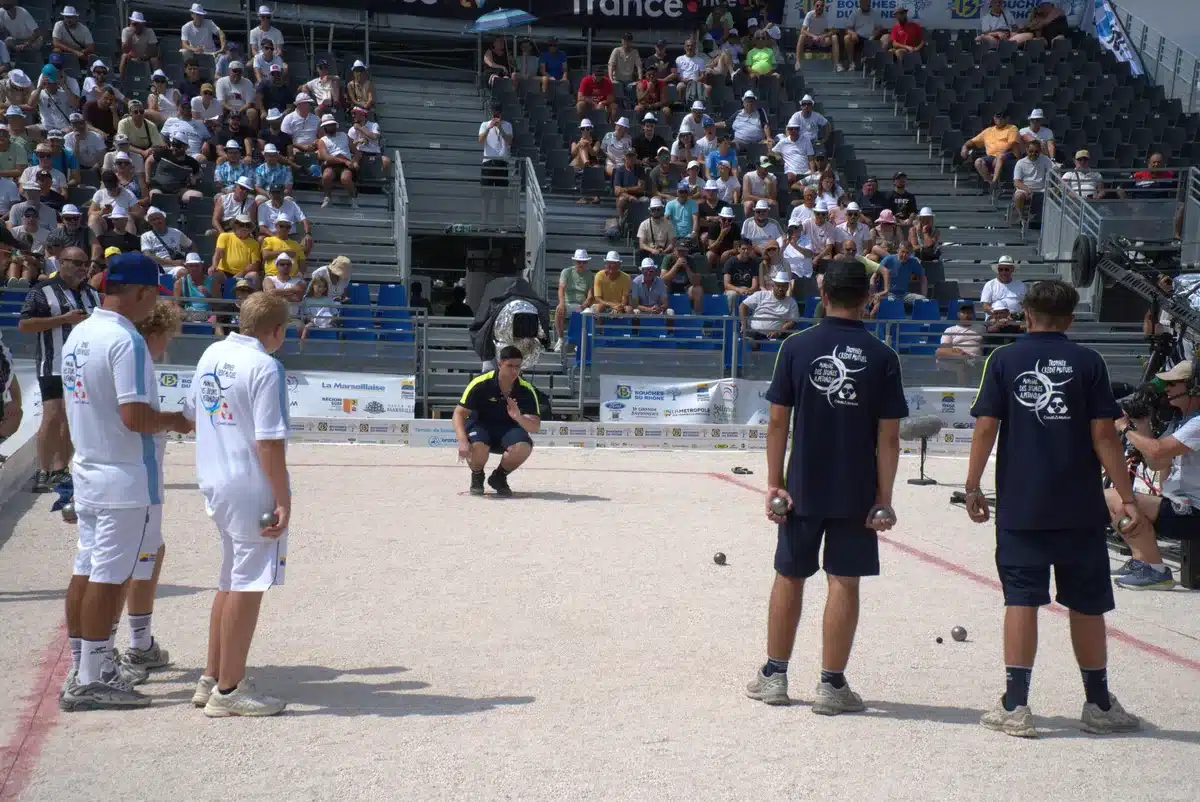
The throwing circle follows a similar rule: if a player picks it up while there are still boules to play, it is put back in place, but only the opponents may play their remaining boules (article 6). In the “Stance” module of our programme, Jean-François ends this reminder with a sentence every boules player should keep in mind.
Last boule played without measuring: who scores the point?
The point goes to the team whose boule is closest to the jack once the end is over, even if that team played its last boule wrongly believing it did not hold the point. No article of the FIPJP rules deals with this case on its own: article 16 simply says that it is up to the team that does not hold the point to play, and that a thrown boule may not be replayed.
The case comes straight from a players’ forum. A team holds the point without knowing it and plays its last boule anyway, without measuring. The opponents, who have one boule left, play short so as not to move anything, and nobody takes the point. When the end is over and the point is measured, the team that held it scores, whether its players knew it or not.
Jean-François points this out in the “Fundamentals” module of our programme: points are only counted at the end of each end. In a competition, if the opponents object, the complaint is made to the umpire, before the end of the game (article 31). The safest course is never to play blind: when the point is close, measure before you play.
Measuring without losing the point
Measuring the point is one of the disputes we see most often, in competition as well as on our petanque coaching course. The same questions keep coming up: who holds the point, should you measure before the end is over, what happens if you touch a boule while measuring? The rules set out the right way to measure a point:
- Moving boules aside Allowed for a moment if they are in the way, once they have been marked, and they then go back to their place (article 25).
- Choosing the tool Each team must have a measuring instrument, and measuring with your feet is forbidden (article 26).
- A light touch If a player moves the jack or a disputed boule while measuring, their team loses the point (article 28).
Jean-François advises always carrying a 2-metre tape measure, precisely to know who has the point. And if it is the umpire who moves a boule while measuring, it is up to the umpire to decide, impartially (article 28).
Is the running shot forbidden in petanque? And sweeping before shooting?
No, the running shot is not forbidden in petanque: no article of the FIPJP rules mentions this shot, where the boule lands well short of the target and reaches it by rolling. The ban many players think they remember comes from another game, the jeu provençal, in which players take a run-up before throwing: “The running shot is forbidden” (our translation), says article 24 ter of its rules, quoted in the FFPJP umpiring code (opens in a new tab). On the other hand, article 10 of the petanque rules really does forbid sweeping the ground before shooting.
On our Facebook page, a video of a champion clearing the ground before a running shot got people talking: “he needs a rake!”, “thought you weren’t allowed to touch the ground any more”. People often confuse these two actions, the running shot and sweeping, yet the rules treat them quite differently.
| Action | Allowed in petanque? | Text |
|---|---|---|
| Playing a running shot | Yes | No article forbids it |
| Playing a running shot in the jeu provençal | No | Article 24 ter of the jeu provençal |
| Testing a landing spot (the point you aim to land on) with a boule, tapping the ground 3 times at most | Yes, for the player about to throw the jack | Article 10 |
| Filling in a hole left by a boule played earlier | Yes, for the player about to play or a partner | Article 10 |
| Cleaning the inside of the circle | Yes, but it must be put back in good order once the end is over | Article 6 |
| Sweeping, flattening or crushing the ground in front of a boule to be shot | No | Article 10, penalties in article 35 |
Filling a hole or sweeping: where is the line?
The line runs between repairing a mark and preparing the ground. The umpiring guide of the European Petanque Confederation (opens in a new tab) is clear: sweeping or dragging your foot to level the ground has never been allowed, any more than pressing down the earth just in front of the target boule. You may fill in the mark left by a boule, a hole about 2 to 3 cm across, but not a whole area around it.
In the videos of the “Pointing” module, Jean-François sums it up: you fill in one hole, and only one, the one the rules allow. One scrape of the sole too many, and the umpire can bring out a card.
The running shot, on the other hand, has a rightful place in the game. The “Shooting” module of our training programme presents the running shot as a technique in its own right, often criticised for its lack of elegance but effective on even, smooth terrain. For Jean-François, it belongs in the repertoire of every real boules player.
The same module also teaches the direct hit, where the boule strikes the target without touching the ground first, and the jump shot, which clears a boule lying in front of the target. To know when to choose the running shot, shooting in front (the boule lands just short of the target) or the direct hit depending on the terrain, read our article on how to shoot in petanque.
The jack comes back near the circle: is the end void?
The jack is dead, but the end is not always void. Article 9 of the FIPJP rules declares a jack dead if, after being hit by a boule, it stops less than 3 metres from the throwing circle, just like one that goes more than 20 metres away (15 metres for younger players). Article 14 then says who scores, depending on the boules still in hand.
Do not confuse these limits with those for throwing the jack: at the start of an end, a throw of the jack only counts if it stops between 6 and 10 metres from the circle for juniors and seniors (article 7). The 3 and 20 metres of article 9 only apply once the jack is in play, when a boule has moved it.
| Boules still to play | Result of the end |
|---|---|
| Both teams | The end is void; the jack goes to the team that scored before, or that won the toss |
| One team only | It scores as many points as it has boules still in hand |
| Neither team | The end is void; the jack goes to the same team as in the first row |
On a forum, a player describes a shot that bounced the jack off a boule and brought it back to about 1.50 metres from the circle. The jack is dead, no argument possible. The same applies to a jack that goes out of bounds, one of the disputes we see most often: everything then comes down to counting the boules still in hand.
On the other hand, a jack moved by a boule from the game stays valid where it stops, unless it falls into one of the dead-jack cases in article 9 (article 12). If a spectator or the umpire stops the moving jack, it stays where it was stopped. If a player stops it, the opponent chooses: leave it there, put it back where it was, or place it along the line of its path; these last two options are only possible if the jack had been marked (article 15).
Red card: game lost or exclusion?
The red card in article 35 of the FIPJP rules excludes only the player at fault: their team does not lose the game and carries on without them. The FFPJP umpiring guide (opens in a new tab) specifies that the exclusion applies to the game after a playing offence, and to the whole competition after a conduct offence.
| Card | Penalty (article 35) | Example |
|---|---|---|
| Yellow | Official warning | Going over the minute: the whole team gets one |
| Orange | Cancellation of the boule played or to be played | A repeat offence by a player already warned |
| Red | Exclusion of the player, for the game or for the competition | A further repeat after an orange card, or bad behaviour |
| Beyond that | Disqualification of the team, or of both teams in case of complicity | Deliberately stopping a moving boule (article 20) |
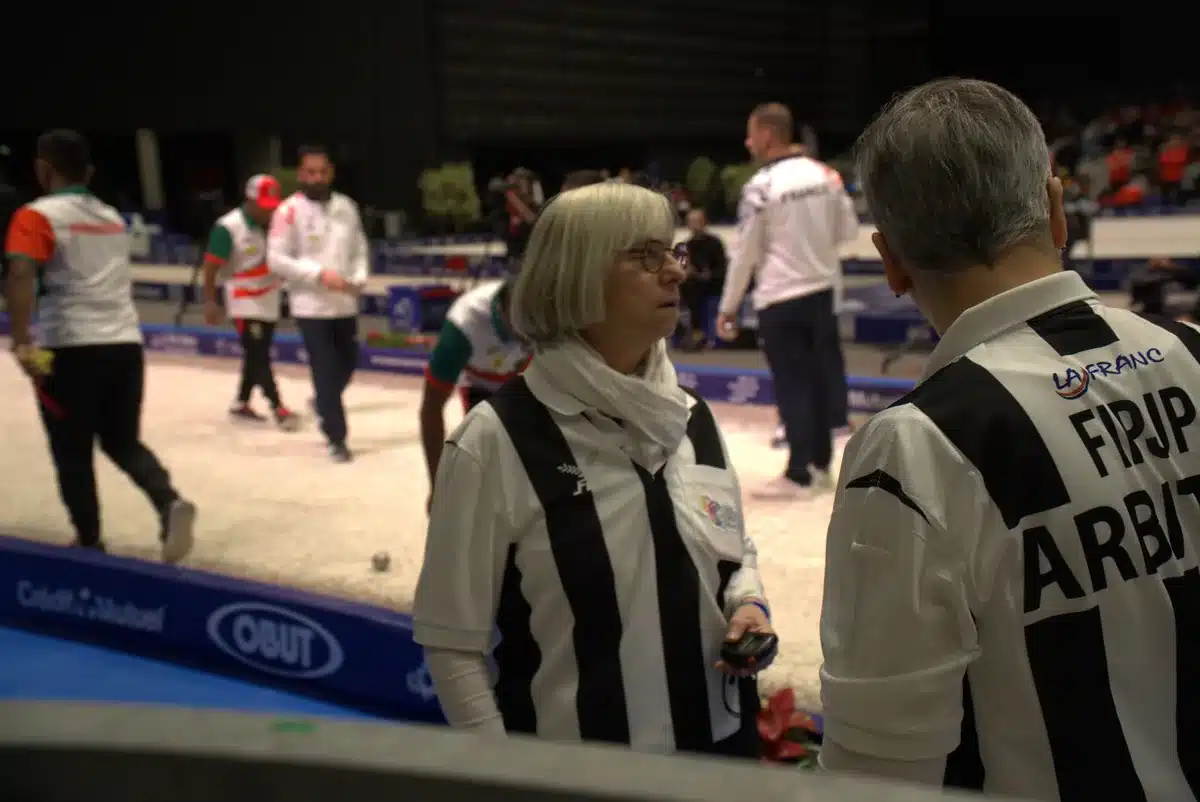
A card is only given for an infringement that has been observed: a simple reminder of the rules at the start of a game does not count as a warning (article 35). A player who already has a yellow card and goes over the minute again loses a boule, in the current end, or in the next one if they have none left to play.
Bad behaviour and violence come under article 39: the player at fault risks exclusion from the competition, withdrawal of their licence, even confiscation of their prize money and awards, and their teammates may be penalised with them. A dispute that gets out of hand therefore costs far more than a lost point.
Staying calm when an opponent disputes a point is something you can work on, just like a throw. The “Mental preparation” module of our programme covers managing your emotions, letting go and focus, so that the anger of one end does not cost you the next.
How do you avoid disputes, with or without an umpire?
Most disputes can be defused before they flare up, with three simple habits: mark the jack and the boules, measure before playing when the point is close, and wait until the points are agreed before picking up your boules. In a competition, when the disagreement persists, it is up to the umpire to decide.
Marking, the small circle drawn on the ground around the jack or a boule, settles many arguments on its own: a jack or a boule that moves without having been marked cannot be put back, and no claim is allowed (articles 6 and 22 of the FIPJP rules). We explain why you mark the jack in petanque, and how to do it, in a dedicated article.
Among friends, with no umpire, agree on the boundaries of the terrain and how to measure before the first end: it is the best insurance against arguments.
What happens when you make a complaint in a competition?
The rules set out the procedure, article by article:
- Call an umpire during the game: every complaint must be made to the umpire, and none is accepted once the game is over (article 31).
- Let the umpire measure: touch no boule before the points are agreed, and stand at least 2 metres away (articles 26 and 27).
- Respect the decision: on a measurement it is final (article 26), and a player or team that refuses to comply risks exclusion for the game, or even disqualification (article 40).
- Faced with a case the rules do not cover, bear in mind that the umpire may refer it to the competition jury, made up of three to five members, whose decision is final (article 41).
Frequently asked questions
Is a boule on the line still in play?
Yes, a boule on the line is still in play as long as it has not completely crossed the boundary of the authorised playing area. Article 19 of the FIPJP rules only declares it dead once it is entirely beyond that boundary when viewed from directly above, in other words when no part of the boule is still above the line. The same rule applies to the jack (article 9).
What should you wear in a competition?
In official competitions, the FFPJP requires correct dress, set out in Annex VII of its 2026 administrative and sporting rules: shoes closed at the top, front and back (no slippers or flip-flops), no vests, no leggings, dresses or skirts, and no torn or ripped clothing. The umpire checks that the players’ dress meets the rules. If something is wrong, the umpire informs the competition jury, which rules on the dress and may disqualify the team, with no appeal; for shoes, the umpire can disqualify the team directly.
How do you become a petanque umpire?
To become an umpire, you must hold an FFPJP licence, be at least 16 and have a clean criminal record, according to the FFPJP umpiring guide. Umpire training starts with the “common core”, followed by a 20-question multiple-choice test on the petanque rules, the jeu provençal rules and the administrative rules, with a pass mark of 14 out of 20. The FFPJP’s 2026 administrative and sporting rules (opens in a new tab) removed the age limit of 65 for candidates, with a yearly medical check beyond that age.
After training as a department-level umpire, you move up level by level: regional after at least two years as a department-level umpire, national after two years at regional level, then European and international. At each level, umpires officiate at competitions of that level and below. The registration forms are on the FFPJP portal, in the umpiring section.
Play by the rules, and keep a cool head
Knowing petanque umpiring rules means not losing a point needlessly, and knowing what to say when a dispute breaks out. Remember three habits: measure before playing when the point is close, pick nothing up before the points are agreed and, in a competition, let the umpire decide. When arguments no longer take up space in your head, what remains is the heart of our wonderful game: your throw, your choices and your composure. Our programme helps you work on them at your own pace.
This programme is not sports instruction within the meaning of the French Sports Code. It is informal educational support, designed to enrich your personal practice of petanque, with no individual supervision and no qualification awarded.
Your next read
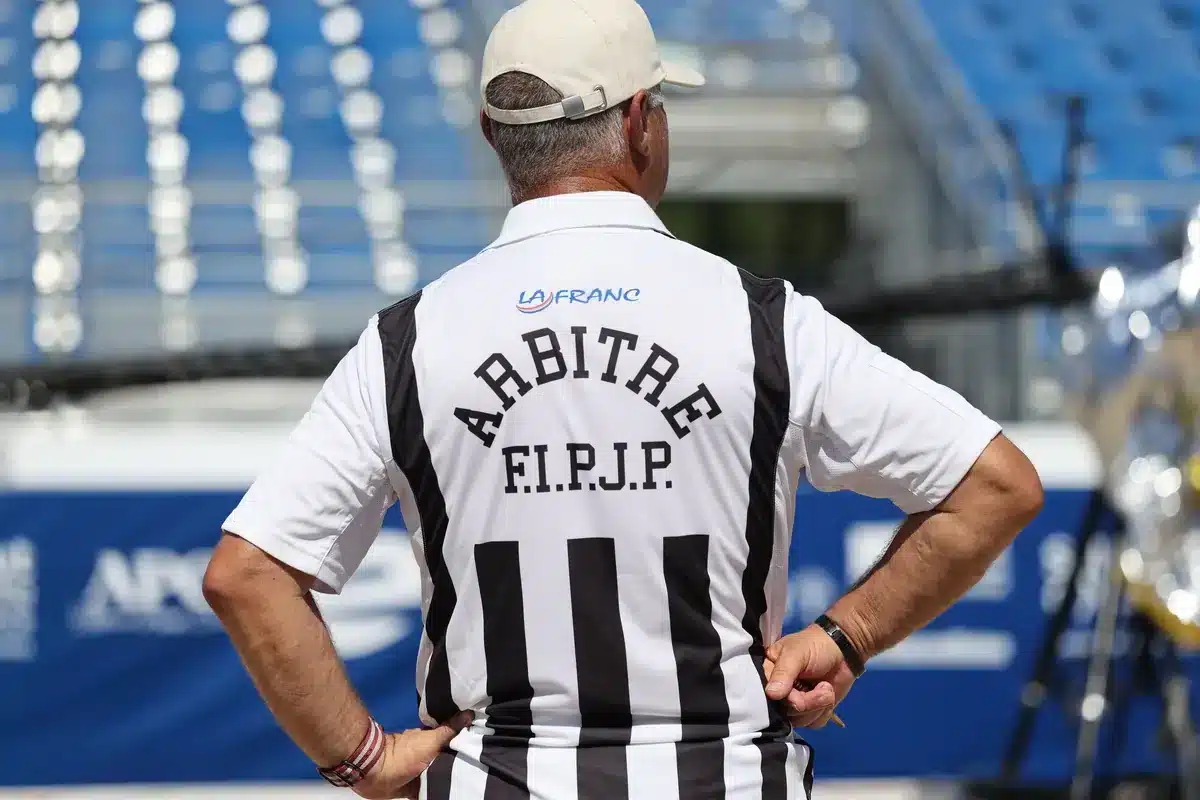
Petanque rules: the complete, up-to-date guide
After the disputes, all the rules of the game: distances, scoring, a jack that goes out and what is new in 2026.