

13 min read
To hold a petanque boule, cradle it in your palm, hand facing the ground, fingers together around it without squeezing. The grip is the same for getting close to the jack or knocking a boule away; mainly your thumb moves, to free your wrist or keep it fixed.
ContentsShow contents10 parts
- How do you hold a petanque boule properly?
- Should you play palm down or palm up?
- Should you hold the boule in your palm or on your fingers?
- Fingers together or apart: where should your fingers go?
- Where should you put your thumb on the boule?
- Do you hold your boule the same way for pointing and shooting?
- When and how should you release your boule?
- Why does my boule go to the right or to the left?
- Frequently asked questions
- Your grip, the basis of every boule
 (the video plays on this page)
How do you hold a petanque boule properly?
Knowing how to hold a petanque boule properly comes down to three things, which Jean-François sets in this order: where the boule sits in your palm, where your fingers go, then your thumb position. You always play palm down, with a boule whose diameter suits your hand.
- The palm The boule sits in the hollow of your hand, sometimes just a touch further forward onto your fingers.
- The fingers Together, or barely apart, they wrap around it with very little pressure.
- The thumb It steadies your hand, and it can be held apart, rest on the boule or press against your index finger.
Jean-François, our FFPJP-qualified coach and certified mental performance coach, gives the petanque grip a very simple first job: stopping the boule from slipping while your arm swings. A good grip must then let the boule go at the right moment, and it is this double role that, in his eyes, makes it one of the most technical skills in our wonderful game. He demonstrates each grip, boule in hand, in his video The finer points of the boule grip in petanque (opens in a new tab) (in French).
That first job gives you a simple check for every boule. During the swing, the back-and-forth of your arm before the release, the boule should not move in your palm, even though your fingers are barely holding it. If it slips, or if you have to squeeze to keep it, go back over the three settings in order.
You still need a boule that suits your hand. If it is too big, it may slip out of your hand; if it is too small, it is hard to throw properly and you risk holding on too long, keeping it in your fingers at the moment of release. As a guide, Jean-François matches a hand of 20 cm, from the tip of the thumb to the tip of the middle finger, with a boule of about 75 mm. You’ll find how to measure your hand, and the size chart, in our guide to choosing petanque boules.
Should you play palm down or palm up?
In petanque, you play palm down, both for pointing and for shooting, in other words for getting close to the jack and for knocking an opponent’s boule away. Your forearm turns inwards so that your palm faces the ground. For Jean-François, it is the only way to control the direction of the boule, thanks to the spin your hand gives it at the release.
Some guides present the palm-up grip, with your palm facing the sky, as another way of playing. Jean-François teaches the palm-down grip, for a practical reason: your palm resting on top of the boule keeps your wrist fixed along the line of play. It is that wrist, bent back and then rolled towards the target, that gives the boule its backspin, the spin that slows it down once it lands.
Should you hold the boule in your palm or on your fingers?
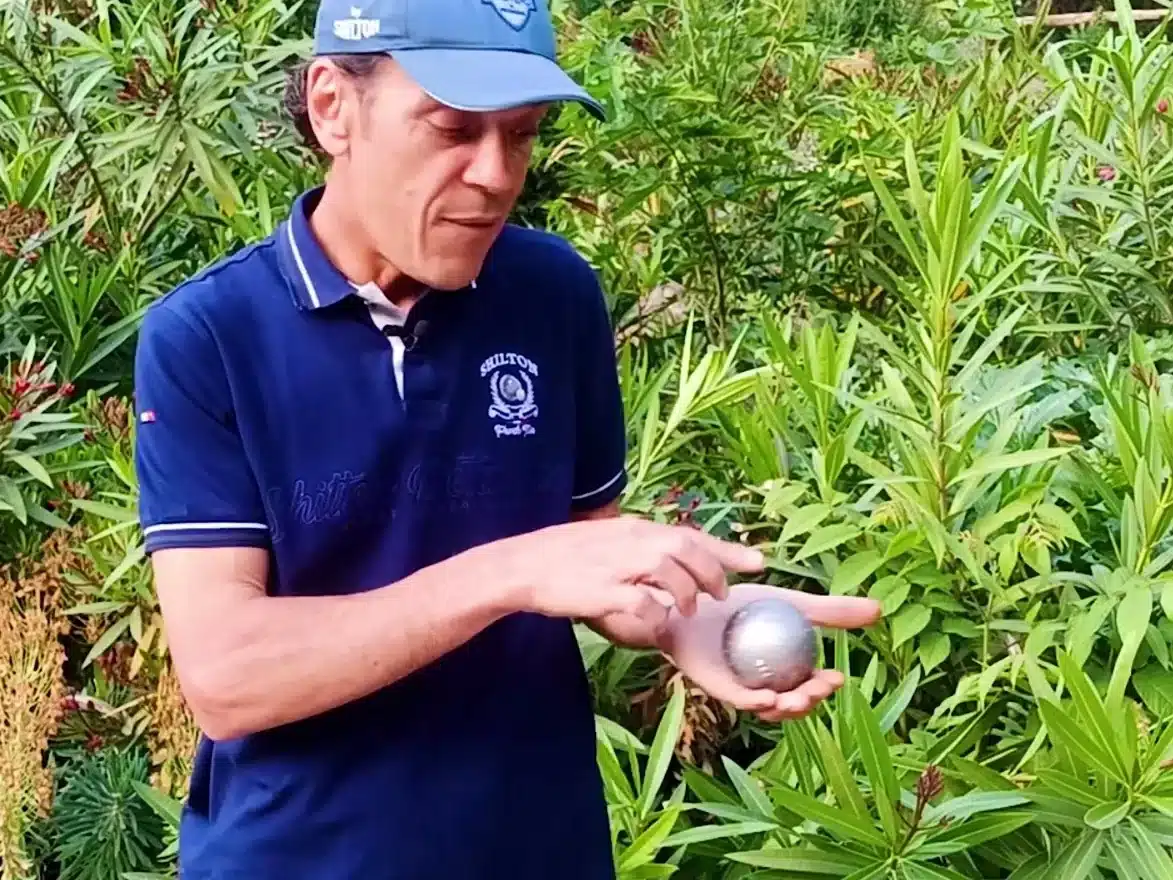
When it comes to palm or fingers, the answer is simple: a petanque boule is held in the palm, in the hollow of your hand. Some players move it very slightly forward onto their fingers, for a better feel, and Jean-François accepts a grip further forward in three specific game situations.
When it sits in your palm, the boule stays steady during the swing, and your fingers only have to wrap around it. It is also the first setting Jean-François shows in his video, before the fingers and the thumb.
When should you move your grip onto your fingers?
Many players tell Jean-François that they shift their grip slightly towards their fingers, and he sees three cases in which this small shift helps:
- When pointing To avoid holding on to the boule too long.
- When shooting When the distance gets close to 10 metres.
- When tired As soon as tiredness starts to set in.
In all three cases, the aim is the same: keeping a smooth throw over time, without forcing with your body. One player actually asked, under a petanque video, whether it was better to shift their grip a little. The answer is yes, as long as the boule stays steady in your palm during the swing.
Fingers together or apart: where should your fingers go?
Your fingers go together, side by side, around the petanque boule, or very slightly apart for some players: either way, you are looking for the best stability. They wrap around it without stiffness and with very little pressure, because it is this relaxed hand that lets the boule leave smoothly at the release.
You will sometimes read that spreading your fingers is a mistake. Jean-François does not agree: fingers very slightly apart are among the grips he accepts, as long as the boule stays steady in your hand. As for pressure, you grip the boule more or less firmly depending on the spin you want to give it.
The real mistake is a tense hand. It holds the boule back just when it should go. Jean-François puts it plainly: the more you force it, the more your muscles tighten, and the less it comes off. Before each boule, check that your fingers wrap around the steel without pressing on it.
Where should you put your thumb on the boule?
Your thumb’s first job is to steady your hand, and it can go in one of three places: held apart from the rest of the hand, resting on the boule at the most comfortable height, or pressed against your index finger to keep your wrist on the line. Jean-François does not impose any of them: every player chooses their own by trying them out.
- Thumb apart This is the grip of champion Philippe Quintais, whom Jean-François holds up as an example for the precision with which he controls his boule in all circumstances.
- Thumb on the boule You rest it at the height where you feel most comfortable.
- Thumb against the index finger It keeps your wrist on the line of the target; it is often recommended to players with a very supple wrist, to stop it twisting sideways.
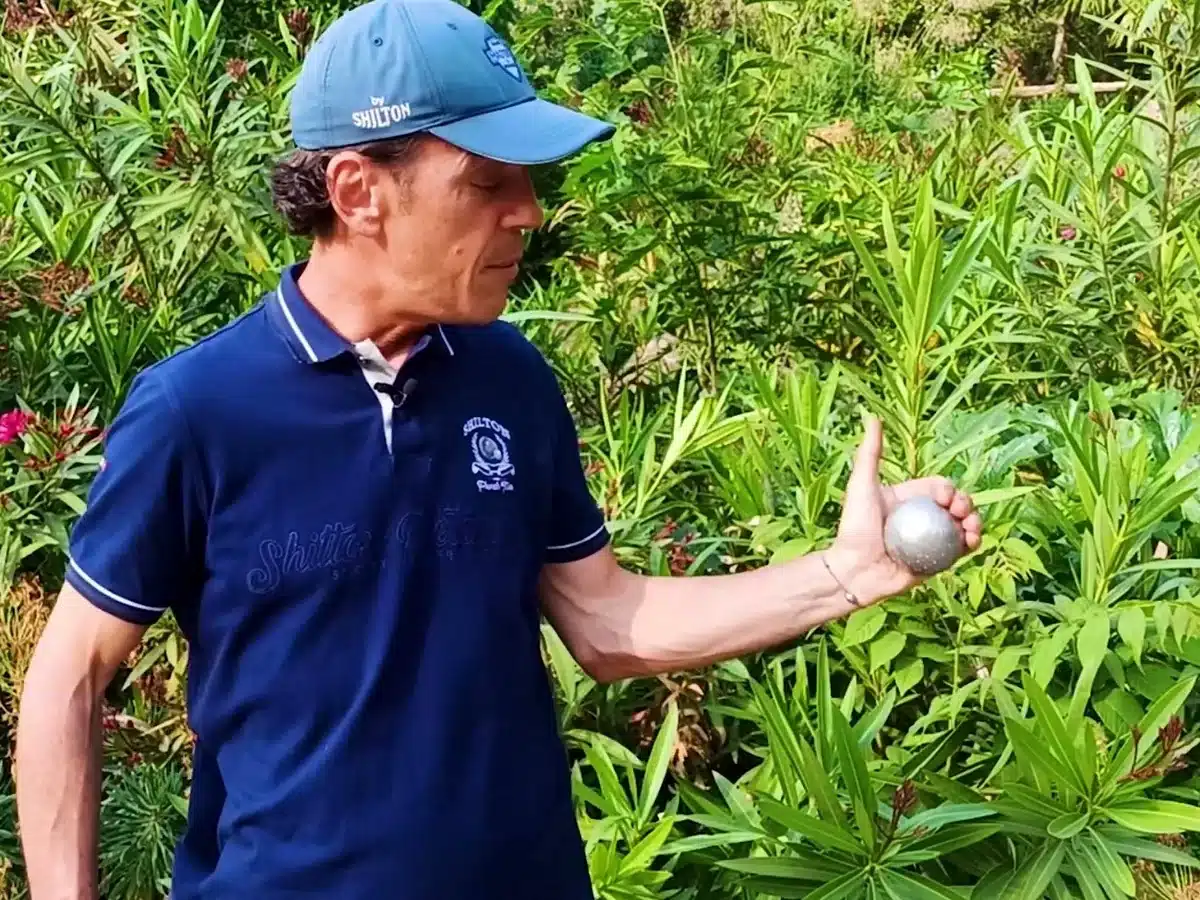
The thumb placed “on the side”, as several guides recommend, even made one viewer smile: on a sphere, where is the side? The real question is rather whether your thumb touches the boule or not, and the answer depends on the shot you are playing.
Do you hold your boule the same way for pointing and shooting?
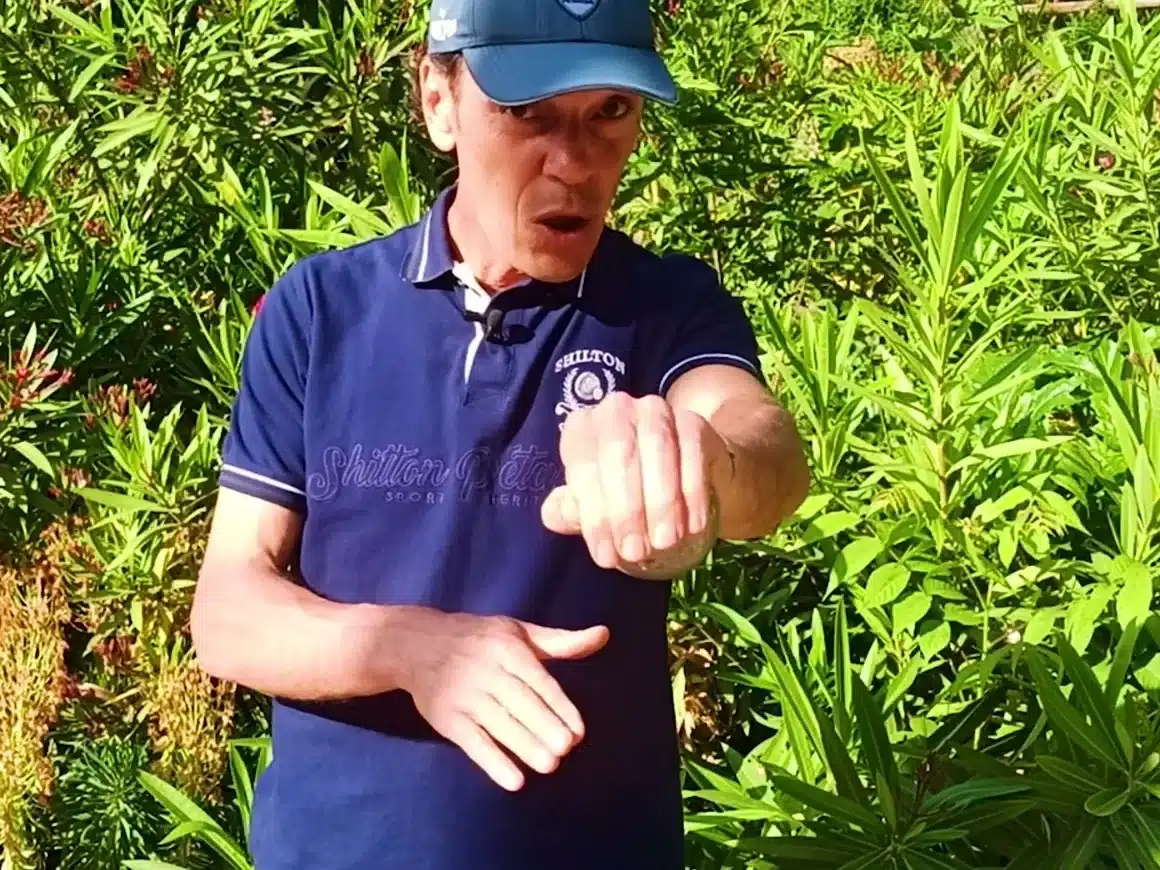
The basic grip is the same for pointing and for shooting in petanque: palm down, the boule in your palm, fingers together. What changes, according to Jean-François, is mainly the thumb: when pointing, it is better not to press it against the boule, whereas when shooting, you can rest it on the boule or not.
| In your hand | Pointing | Shooting |
|---|---|---|
| The boule | In the palm; a little further onto the fingers to avoid holding on too long | In the palm; a little further onto the fingers close to 10 metres or when tiredness sets in |
| The thumb | Ideally off the boule: pressed on, it stiffens the wrist and spoils the backspin | On the boule or not: resting on it, it helps steady a wrist that twists sideways |
| The fault to watch | Thumb pressed on: unwanted wrist twists that push the boule sideways | Thumb resting on it: at the slightest tension, it presses and sends the boule off line |
| The release | From the fingertips, with the wrist rolling through to give backspin | From the fingertips, at breastbone height, or even at eye level |
How should you hold your boule for pointing?
To point, hold the boule palm down, in the hollow of your palm, and ideally keep your thumb off it: pressed against the boule, it makes your throw less fluid, limits how far your wrist can bend, and gives you less control over your backspin. If you tend to hold on too long, move the boule a touch further onto your fingers.
As a general rule, Jean-François prefers the thumb not to touch the boule, so that it does not pull it off its line. Once your grip is set, you still need to choose how to stand: our article on how to point standing or crouching in petanque will help you find the position that suits you.
How should you hold your boule to shoot well?
To shoot well, hold the boule as you would for pointing, palm down and in the hollow of your palm, and move it a little further onto your fingers when you shoot from close to 10 metres or when tiredness sets in. That leaves the thumb: to decide where it goes, Jean-François relies on a simple yardstick, your success rate.
A thumb resting on the boule helps shooters whose wrist clearly twists sideways. It works against players who tense up, though: it then presses hard on the boule and sends it well off the line.
Where to put your thumb for pointing and shooting, the wrist roll and the opening of the hand are at the heart of the “Throwing technique” module of our training programme. Jean-François explains each setting on video, with demonstrations and practical exercises.
When and how should you release your boule?
Here is how to release a petanque boule well: let your wrist roll all the way through, then open your whole hand so the boule leaves from your fingertips. When shooting, Jean-François places that release at breastbone height, or even at eye level. The movement comes in four stages:
- Your wrist bends at the back of the swing.
- It lines up with your arm again as the arm comes forward.
- Your fingers open, and the boule slips away.
- Your hand finishes flat, fully extended.
That opening of the hand should be quick, gradual and complete. If your fingers are still bent when the boule leaves, you are holding on too long: the boule lands short, or veers off the line.
Jean-François warns above all against letting go too early, which he calls a forced shot. You then use up a lot of energy and tire before the end of the game; and because the throw lacks range, you end up correcting it with your wrist.
His guideline is very simple: as the boule leaves your fingers, you should see your hand in front of you. If you cannot see it, you’ve probably let go too early.
To shoot without forcing it, your hand isn’t the whole story: our article on how to shoot in petanque without forcing it goes through the shooter’s entire throw, from where you stand in the circle to your swing.
Should you cock your wrist?
Yes, you should cock your wrist, in the sense players mean it: it bends back on the backswing, as your arm swings back, then rolls towards the target. It is even how Jean-François describes backspin when pointing: you cock your wrist sharply on the backswing, then release the boule from your fingertips, after quickly straightening your wrist.
What you must avoid is a wrist that turns sideways. The useful movement runs back and forth, along the line of play; the palm-down grip, and for some players the thumb against the index finger, are precisely what keep it on that line.
Why does my boule go to the right or to the left?
A petanque boule that keeps going to the same side often reveals a wrist twist: your wrist turns at the release and gives the boule sidespin. For Jean-François, this fault comes from a poor grip, often combined with a lack of momentum: the player then makes up for it with the wrist.
For a right-hander, the hand finishes with the thumb pointing up and the boule spins from right to left; for a left-hander, it is the other way round. When pointing, this fault forces you to aim wide of the jack so that the boule comes back to it, as if on a side slope, a terrain that tilts to one side. Jean-François advises correcting it quickly, before it sets in for good.
To reduce a wrist twist, Jean-François suggests three things to try:
- Take enough momentum, so that you do not look for power in your wrist.
- Keep your thumb close to your fingers, then release the boule in one go, spreading your fingers wide.
- Try a boule with a slightly larger diameter, keeping to 700 grams at most, as he recommends in this case.
If the boule keeps going to the same side despite a good grip, look at your other arm too: it should act as a counterweight. Without that counterweight, your body turns at the release and drags the boule off line, as Jean-François puts it.
Your best bet is to film yourself, as Jean-François advises, to see what you cannot feel. For an outside eye on the terrain, we also welcome players on our coaching course, in Nantes and Geneva.
Frequently asked questions
Should you lock your elbow when you throw?
When shooting, yes: your elbow locks in the middle of the throw. Jean-François describes a straight arm that drops to the vertical, then swings back up behind you, like a ball on the end of a string. An arm that stays bent lacks speed at the release.
What weight and diameter of boule should a shooter choose?
Shooters generally choose a fairly light boule, which takes less effort with every throw. Jean-François also advises them to go one millimetre larger in diameter than their hand measurement suggests, so that the boule leaves the hand cleanly. The full size chart, from pointer to shooter, is in our guide to choosing boules.
What should you do if your boule slips, in cold weather or when your hands sweat?
In cold weather, warm up your hands before playing: Jean-François’s warm-up routine starts by rubbing your hands together, “especially in cold weather”. When your hands sweat, wipe the boule and your hand before every throw, so that the boule does not slip at the release. We cover other ways to beat the cold in our article on petanque training at home.
Is the grip the same for a left-hander?
Yes, a left-hander’s grip is the same, as a mirror image: the boule, the fingers and the thumb sit the same way in the left hand. Only the spins are reversed, like the wrist twist, which gives a right-hander right-to-left spin and a left-hander left-to-right spin.
Your grip, the basis of every boule
To know how to hold a petanque boule, remember a few guidelines: your palm facing the ground, the boule in the hollow of your hand, fingers together without squeezing, a thumb that steadies without pressing, and a hand you can see in front of you at the release. The rest you fine-tune by trying, boule after boule, as Jean-François advises. To go further, our training programme covers the boule grip on video, then your whole throwing technique, at your own pace.
This programme is not sports instruction within the meaning of the French Sports Code. It is informal educational support, designed to enrich your personal practice of petanque, with no individual supervision and no qualification awarded.
Your next read
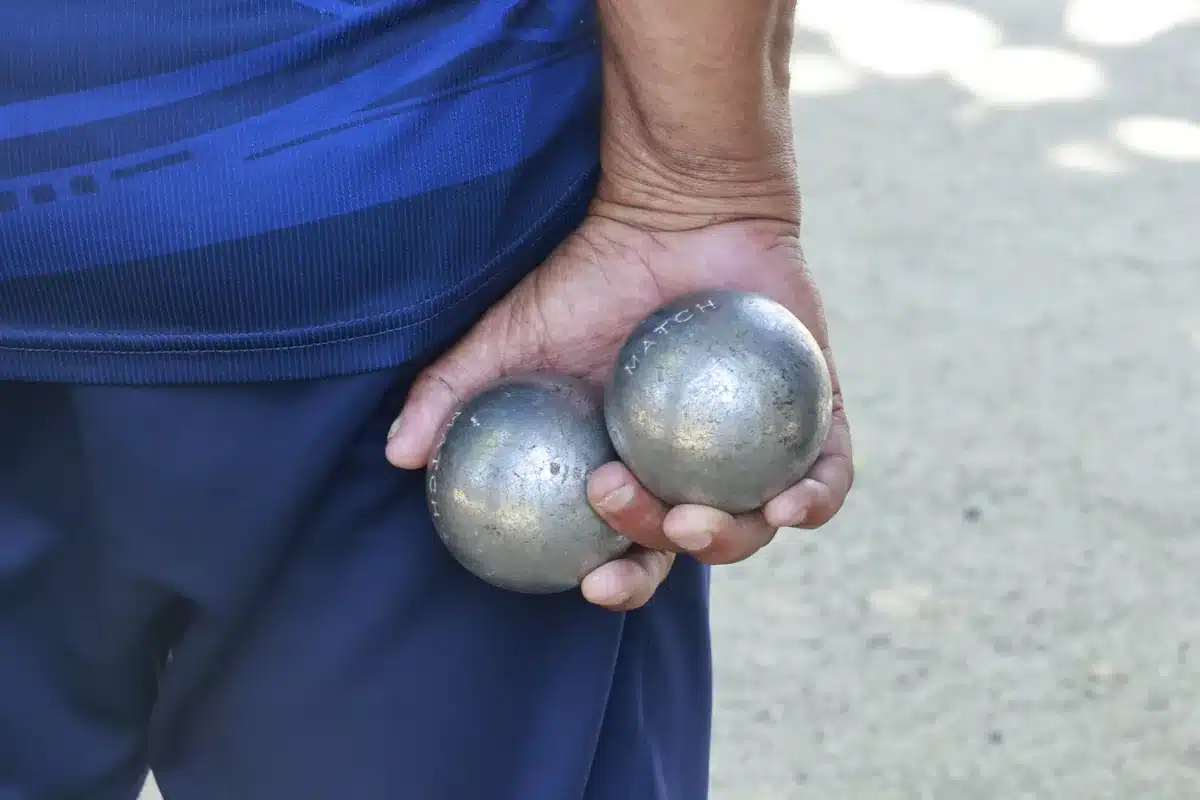
Choosing petanque boules: size chart, weight and hardness
Check that the diameter of your boules suits your hand before you fine-tune your grip.